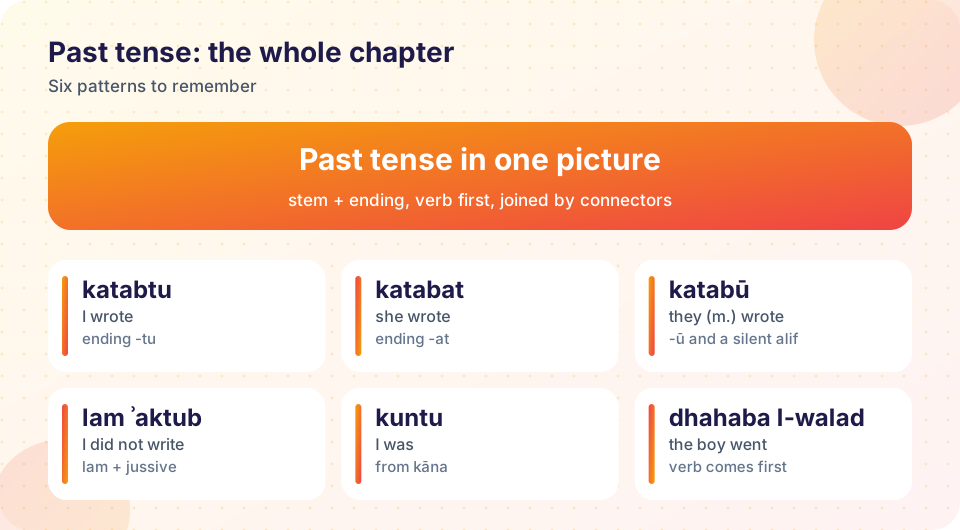
In this chapter you learned to talk about what has already happened. You built past-tense verbs from endings, said did not with لَمْ , used كَانَ for was , put the verb first in a sentence and told a small story with connectors. This review gathers the rules on one page and lets you test yourself.
The chapter in one picture: stem + ending, was, did not and verb-first order. What you will learn#
A recap of the chapter in one table
A quick routine for telling a story in the past
Where your mistakes are likely to be, and how to fix them
Chapter recap#
Idea
Rule
Example
Past endings
-tu, -ta, -ti, -a, -at, -nā, -tum, -tunna, -ū, -na
كَتَبْتُ , كَتَبَتْ , كَتَبُوا
Dictionary form
the past he form
كَتَبَ , ذَهَبَ
Was / were
كُنْتُ , كَانَ , كَانَتْ , كَانُوا كُنْتُ طَالِبًا
Did not
لَمْ + jussive (sukun)لَمْ أَكْتُبْ
Irregular verbs
the long ā shortens before endings
قُلْتُ , نِمْتُ , جِئْتُ
Word order
verb, doer, rest; verb stays singular before a plural doer
ذَهَبَ الأَوْلَاد
Connectors
وَ , ثُمَّ , فَـ , لَكِنْ , أَوْ , لِأَنَّ ذَهَبْتُ ثُمَّ رَجَعْتُ
Time words
أَمْسِ , قَبْلَ يَوْمَيْن , الأُسْبُوع المَاضِي أَمْسِ دَرَسْتُ
A routine for telling a story#
Practice this simple three-sentence story every day for a week:
Time first. Start with أَمْسِ (yesterday) or الأُسْبُوع المَاضِي (last week).Two actions. Use two verbs joined by وَ or ثُمَّ : ذَهَبْتُ إِلَى السُّوق ثُمَّ اشْتَرَيْتُ خُبْزًا. A reason or a contrast. End with لِأَنَّ or لَكِنْ : لَكِنْ لَمْ أَجِدِ التُّفَّاح. (But I did not find the apples.)
This routine uses almost every rule from the chapter, and it takes under a minute to say.
Where mistakes usually appear#
Forgetting the sukun before -tu , -ta , -nā : it is كَتَبْتُ , not "katabutu".
Using the past after لَمْ : the correct form is the jussive, لَمْ أَكْتُبْ .
Making the verb plural when it comes first: ذَهَبَ الأَوْلَاد .
Mixing up -nā (we) and -na (they, f.).
Diagnose yourself#
Use your quiz result to decide what to review.
You missed the endings (quiz 1, 2, 9). Say the ten forms of كَتَبَ and شَرِبَ aloud with a steady rhythm, then write them from memory and check.You missed negation or kāna (quiz 3 and 5). Remember: لَمْ takes the present-tense jussive with a sukun; كَانَ has its own forms, كُنْتُ، كُنْتَ، كُنْتِ، كَانَ، كَانَتْ، كُنَّا، كَانُوا .You missed weak verbs (quiz 6). Learn قَالَ / قُلْتُ , نَامَ / نِمْتُ , جَاءَ / جِئْتُ as pairs of "he" and "I" forms.You missed word order or connectors (quiz 4, 7, 8). Build five sentences in layers, starting with only the verb and adding the doer, the place, the time and a second action.
A complete review example#
Take a new verb, سَمِعَ (samiʿa, to hear), and run it through everything in the chapter. The ten past forms are سَمِعْتُ، سَمِعْتَ، سَمِعْتِ، سَمِعَ، سَمِعَتْ، سَمِعْنَا، سَمِعْتُمْ، سَمِعْتُنَّ، سَمِعُوا، سَمِعْنَ . The negative is لَمْ أَسْمَعْ (I did not hear). A sentence with verb-first order: سَمِعَ الطُّلَّاب الخَبَر (the students heard the news), where الخَبَر (al-khabar) means "the news". A story with a connector: سَمِعْتُ البَاب فَفَتَحْتُ (I heard the door, so I opened it). In under three minutes, one verb has produced eleven forms and three sentences, and nearly all the rules of the chapter have been used at least once.
Keep telling stories#
The best review is storytelling. Each evening, tell yourself in Arabic what you did that day, in three to five sentences. Begin with اليَوْم (today) or أَمْسِ (yesterday), use the verb first, link the sentences with ثُمَّ or وَ , and finish with a reason using لِأَنَّ . In a week you will have told seven small stories, and the past tense will feel like an old friend.
Practice that goes beyond the quiz#
To keep the past tense fresh, write three sentences each day about what you did, using three different verbs, one with لَمْ and one with كَانَ . For example: قَرَأْتُ كِتَابًا , لَمْ أَشْرَبِ القَهْوَة , كُنْتُ فِي البَيْت . Check the endings against the recap table and read the sentences aloud. If you can, say your sentences to someone and ask whether they sound natural. Writing and speaking in the past, even for five minutes a day, quickly makes the endings automatic.
Try it#
Mixed practice on endings, لَمْ and كَانَ .
Past tense mixed practice
Reset
< divstyle = " max-width : 620px; margin : 0 auto" > < divclass = " row" style = " justify-content : space-between; margin : 0 0 10px" > < spanclass = " mut" id = " prog" > </ span> < spanclass = " mut" id = " score" > </ span> </ div> < divclass = " card" style = " text-align : center" > < divclass = " ar" lang = " ar" dir = " rtl" id = " q" style = " font-size : 34px; line-height : 1.6" > </ div> < divid = " tr" class = " mut" style = " margin-top : 4px" > </ div> < divid = " en" style = " margin-top : 4px; color : #475569" > </ div> < divclass = " row" id = " opts" > </ div> < divid = " fb" style = " margin-top : 10px; font-weight : 600; min-height : 24px" > </ div> < divclass = " row" > < buttonclass = " go" id = " next" style = " display : none" > </ button> </ div> </ div> </ div> < style>
* { box-sizing : border-box}
body { margin : 0; padding : 14px; font-family : system-ui, 'Segoe UI' , sans-serif; background : linear-gradient ( 135deg, #faf5ff, #eff6ff) ; color : #1e1b4b}
.ar { font-family : 'Noto Naskh Arabic' , 'Segoe UI' , 'Traditional Arabic' , Amiri, serif}
button { font : inherit; font-size : 15px; border : 0; border-radius : 999px; padding : 8px 16px; cursor : pointer; background : #fff; color : #1e1b4b; box-shadow : 0 2px 8px rgba ( 67, 56, 202, .18) }
button:hover { transform : translateY ( -1px) }
button.yes { background : linear-gradient ( 135deg, #10b981, #14b8a6) ; color : #fff}
button.no { background : linear-gradient ( 135deg, #f59e0b, #ef4444) ; color : #fff}
button.go { background : linear-gradient ( 135deg, #6366f1, #a78bfa) ; color : #fff}
.card { background : #fff; border-radius : 20px; box-shadow : 0 10px 24px rgba ( 67, 56, 202, .16) ; padding : 18px}
.row { display : flex; gap : 10px; flex-wrap : wrap; align-items : center; justify-content : center; margin-top : 12px}
.mut { color : #475569; font-size : 14px}
</ style> < script>
const items = [ { "q" : "نَحْنُ ___ إِلَى المَدْرَسَة" , "en" : "We went to school." , "options" : [ "ذَهَبْتُ" , "ذَهَبْنَا" , "ذَهَبُوا" ] , "answer" : 1 , "tr" : "naḥnu dhahabnā ʾilā l-madrasa" , "note" : "-nā marks we." } , { "q" : "هِيَ لَمْ ___ الكِتَاب" , "en" : "She did not open the book." , "options" : [ "فَتَحَتْ" , "تَفْتَحْ" , "تَفْتَحُ" ] , "answer" : 1 , "tr" : "hiya lam taftaḥ al-kitāb" , "note" : "lam + jussive." } , { "q" : "___ طَالِبَةً فِي القَاهِرَة" , "en" : "I (f.) was a student in Cairo." , "options" : [ "كُنْتُ" , "كَانَتْ" , "كُنَّا" ] , "answer" : 0 , "tr" : "kuntu ṭāliba fī l-qāhira" , "note" : "kuntu is I was, for a man or a woman." } , { "q" : "أَنْتَ ___ رِسَالَة أَمْسِ" , "en" : "You (m.) wrote a letter yesterday." , "options" : [ "كَتَبْتِ" , "كَتَبْتَ" , "كَتَبْتُ" ] , "answer" : 1 , "tr" : "ʾanta katabta risāla ʾamsi" , "note" : "-ta marks you (m.)." } , { "q" : "___ الطُّلَّاب الدَّرْس" , "en" : "The students understood the lesson." , "options" : [ "فَهِمُوا" , "فَهِمَ" , "فَهِمْنَ" ] , "answer" : 1 , "tr" : "fahima ṭ-ṭullāb ad-dars" , "note" : "The verb comes first, so it stays singular." } , { "q" : "___ سَاعَتَيْن دَرَسْتُ" , "en" : "Two hours ago I studied." , "options" : [ "مَعَ" , "قَبْلَ" , "فِي" ] , "answer" : 1 , "tr" : "qabla sāʿatayn darastu" , "note" : "qabla + a time = ago." } ] ;
const $ = id => document. getElementById ( id) ;
let i = 0 , score = 0 , answered = false ;
function show ( ) {
const it = items[ i] ; answered = false ;
if ( ! it) { $ ( 'q' ) . textContent = '' ; $ ( 'tr' ) . textContent = '' ; $ ( 'en' ) . textContent = 'Finished: ' + score + ' of ' + items. length + ' correct.' ; $ ( 'opts' ) . innerHTML = '' ; $ ( 'fb' ) . textContent = '' ; $ ( 'next' ) . style. display = 'none' ; $ ( 'prog' ) . textContent = '' ; return ; }
$ ( 'prog' ) . textContent = 'Question ' + ( i + 1 ) + ' of ' + items. length; $ ( 'score' ) . textContent = 'Score ' + score;
$ ( 'q' ) . textContent = it. q; $ ( 'tr' ) . textContent = '' ; $ ( 'en' ) . textContent = it. en; $ ( 'fb' ) . textContent = '' ; $ ( 'next' ) . style. display = 'none' ;
$ ( 'opts' ) . innerHTML = '' ;
it. options. forEach ( ( o, k ) => { const b = document. createElement ( 'button' ) ; b. className = 'ar' ; b. lang = 'ar' ; b. dir = 'rtl' ; b. style. fontSize = '24px' ; b. textContent = o; b. onclick = ( ) => pick ( k, b) ; $ ( 'opts' ) . appendChild ( b) ; } ) ;
}
function pick ( k, b ) {
if ( answered) return ; answered = true ; const it = items[ i] ;
if ( k === it. answer) { score++ ; b. className += ' yes' ; $ ( 'fb' ) . style. color = '#059669' ; $ ( 'fb' ) . textContent = 'Correct. ' + ( it. note || '' ) ; }
else { b. className += ' no' ; $ ( 'fb' ) . style. color = '#dc2626' ; $ ( 'fb' ) . textContent = 'Not quite. The answer is ' + it. options[ it. answer] + '. ' + ( it. note || '' ) ; }
$ ( 'tr' ) . textContent = it. tr || '' ; $ ( 'score' ) . textContent = 'Score ' + score; $ ( 'next' ) . style. display = '' ;
}
$ ( 'next' ) . onclick = ( ) => { i++ ; show ( ) ; } ;
show ( ) ;
</ script>
Then match the forms to their meanings.
Forms and meanings
Reset
< divstyle = " max-width : 640px; margin : 0 auto" > < divclass = " row" style = " justify-content : space-between; margin : 0 0 10px" > < spanclass = " mut" > </ span> < spanclass = " mut" id = " score" > </ span> </ div> < divstyle = " display : grid; grid-template-columns : 1fr 1fr; gap : 10px" > < divid = " L" style = " display : grid; gap : 8px" > </ div> < divid = " R" style = " display : grid; gap : 8px" > </ div> </ div> < divclass = " row" > < buttonclass = " go" id = " re" > </ button> </ div> </ div> < style>
* { box-sizing : border-box}
body { margin : 0; padding : 14px; font-family : system-ui, 'Segoe UI' , sans-serif; background : linear-gradient ( 135deg, #faf5ff, #eff6ff) ; color : #1e1b4b}
.ar { font-family : 'Noto Naskh Arabic' , 'Segoe UI' , 'Traditional Arabic' , Amiri, serif}
button { font : inherit; font-size : 15px; border : 0; border-radius : 999px; padding : 8px 16px; cursor : pointer; background : #fff; color : #1e1b4b; box-shadow : 0 2px 8px rgba ( 67, 56, 202, .18) }
button:hover { transform : translateY ( -1px) }
button.yes { background : linear-gradient ( 135deg, #10b981, #14b8a6) ; color : #fff}
button.no { background : linear-gradient ( 135deg, #f59e0b, #ef4444) ; color : #fff}
button.go { background : linear-gradient ( 135deg, #6366f1, #a78bfa) ; color : #fff}
.card { background : #fff; border-radius : 20px; box-shadow : 0 10px 24px rgba ( 67, 56, 202, .16) ; padding : 18px}
.row { display : flex; gap : 10px; flex-wrap : wrap; align-items : center; justify-content : center; margin-top : 12px}
.mut { color : #475569; font-size : 14px}
</ style> < style> .it { padding : 10px 12px; border-radius : 14px; background : #fff; box-shadow : 0 2px 8px rgba ( 67, 56, 202, .18) ; cursor : pointer; text-align : center; min-height : 44px; display : flex; align-items : center; justify-content : center; border : 2px solid transparent} .it.sel { border-color : #6366f1; background : #eef2ff} .it.ok { background : #d1fae5; border-color : #10b981; cursor : default} .it.bad { background : #fee2e2; border-color : #ef4444} </ style> < script>
const pairs = [ [ "قُلْتُ" , "I said" ] , [ "كَانَتْ" , "she was" ] , [ "لَمْ أَذْهَبْ" , "I did not go" ] , [ "اشْتَرَيْنَا" , "we bought" ] , [ "كَتَبُوا" , "they (m.) wrote" ] , [ "جَلَسْتِ" , "you (f.) sat" ] ] ;
const $ = id => document. getElementById ( id) ;
let sel = null , done = 0 , miss = 0 ;
function shuffle ( a ) { a = a. slice ( ) ; for ( let i = a. length - 1 ; i > 0 ; i-- ) { const j = Math. floor ( Math. random ( ) * ( i + 1 ) ) ; [ a[ i] , a[ j] ] = [ a[ j] , a[ i] ] ; } return a; }
function setup ( ) {
sel = null ; done = 0 ; miss = 0 ; $ ( 'L' ) . innerHTML = '' ; $ ( 'R' ) . innerHTML = '' ;
pairs. forEach ( ( p, i ) => { const d = document. createElement ( 'div' ) ; d. className = 'it ar' ; d. lang = 'ar' ; d. dir = 'rtl' ; d. style. fontSize = '24px' ; d. textContent = p[ 0 ] ; d. dataset. i = i; d. onclick = pick; $ ( 'L' ) . appendChild ( d) ; } ) ;
shuffle ( pairs. map ( ( p, i ) => i) ) . forEach ( i => { const d = document. createElement ( 'div' ) ; d. className = 'it' ; d. textContent = pairs[ i] [ 1 ] ; d. dataset. i = i; d. onclick = pick; $ ( 'R' ) . appendChild ( d) ; } ) ;
upd ( ) ;
}
function upd ( ) { $ ( 'score' ) . textContent = done + ' of ' + pairs. length + ' matched, ' + miss + ' misses' + ( done === pairs. length ? ' - well done!' : '' ) ; }
function pick ( e ) {
const el = e. currentTarget; if ( el. classList. contains ( 'ok' ) ) return ;
const side = el. parentElement. id;
if ( ! sel || sel. parentElement. id === side) { if ( sel) sel. classList. remove ( 'sel' ) ; sel = el; el. classList. add ( 'sel' ) ; return ; }
if ( sel. dataset. i === el. dataset. i) { sel. classList. remove ( 'sel' ) ; sel. classList. add ( 'ok' ) ; el. classList. add ( 'ok' ) ; done++ ; }
else { miss++ ; const a = sel, b = el; a. classList. add ( 'bad' ) ; b. classList. add ( 'bad' ) ; setTimeout ( ( ) => { a. classList. remove ( 'bad' , 'sel' ) ; b. classList. remove ( 'bad' ) ; } , 500 ) ; }
sel = null ; upd ( ) ;
}
$ ( 're' ) . onclick = setup; setup ( ) ;
</ script>
Check your understanding#
1. What is the past tense "she" form of شَرِبَ?
A
شَرِبْتُ
B
شَرِبَتْ
C
شَرِبْنَ
2. Which ending means "we" in the past?
A
-tu
B
-ū
C
-nā
3. How do you say "I did not drink"?
A
لَمْ شَرِبْتُ
B
لَمْ أَشْرَبْ
C
لَا شَرِبْتُ
4. Which sentence is correct for "The students went" with the verb first?
A
ذَهَبُوا الطُّلَّاب
B
ذَهَبْنَ الطُّلَّاب
C
ذَهَبَ الطُّلَّاب
5. How do you say "I was tired"?
A
كَانَ مُتْعَبًا
B
كُنْتُ مُتْعَبًا
C
كُنَّا مُتْعَبِينَ
6. What is "I said" from قَالَ?
A
قَلْتُ
B
قُلْتُ
C
قَوَلْتُ
7. Which connector means "because"?
A
لَكِنْ
B
ثُمَّ
C
لِأَنَّ
8. How do you say "two days ago"?
A
بَعْدَ يَوْمَيْن
B
قَبْلَ يَوْمَيْن
C
مَعَ يَوْمَيْن
9. Which form has a silent alif?
A
كَتَبُوا
B
يَكْتُبُونَ
C
كَتَبْنَ
10. What is the dictionary form of an Arabic verb?
A
The present tense, I form
B
The past tense, he form
C
The command form
Summary#
Past endings attach to a stable stem; the he form is the dictionary form.
كَانَ gives was , لَمْ gives did not , and weak verbs shorten in some forms.Stories start with the verb and are linked by وَ , ثُمَّ , لَكِنْ and لِأَنَّ .
Practice with a short three-sentence story every day.
Next: Conversation and culture: the big picture