


















Lesson 18 of 45 · Nouns, Gender and Definiteness
Gender: Masculine and Feminine
Learn how Arabic marks masculine and feminine nouns, how to build feminine forms with ة, the main exceptions, plus pronouns and 'this' and 'that' with examples.
In Arabic every noun is either masculine or feminine, and the choice has consequences everywhere: it decides the form of "you", "this", of adjectives and of verbs. Speakers of English, which has almost no grammatical gender, often worry about this. The good news is that Arabic is more regular about gender than most languages with the feature. A simple spelling clue, the final ة, solves most of the cases, and the exceptions come in short, learnable lists. By the end of this lesson you will say whether a noun is masculine or feminine, build the feminine of many words and use this, that, he and she correctly.
What you will learn
- The ة rule and how to build feminine forms from masculine ones.
- Which common feminine nouns do not end in ة.
- How to form nationalities in masculine and feminine.
- The pronouns I, you (m/f), he and she.
- The demonstratives this and that in both genders.
Key terms
Grammatical gender: a noun class (masculine or feminine) that affects other words in the sentence, regardless of the thing's real sex.
Tā' marbūṭa (ة): the usual feminine ending.
Pronoun: a word that stands for a noun: I, you, he, she.
Demonstrative: a pointing word: this, that.
Agreement: matching words to each other, for example in gender.
The basic rule
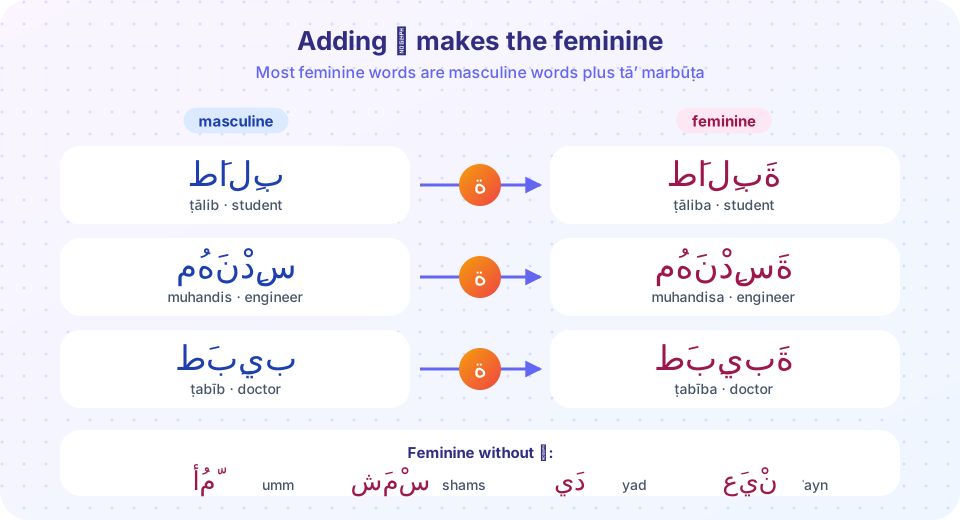
Masculine is the base form and has no special ending. Feminine nouns usually add ة. Most pairs of people and jobs work like this:
| Masculine | Feminine | Meaning |
|---|---|---|
| طَالِب ṭālib | طَالِبَة ṭāliba | student |
| مُعَلِّم muʿallim | مُعَلِّمَة muʿallima | teacher |
| صَدِيق ṣadīq | صَدِيقَة ṣadīqa | friend |
| مُهَنْدِس muhandis | مُهَنْدِسَة muhandisa | engineer |
| طَبِيب ṭabīb | طَبِيبَة ṭabība | doctor |
| جَار jār | جَارَة jāra | neighbor |
To make the feminine, put a fatḥa on the last consonant and add ة. Note how this changes the end of the vowelled word: طَالِب becomes طَالِبَة.
The same rule applies to things. Many ordinary objects are feminine because they end in ة: مَدْرَسَة (school), سَيَّارَة (car), طَاوِلَة (table), قَهْوَة (coffee), مَدِينَة (city), حَدِيقَة (garden). Masculine things have no ending: كِتَاب (book), بَيْت (house), قَلَم (pen), بَاب (door).
Nationalities
Nationalities and many other adjectives end in ـِيّ (-ī) for the masculine and ـِيَّة (-iyya) for the feminine.
| Country | Masculine | Feminine |
|---|---|---|
| مِصْر (Egypt) | مِصْرِيّ miṣrī | مِصْرِيَّة miṣriyya |
| الْعِرَاق (Iraq) | عِرَاقِيّ ʿirāqī | عِرَاقِيَّة ʿirāqiyya |
| هِنْد (India) | هِنْدِيّ hindī | هِنْدِيَّة hindiyya |
| أَمْرِيكَا (America) | أَمْرِيكِيّ amrīkī | أَمْرِيكِيَّة amrīkiyya |
| عَرَب (Arabs) | عَرَبِيّ ʿarabī | عَرَبِيَّة ʿarabiyya |
The ending ـِيّ has a shadda on the yā' (a doubled ي), so -ī is long and strong. When you add ة, the doubled y becomes visible in the sound: -iyya. A woman from Egypt says أَنَا مِصْرِيَّة (anā miṣriyya, "I am Egyptian"); a man says أَنَا مِصْرِيّ (anā miṣrī).
Feminine nouns without ة
Some of the most common feminine nouns do not end in ة. Learn this short list; it covers a surprising share of everyday speech.
| Arabic | Reads | Meaning |
|---|---|---|
| أُمّ | umm | mother |
| بِنْت | bint | girl, daughter |
| أُخْت | ukht | sister |
| شَمْس | shams | sun |
| عَيْن | ʿayn | eye |
| يَد | yad | hand |
| رِجْل | rijl | foot, leg |
| أَرْض | arḍ | earth, land |
| نَار | nār | fire |
Three tendencies help:
- Words for female humans and animals are feminine whether or not they have ة (mother, sister, girl).
- Body parts that come in pairs (eye, hand, foot, ear) are feminine.
- Most names of countries and cities are treated as feminine: miṣr (Egypt) is a feminine name.
Meanwhile a few words end in ة but are masculine because they name men: خَلِيفَة (khalīfa, caliph), حَمْزَة (the name Ḥamza). Treat them as exceptions you learn individually.
Always learn a new noun with a marker of its gender, for example "bayt (m)" or "sayyāra (f)". The habit costs one second and saves hours.
The pronouns: I, you, he, she
Gender also shows up in the personal pronouns, which you need for the sentences coming up in lesson 5.
| Pronoun | Reads | Meaning |
|---|---|---|
| أَنَا | anā | I |
| أَنْتَ | anta | you (to a man) |
| أَنْتِ | anti | you (to a woman) |
| هُوَ | huwa | he, it (m) |
| هِيَ | hiya | she, it (f) |
Remember kayfa ḥāluka / ḥāluki from Chapter 1: the final -a or -i is the same masculine/feminine contrast. Now you can say the following with no verb "to be", because Arabic omits it in the present:
- هُوَ طَالِب (huwa ṭālib): He is a student.
- هِيَ طَالِبَة (hiya ṭāliba): She is a student.
- أَنَا مُعَلِّمَة (anā muʿallima): I am a teacher (a woman speaking).
- أَنْتَ صَدِيقِي (anta ṣadīqī): You are my friend (to a man).
This and that
The pointing words change with the gender of what they point at.
| Masculine | Feminine | |
|---|---|---|
| this | هَٰذَا hādhā | هَٰذِهِ hādhihi |
| that | ذَٰلِكَ dhālika | تِلْكَ tilka |
The small slanted mark over the first letter in هَٰذَا is a dagger alif, a tiny alif that shows a long ā which the standard spelling does not write with a full letter. You will see it in a handful of words, including hādhā, dhālika and Allāh.
Put them to work:
- هَٰذَا كِتَاب. (hādhā kitāb.) This is a book.
- هَٰذِهِ سَيَّارَة. (hādhihi sayyāra.) This is a car.
- ذَٰلِكَ بَيْت. (dhālika bayt.) That is a house.
- تِلْكَ مَدْرَسَة. (tilka madrasa.) That is a school.
Notice that the gender of "this" follows the noun that comes after it: هَٰذَا goes with a masculine noun and هَٰذِهِ with a feminine one. A common mistake is to say hādhā madrasa; it must be hādhihi madrasa.
Gender in the family
Family words are the clearest examples of gender pairs, and they are useful from day one. Each pair below follows the same ة rule, with a few extra changes.
| Masculine | Feminine |
|---|---|
| اِبْن ibn, son | اِبْنَة ibna, daughter |
| أَخ akh, brother | أُخْت ukht, sister |
| أَب ab, father | أُمّ umm, mother |
| عَمّ ʿamm, paternal uncle | عَمَّة ʿamma, paternal aunt |
| خَال khāl, maternal uncle | خَالَة khāla, maternal aunt |
| جَدّ jadd, grandfather | جَدَّة jadda, grandmother |
Notice that Arabic distinguishes the father's side from the mother's side of the family, something English does not do. A maternal uncle (khāl) and a paternal uncle (ʿamm) are different words, and so are their wives.
Animals and professions
Animals work like people: قِطّ (qiṭṭ) is a male cat, قِطَّة (qiṭṭa) a female cat, and in everyday speech qiṭṭa is often used for cats in general. Professions follow the ة rule too, as in muhandis / muhandisa. In the news, you will see feminine forms for women, so muhandisa (a female engineer) is expected, not strange.
How to memorize gender
Memorizing 1,000 nouns plus 1,000 genders sounds heavy, but there are two effective tricks. The first is to color-code flashcards: blue edge for masculine, pink for feminine. The second is to always learn a noun with a small phrase, preferably one that shows the gender: hādhā kitāb, hādhihi madrasa. The phrase carries the gender in the sound of the pointing word, which is easier to remember than a label.
Try it
Press Run (or Ctrl + Enter) to see the result here.
Program input · what you'd type while the program runs
Type the answers before you press Run, one per line. Each time the program reads a line (with input()), it gets the next line from this box.
Mixed groups and polite usage
When you talk about a group of people that includes both men and women, Arabic grammar uses the masculine plural for the whole group, even if the women outnumber the men. So a class of 20 girls and one boy is "students" in the masculine plural, ṭullāb. This is a feature of the grammar, not a statement about anyone's importance, and in modern usage speakers and writers often name both groups explicitly (الطُّلَّاب وَالطَّالِبَات, aṭ-ṭullāb wa ṭ-ṭālibāt, "the male and female students") to be inclusive. The same habit shows in formal speeches that begin "ladies and gentlemen".
A practical consequence for learners: when you are not sure who you are addressing, ask. Politeness in Arabic involves gender endings on "you", so a quick kayfa ḥāluka? said to a woman will be understood, but it is better to get it right. In writing for a mixed audience, the masculine form is the default.
Checking gender with a small test
Whenever you meet a new noun, ask three questions. First, does it end in ة? If yes, it is almost surely feminine. Second, is it a female person or animal, a paired body part or a country? If yes, it is feminine. Third, otherwise it is probably masculine, and you should make a note to check in a dictionary. A dictionary entry gives the gender as m. or f. beside the word, and it is worth getting used to reading that label.
Common misconceptions
"Gender follows biology." For people it often does (a woman is feminine), but for things it is a grammatical fact: a car is feminine and a pen is masculine.
"Every word ending in ة is feminine." Almost every one, but a few words naming men, like khalīfa, are masculine.
"Every feminine word ends in ة." No: umm, bint, shams, ʿayn and many others do not.
"Hādhā and hādhihi mean the same thing." Both mean "this", but each goes with its own gender.
Check your understanding
Quick check · 5 questions
of 5 answered You scored / 5 · perfect!
-
1. How do you form the feminine of طَالِب?
A fatḥa and a tā' marbūṭa give the feminine: ṭāliba. -
2. Which noun is feminine despite not ending in ة?
Shams (sun) is feminine. -
3. Which sentence is correct for 'This is a car'?
Sayyāra is feminine, so you use hādhihi. -
4. What does أَنْتِ mean?
Anti addresses a woman; anta addresses a man. -
5. How do you say 'She is a teacher'?
Hiya muʿallima: the pronoun is feminine and the noun ends in ة.
Summary
- Feminine nouns usually add ة; masculine is the unmarked form.
- Exceptions include umm, bint, ukht, shams, ʿayn, yad, paired body parts and most country names.
- Nationalities: -ī for men, -iyya for women.
- Pronouns: anā, anta, anti, huwa, hiya; the verb "to be" is dropped in the present.
- Hādhā and hādhihi match the gender of the noun they point to.
Next: The Definite Article ال
Track your progress
Create a free account to tick off lessons and pick up where you left off on any device.
of Arabic for Beginners lessons completed