


















Lesson 44 of 45 · Projects and Practice
Cheat Sheet: Verbs, Questions, Numbers and Phrases
A one-page Arabic cheat sheet for beginners: present and past endings, particles, question words, number rules, possessives, time and key phrases.
This page is your one-stop recap. It compresses the second half of the course into a few tables and one big picture. Print it, save it, or keep it open in another tab while you practice. Each table points back to the lesson where the rule was explained, so you can dive deeper when needed.
What you will learn
- How to read the whole verb system from one table
- Where to find the particles, question words, numbers and possessive endings at a glance
- How to use the cheat sheet without leaning on it too much
Key terms
Cheat sheet: a short summary for quick reference during study.
Active recall: testing yourself from memory; the best way to learn from a summary.
Chunk: a ready-made phrase you learn as one unit, like كَيْفَ حَالُكَ؟.
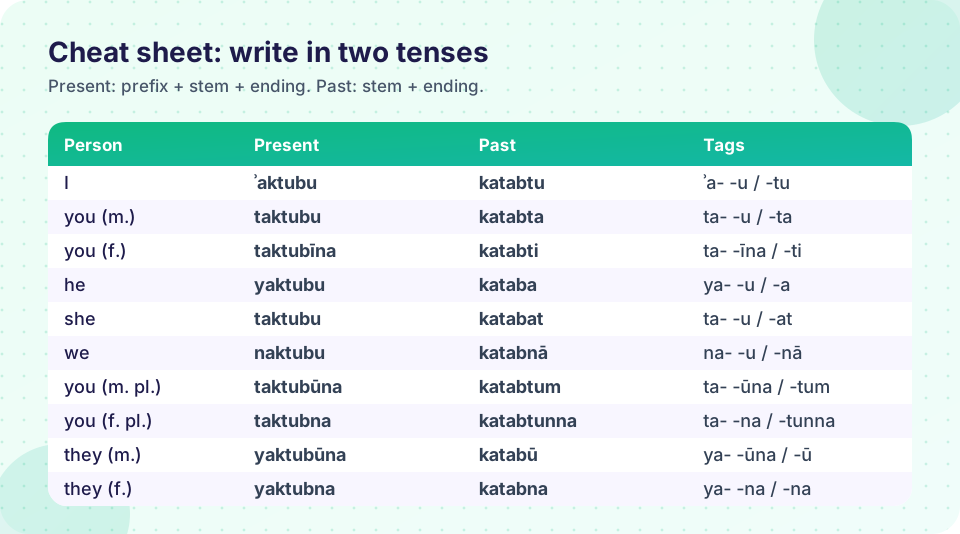
1. Verb endings (see conjugation and past tense)
| Person | Present of كَتَبَ | Past of كَتَبَ |
|---|---|---|
| I | أَكْتُبُ | كَتَبْتُ |
| you (m.) | تَكْتُبُ | كَتَبْتَ |
| you (f.) | تَكْتُبِينَ | كَتَبْتِ |
| he | يَكْتُبُ | كَتَبَ |
| she | تَكْتُبُ | كَتَبَتْ |
| we | نَكْتُبُ | كَتَبْنَا |
| you (m. pl.) | تَكْتُبُونَ | كَتَبْتُمْ |
| you (f. pl.) | تَكْتُبْنَ | كَتَبْتُنَّ |
| they (m.) | يَكْتُبُونَ | كَتَبُوا |
| they (f.) | يَكْتُبْنَ | كَتَبْنَ |
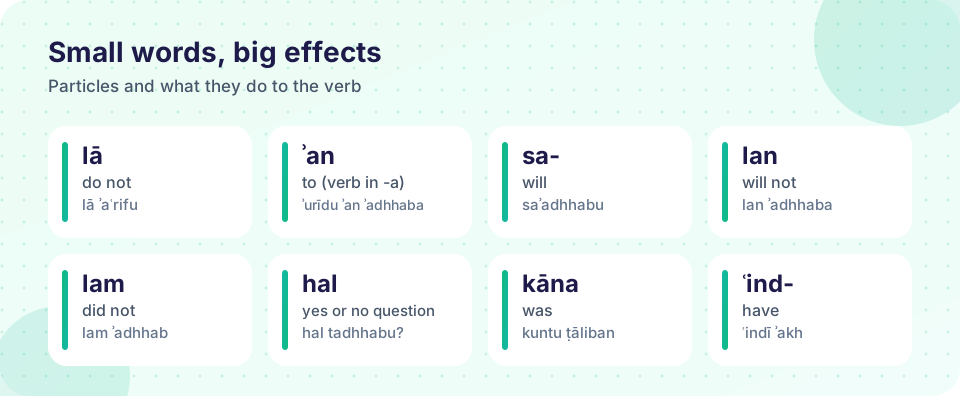
2. Small words that change the verb (see negation and wishes)
| Word | Use | Verb form | Example |
|---|---|---|---|
| لَا | do not | ordinary present | لَا أَعْرِفُ |
| أَنْ | to (want to, must) | subjunctive | أُرِيدُ أَنْ أَذْهَبَ |
| سَـ / سَوْفَ | will | ordinary present | سَأَذْهَبُ |
| لَنْ | will not | subjunctive | لَنْ أَذْهَبَ |
| لَمْ | did not | jussive | لَمْ أَذْهَبْ |
| هَلْ | yes/no question | unchanged | هَلْ تَذْهَبُ؟ |
| كَانَ | was | past | كُنْتُ طَالِبًا |
3. Question words (see question words and hal)
مَنْ who, مَا / مَاذَا what, أَيْنَ where, مَتَى when, كَيْفَ how, لِمَاذَا why, كَمْ how many, أَيُّ which, هَلْ (yes/no). Reasons: لِأَنَّ because.
4. Numbers, days and time (see numbers, days and time)
- 1 to 10: وَاحِد، اثْنَان، ثَلَاثَة، أَرْبَعَة، خَمْسَة، سِتَّة، سَبْعَة، ثَمَانِيَة، تِسْعَة، عَشَرَة.
- 1 and 2 follow the noun; 3 to 10 take the opposite gender; 11 and up take a singular noun.
- Days: الأَحَد، الاثْنَيْن، الثُّلَاثَاء، الأَرْبِعَاء، الخَمِيس، الجُمُعَة، السَّبْت.
- Time: السَّاعَة الثَّالِثَة وَالنِّصْف, وَالرُّبْع, إِلَّا رُبْعًا.
5. Possessives and "I have" (see family, food and places)
| my | your (m.) | your (f.) | his | her | our | your (pl.) | their |
|---|---|---|---|---|---|---|---|
| -ī | -ka | -ki | -hu | -hā | -nā | -kum | -hum |
I have = عِنْدِي; I do not have = لَيْسَ عِنْدِي. Nouns with a possessive ending lose ال; ة becomes ت.
6. Sentence order (see verbal sentences)
Verb, doer, rest. A verb before its doer stays singular (ذَهَبَ الأَوْلَاد). Connectors: وَ، ثُمَّ، فَـ، لَكِنْ، أَوْ، لِأَنَّ.
7. Essential phrases (see greetings and dialogues)
السَّلَامُ عَلَيْكُمْ, صَبَاحُ الخَيْرِ, كَيْفَ حَالُكَ؟, شُكْرًا, عَفْوًا, مِنْ فَضْلِكَ, لَوْ سَمَحْتَ, تَشَرَّفْنَا, بِكَمْ هَذَا؟, أَيْنَ ...؟, مَعَ السَّلَامَةِ.
Using the cheat sheet well
- Test before you look. Cover a table, recite it, then check.
- Do not memorize whole tables first. Learn them through sentences and dialogues.
- Update it. Add your own examples, new verbs and mistakes you often make.
How to read the verb table in five seconds
Look at the left column of the first table and find the person. Then look right. If you want the present, you will see a prefix at the front (أَـ, تَـ, يَـ, نَـ) and an ending at the back (-u, -īna, -ūna, -na). If you want the past, you will see only an ending at the back (-tu, -ta, -ti, -a, -at, -nā, -tum, -tunna, -ū, -na). The stem in the middle never moves. This "frame and filler" way of seeing the table is the most useful habit you can build.
Five mistakes to watch for
- Mixing the prefixes of "you" and "she". Both use تَـ. Check the ending: -īna means you (f.), a bare -u can be you (m.) or she.
- Using the wrong ending after a particle. After لَا and سَـ use the ordinary form; after أَنْ and لَنْ use the lighter -a form; after لَمْ use the jussive with a sukun.
- Forgetting the number-gender rule. Three to ten take the opposite gender.
- Putting ال on a possessed noun. كِتَابِي, never "al-kitābī".
- Dropping the greeting reply. A greeting should be returned.
Memory tricks
Rhythm helps. Chant the present endings in order: u, u, īna, u, u, u, ūna, na, ūna, na. Chant the past endings: tu, ta, ti, a, at, nā, tum, tunna, ū, na. For the number rule, remember the image of the ة as a decoration worn next to masculine nouns. For the particles, group them by the form they take: لَا + سَـ (ordinary), أَنْ + لَنْ (lighter -a), لَمْ (sukun). Making your own memory trick, even a silly one, helps it stick better than a trick someone else gave you.
Where this sheet stops
A cheat sheet is a map, not the territory. It does not show weak verbs, irregular plurals, case endings or the derived verb forms. When you meet a verb that does not fit the table, such as قَالَ / يَقُولُ, check the lesson on conjugation or ask a teacher. As your study grows, add your own notes to the sheet so that it remains useful.
Try it
Search a small phrasebook by English keyword. Add your own phrases to the list and run it again.
Press Run (or Ctrl + Enter) to see the result here.
Program input · what you'd type while the program runs
Type the answers before you press Run, one per line. Each time the program reads a line (with input()), it gets the next line from this box.
Then drill the essential phrases with flash cards.
Check your understanding
Quick check · 4 questions
of 4 answered You scored / 4 · perfect!
-
1. Which particle takes the jussive?
lam + jussive means did not. -
2. What does the pattern ثَلَاث بَنَات illustrate?
bint is feminine, so the number three is used without the ta marbuta. -
3. Which ending marks "her" in كِتَابُهَا?
-hā means her. -
4. What is the first thing to do with a cheat sheet?
Active recall helps you learn from a summary.
Summary
- The verb system fits on one table: prefixes and endings in the present, endings only in the past.
- A few small words (لَا، أَنْ، لَنْ، لَمْ، سَـ، هَلْ) change meaning; know which verb form each needs.
- Remember the number-gender rule, the possessive endings and the key phrases.
- Use the sheet for active recall, not just rereading.
Next: Where to go next
Track your progress
Create a free account to tick off lessons and pick up where you left off on any device.
of Arabic for Beginners lessons completed