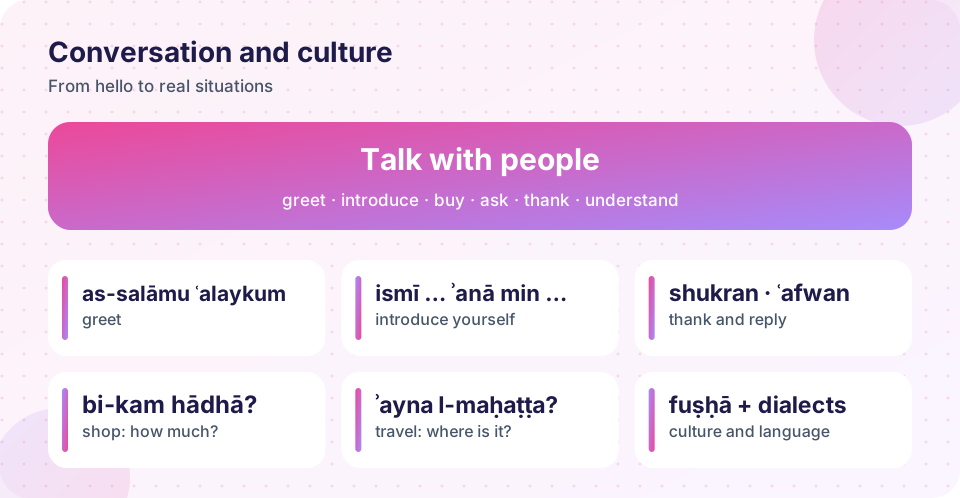
Preview the chapter on real Arabic conversation: greetings, introductions, shopping, travel and café dialogues, plus dialects, manners and culture.
Grammar and vocabulary are the bricks; conversation is the house. In this chapter you put everything together and learn how Arabic is actually used between people: how to greet, how to introduce yourself, how to buy a coffee, ask for directions and thank someone politely. You will also learn something that every Arabic learner discovers sooner or later: the Arabic people speak in daily life is not exactly the Arabic you read in books.
A course can prepare you well, but it cannot replace speaking with real people. As you work through this chapter, look for a language partner, a tutor, a community class or a conversation group, and use these phrases out loud as soon as you can. Mistakes are normal, and people almost always appreciate the effort.
Modern Standard Arabic (الفُصْحَى, al-fuṣḥā): the shared written and formal language used in news, books, speeches and schools across the Arab world. This course teaches it.
Dialect (لَهْجَة, lahja): the spoken everyday variety of a region, such as Egyptian, Levantine, Gulf or Moroccan Arabic.
Etiquette: the customs of polite behavior, such as how to greet and how to accept hospitality.
Register: how formal or casual your language is, chosen to fit the situation.
Here is a typical first meeting. Read it aloud, then try covering the transliteration.
Arabic
Transliteration
English
السَّلَامُ عَلَيْكُمْ.
as-salāmu ʿalaykum.
Peace be upon you (hello).
وَعَلَيْكُمُ السَّلَامُ. أَهْلًا وَسَهْلًا!
wa-ʿalaykumu s-salām. ʾahlan wa-sahlan!
And upon you peace. Welcome!
اسْمِي سَارَة. مَا اسْمُكَ؟
ismī sāra. mā ismuka?
My name is Sara. What is your name?
اسْمِي يُوسُف. تَشَرَّفْنَا.
ismī yūsuf. tasharrafnā.
My name is Yusuf. Pleased to meet you.
أَنَا مِنْ كَنَدَا. وَأَنْتَ؟
ʾanā min kanadā. wa-ʾanta?
I am from Canada. And you?
أَنَا مِنَ المَغْرِب.
ʾanā mina l-maghrib.
I am from Morocco.
You already understand most of it: مَا اسْمُكَ؟, أَنَا مِنْ, وَأَنْتَ؟. The new pieces are the greeting, أَهْلًا وَسَهْلًا (welcome) and تَشَرَّفْنَا (pleased to meet you).
Real conversation is not a performance of perfect sentences. It is a series of small cooperative moves: a greeting, a question, a short answer, a reaction, a pause while someone thinks, a request to repeat. A beginner can take part from the first day, as long as they learn a few "repair" phrases that keep the exchange going when understanding breaks down. Useful ones are لَا أَفْهَمُ (lā ʾafhamu, I do not understand), هَلْ يُمْكِنُ أَنْ تُعِيدَ؟ (could you repeat?) and أَتَكَلَّمُ العَرَبِيَّة قَلِيلًا (ʾatakallamu l-ʿarabiyya qalīlan, I speak a little Arabic). Say them without embarrassment; they signal that you are a learner, and most people respond with patience and often with encouragement.
There are three habits that separate learners who improve quickly from learners who stall. The first is to listen for key words instead of trying to understand everything. The second is to answer with a short, complete sentence instead of waiting until you can say something perfect. The third is to ask a question back, such as وَأَنْتَ؟ (and you?), which keeps the other person talking and gives you more listening practice.
In the greetings lesson, watch how greetings come in pairs and how politeness changes with the person you speak to. In the dialogue lesson, notice how each scene reuses the same small set of sentence patterns: a request, a price, a place, a time. In the culture lesson, notice that language and behavior go together: the right phrase said with the right gesture is worth more than perfect grammar. Keep a small notebook of phrases you hear and want to use. Each time you try one in a real situation, mark it with a tick.
Practice ten greetings and polite phrases. Say each one aloud before you flip it.
Greetings and polite phrases
<divstyle="max-width:560px;margin:0 auto"><divclass="row"style="justify-content:space-between;margin:0 0 10px"><spanclass="mut"id="cnt"></span><buttonid="sp">Listen</button></div><divclass="card"id="card"tabindex="0"style="min-height:190px;text-align:center;cursor:pointer;display:flex;flex-direction:column;justify-content:center;gap:6px"></div><divclass="row"><buttonclass="no"id="again">Again</button><buttonid="flip">Flip</button><buttonclass="yes"id="know">Got it</button></div></div><style>*{box-sizing:border-box}body{margin:0;padding:14px;font-family:system-ui,'Segoe UI',sans-serif;background:linear-gradient(135deg,#faf5ff,#eff6ff);color:#1e1b4b}.ar{font-family:'Noto Naskh Arabic','Segoe UI','Traditional Arabic',Amiri,serif}button{font:inherit;font-size:15px;border:0;border-radius:999px;padding:8px 16px;cursor:pointer;background:#fff;color:#1e1b4b;box-shadow:0 2px 8px rgba(67,56,202,.18)}button:hover{transform:translateY(-1px)}button.yes{background:linear-gradient(135deg,#10b981,#14b8a6);color:#fff}button.no{background:linear-gradient(135deg,#f59e0b,#ef4444);color:#fff}button.go{background:linear-gradient(135deg,#6366f1,#a78bfa);color:#fff}.card{background:#fff;border-radius:20px;box-shadow:0 10px 24px rgba(67,56,202,.16);padding:18px}.row{display:flex;gap:10px;flex-wrap:wrap;align-items:center;justify-content:center;margin-top:12px}.mut{color:#475569;font-size:14px}</style><script>const cards =[["السَّلَامُ عَلَيْكُمْ","as-salāmu ʿalaykum","peace be upon you (hello)"],["وَعَلَيْكُمُ السَّلَامُ","wa-ʿalaykumu s-salām","and upon you peace (reply)"],["صَبَاحُ الخَيْرِ","ṣabāḥ al-khayr","good morning"],["مَسَاءُ الخَيْرِ","masāʾ al-khayr","good evening"],["مَرْحَبًا","marḥaban","hello"],["أَهْلًا وَسَهْلًا","ʾahlan wa-sahlan","welcome"],["شُكْرًا","shukran","thank you"],["عَفْوًا","ʿafwan","you are welcome"],["مِنْ فَضْلِكَ","min faḍlika","please (to a man)"],["مَعَ السَّلَامَةِ","maʿa s-salāma","goodbye"]];const$=id=> document.getElementById(id);let deck = cards.slice(), total = cards.length, flipped =false;functionrender(){$('cnt').textContent =(total - deck.length)+' of '+ total +' learned';const c = deck[0];if(!c){$('card').innerHTML ='<div style="font-size:20px">All '+ total +' cards learned. Reload the preview to start again.</div>';return;}$('card').innerHTML ='<div class="ar" lang="ar" dir="rtl" style="font-size:46px;line-height:1.5">'+ c[0]+'</div>'+(flipped ?'<div style="font-size:22px;font-weight:700;color:#4338ca">'+ c[1]+'</div><div style="font-size:18px;color:#475569">'+ c[2]+'</div>':'<div class="mut">Say it aloud, then click the card</div>');}$('card').onclick =$('flip').onclick=()=>{ flipped =!flipped;render();};$('know').onclick=()=>{ deck.shift(); flipped =false;render();};$('again').onclick=()=>{ deck.push(deck.shift()); flipped =false;render();};$('sp').onclick=()=>{try{const u =newSpeechSynthesisUtterance(deck[0][0]); u.lang ='ar-SA'; speechSynthesis.speak(u);}catch(e){alert('Speech is not available in this preview. Say it aloud yourself.');}};render();</script>
Now match phrases with their meanings.
Phrases and meanings
<divstyle="max-width:640px;margin:0 auto"><divclass="row"style="justify-content:space-between;margin:0 0 10px"><spanclass="mut">Click an Arabic item, then its meaning.</span><spanclass="mut"id="score"></span></div><divstyle="display:grid;grid-template-columns:1fr 1fr;gap:10px"><divid="L"style="display:grid;gap:8px"></div><divid="R"style="display:grid;gap:8px"></div></div><divclass="row"><buttonclass="go"id="re">Shuffle again</button></div></div><style>*{box-sizing:border-box}body{margin:0;padding:14px;font-family:system-ui,'Segoe UI',sans-serif;background:linear-gradient(135deg,#faf5ff,#eff6ff);color:#1e1b4b}.ar{font-family:'Noto Naskh Arabic','Segoe UI','Traditional Arabic',Amiri,serif}button{font:inherit;font-size:15px;border:0;border-radius:999px;padding:8px 16px;cursor:pointer;background:#fff;color:#1e1b4b;box-shadow:0 2px 8px rgba(67,56,202,.18)}button:hover{transform:translateY(-1px)}button.yes{background:linear-gradient(135deg,#10b981,#14b8a6);color:#fff}button.no{background:linear-gradient(135deg,#f59e0b,#ef4444);color:#fff}button.go{background:linear-gradient(135deg,#6366f1,#a78bfa);color:#fff}.card{background:#fff;border-radius:20px;box-shadow:0 10px 24px rgba(67,56,202,.16);padding:18px}.row{display:flex;gap:10px;flex-wrap:wrap;align-items:center;justify-content:center;margin-top:12px}.mut{color:#475569;font-size:14px}</style><style>.it{padding:10px 12px;border-radius:14px;background:#fff;box-shadow:0 2px 8px rgba(67,56,202,.18);cursor:pointer;text-align:center;min-height:44px;display:flex;align-items:center;justify-content:center;border:2px solid transparent}.it.sel{border-color:#6366f1;background:#eef2ff}.it.ok{background:#d1fae5;border-color:#10b981;cursor:default}.it.bad{background:#fee2e2;border-color:#ef4444}</style><script>const pairs =[["شُكْرًا","thank you"],["عَفْوًا","you are welcome"],["مَرْحَبًا","hello"],["مَعَ السَّلَامَةِ","goodbye"],["أَهْلًا وَسَهْلًا","welcome"],["صَبَاحُ الخَيْرِ","good morning"]];const$=id=> document.getElementById(id);let sel =null, done =0, miss =0;functionshuffle(a){ a = a.slice();for(let i = a.length -1; i >0; i--){const j = Math.floor(Math.random()*(i +1));[a[i], a[j]]=[a[j], a[i]];}return a;}functionsetup(){
sel =null; done =0; miss =0;$('L').innerHTML ='';$('R').innerHTML ='';
pairs.forEach((p, i)=>{const d = document.createElement('div'); d.className ='it ar'; d.lang ='ar'; d.dir ='rtl'; d.style.fontSize ='24px'; d.textContent = p[0]; d.dataset.i = i; d.onclick = pick;$('L').appendChild(d);});shuffle(pairs.map((p, i)=> i)).forEach(i=>{const d = document.createElement('div'); d.className ='it'; d.textContent = pairs[i][1]; d.dataset.i = i; d.onclick = pick;$('R').appendChild(d);});upd();}functionupd(){$('score').textContent = done +' of '+ pairs.length +' matched, '+ miss +' misses'+(done === pairs.length ?' - well done!':'');}functionpick(e){const el = e.currentTarget;if(el.classList.contains('ok'))return;const side = el.parentElement.id;if(!sel || sel.parentElement.id === side){if(sel) sel.classList.remove('sel'); sel = el; el.classList.add('sel');return;}if(sel.dataset.i === el.dataset.i){ sel.classList.remove('sel'); sel.classList.add('ok'); el.classList.add('ok'); done++;}else{ miss++;const a = sel, b = el; a.classList.add('bad'); b.classList.add('bad');setTimeout(()=>{ a.classList.remove('bad','sel'); b.classList.remove('bad');},500);}
sel =null;upd();}$('re').onclick = setup;setup();</script>