


















Lesson 4 of 45 · Getting Started
First Greetings: Hello, Thank You and Goodbye
Learn essential Arabic greetings and polite phrases in Arabic script with transliteration, gender forms, a first dialogue and pronunciation tips.
Greetings are the doorway to any language, and in Arabic-speaking cultures they carry extra weight. People often exchange several greetings before they get to the point, asking about each other's health, family and day. Learning the main phrases now gives you something to say from the very first week, even though you cannot read the script yet. Read the Arabic if you like, but rely on the transliteration and say each phrase aloud.
What you will learn
- How to say hello, good morning and good evening, and how to answer each greeting.
- How to ask "How are you?" to a man and to a woman, and how to reply.
- How to say please, thank you, you're welcome, excuse me and goodbye.
- How to introduce yourself and ask someone's name.
- Why many phrases change for a male or female listener.
Key terms
Greeting and response pair: a greeting that expects a fixed reply, such as as-salāmu ʿalaykum and wa ʿalaykumu s-salām.
Masculine / feminine address: Arabic marks whether you speak to a man or a woman with different endings, such as -ka and -ki.
Formula: a fixed expression, like al-ḥamdu lillāh, that people say without thinking about each word.
Glottal stop (ʾ): the tiny catch in your throat in the middle of "uh-oh".
Hello and the peace greeting
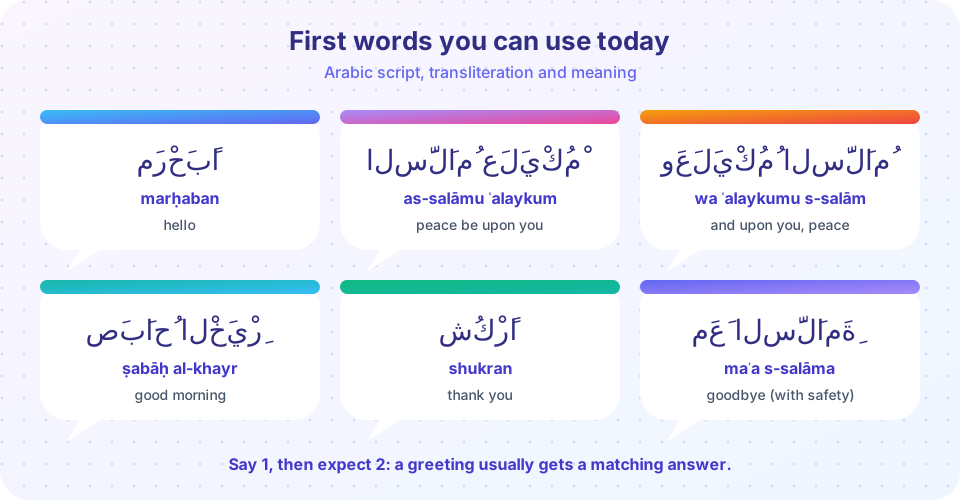
The simplest word is مَرْحَبًا (marḥaban), "hello". It works almost everywhere. Another friendly option is أَهْلًا (ahlan), "welcome, hi", and the fuller أَهْلًا وَسَهْلًا (ahlan wa sahlan), "welcome". When someone says ahlan, you can answer ahlan or ahlan bika ("welcome to you").
The classic greeting is السَّلَامُ عَلَيْكُمْ (as-salāmu ʿalaykum), "peace be upon you". Its standard answer is وَعَلَيْكُمُ السَّلَامُ (wa ʿalaykumu s-salām), "and upon you, peace". It is a religious greeting with deep roots in Muslim culture and is used all over the Arab world, and as a visitor you will hear it constantly. Non-Muslim speakers and learners also use it, though in mixed company marḥaban or ahlan is perfectly safe.
Times of day
| Arabic | Transliteration | Meaning |
|---|---|---|
| صَبَاحُ الْخَيْرِ | ṣabāḥ al-khayr | good morning (morning of goodness) |
| صَبَاحُ النُّورِ | ṣabāḥ an-nūr | reply: morning of light |
| مَسَاءُ الْخَيْرِ | masāʾ al-khayr | good evening |
| مَسَاءُ النُّورِ | masāʾ an-nūr | reply: evening of light |
Notice that the reply is not an echo. It plays with the original: you offer "goodness" and receive "light". Many Arabic greetings work like this, answering with an even warmer wish.
How are you?
The question changes with the person you speak to:
- To a man: كَيْفَ حَالُكَ؟ (kayfa ḥāluka?)
- To a woman: كَيْفَ حَالُكِ؟ (kayfa ḥāluki?)
The only difference is the last vowel, -a for a man and -i for a woman. The standard answer is بِخَيْرٍ، الْحَمْدُ لِلَّهِ (bi-khayr, al-ḥamdu lillāh), "well, praise be to God". Then you return the question with وَأَنْتَ؟ (wa anta?) to a man or وَأَنْتِ؟ (wa anti?) to a woman, "and you?". If you are not well, you can say laysa jayyidan (not good), but most people give a positive reply as a social habit.
Gender endings are the first example of a pattern that returns in every chapter: Arabic often marks gender in the word for "you". If you are unsure whom you are addressing, ask, or listen for how others address them.
Polite words
| Arabic | Transliteration | Meaning |
|---|---|---|
| شُكْرًا | shukran | thank you |
| عَفْوًا | ʿafwan | you're welcome; also "excuse me" |
| مِنْ فَضْلِكَ | min faḍlika | please (to a man) |
| مِنْ فَضْلِكِ | min faḍliki | please (to a woman) |
| نَعَمْ | naʿam | yes |
| لَا | lā | no |
| آسِفٌ / آسِفَةٌ | āsif / āsifa | sorry (said by a man / by a woman) |
Min faḍlika means "from your favor". You use it for requests: "from your favor, a glass of water". Shukran has a longer form, شُكْرًا جَزِيلًا (shukran jazīlan), "thank you very much". A very common spoken reply to thanks in dialects is ʿafwan, and ahlan (welcome) also works as a friendly answer.
Introductions
To ask someone's name use مَا اسْمُكَ؟ (mā ismuka?) for a man and مَا اسْمُكِ؟ (mā ismuki?) for a woman. To say yours, put اسْمِي (ismī, "my name") before it: ismī Sara. You can also say أَنَا سَارَة (anā Sāra), "I am Sara". When you meet, تَشَرَّفْنَا (tasharrafnā) means "we are honored", the usual way to say "nice to meet you".
A first dialogue
Two people meet in the morning.
| Speaker | Arabic | Transliteration | English |
|---|---|---|---|
| Layla | صَبَاحُ الْخَيْرِ | ṣabāḥ al-khayr | Good morning. |
| Omar | صَبَاحُ النُّورِ. كَيْفَ حَالُكِ؟ | ṣabāḥ an-nūr. kayfa ḥāluki? | Morning of light. How are you? |
| Layla | بِخَيْرٍ، الْحَمْدُ لِلَّهِ. وَأَنْتَ؟ | bi-khayr, al-ḥamdu lillāh. wa anta? | Well, thank God. And you? |
| Omar | بِخَيْرٍ، شُكْرًا. | bi-khayr, shukran. | Well, thanks. |
| Layla | مَا اسْمُكَ؟ | mā ismuka? | What is your name? |
| Omar | اسْمِي عُمَر. تَشَرَّفْنَا. | ismī ʿUmar. tasharrafnā. | My name is Omar. Pleased to meet you. |
| Layla | مَعَ السَّلَامَةِ. | maʿa s-salāma. | Goodbye. |
Look at how Omar says ḥāluki to Layla (feminine) and Layla says ismuka to Omar (masculine). Each speaker chooses the ending that matches the listener.
Saying goodbye
مَعَ السَّلَامَةِ (maʿa s-salāma) means "with safety" and is the everyday goodbye; the other speaker answers اللَّهُ يُسَلِّمُكَ (allāhu yusallimuka, "may God keep you safe") in many places. A more formal option is إِلَى اللِّقَاءِ (ilā l-liqāʾ), "until the meeting". Another formula you will hear all the time is إِنْ شَاءَ اللَّهُ (in shāʾa llāh), "God willing", attached to anything in the future. It can be a sincere wish, a polite maybe or just a habit.
Pronunciation tips
- ḥ (ح) is a breathy, whispered h from deep in the throat, like fogging up a mirror.
- kh (خ) is like the "ch" in Scottish "loch" or German "Bach".
- ʿ (ع) has no English equivalent; it is a tightened throat sound. For now, treat it as a gentle squeeze and listen to native speakers. Chapter 2 gives it a full lesson.
- ā and the other long vowels are held about twice as long as the short ones.
- Double letters are really doubled: tasharrafnā has a doubled r sound written with a shadda mark (Chapter 3).
Cultural notes
Greetings in Arabic-speaking societies are warm and unhurried. Men often shake hands, and close friends may kiss on the cheek, two or three times depending on the region. Between men and women, customs vary: in some settings people shake hands, in others they greet by placing a hand over the heart. A good rule is to wait for the other person to offer a hand. Always use the right hand for greeting, eating and giving things. Taking time to ask about someone's family and health is a sign of respect, not a waste of time.
Extra phrases for real situations
Once you are comfortable with the core set, add these frequent phrases. On the telephone, people say أَلُو (alū) for "hello". When someone thanks you for a favor, a common reply in many places is لَا شُكْرَ عَلَى وَاجِبٍ (lā shukra ʿalā wājib), "no thanks are due for a duty", which means "it is nothing". To apologize you can say آسِف (āsif, a man) or آسِفَة (āsifa, a woman), or the more formal أَعْتَذِر (aʿtadhir, "I apologize"). To ask someone to repeat, say مَرَّةً أُخْرَى، مِنْ فَضْلِكَ (marratan ukhrā, min faḍlika), "once more, please", or لَا أَفْهَم (lā afham), "I do not understand".
Shadowing: a fast way to sound natural
Choose one dialogue from this lesson and play it, or read it aloud, then repeat each line immediately after you hear or read it, copying the rhythm. Do this for five minutes, three times a week. The aim is not accuracy at first but smoothness, because Arabic greetings run together in speech. Soon the pairs will come out without thought, which frees your attention for the new material in the next chapters.
Try it
Press Run (or Ctrl + Enter) to see the result here.
Program input · what you'd type while the program runs
Type the answers before you press Run, one per line. Each time the program reads a line (with input()), it gets the next line from this box.
Common misconceptions
"As-salāmu ʿalaykum is only for religious settings." It is used widely as an everyday greeting, but it is a Muslim greeting in origin. Other Arabs say marḥaban, ahlan or time-of-day greetings, and no one will mind if a learner uses any of them politely.
"Shukran alone is enough everywhere." It is always polite, but longer forms and the reply ʿafwan make conversation smoother. People often chain several greetings.
"Gender endings do not matter for a beginner." They do, because they are everywhere. A wrong ending is understood, but trying to get it right shows respect.
Check your understanding
Quick check · 5 questions
of 5 answered You scored / 5 · perfect!
-
1. What is the standard reply to 'as-salāmu ʿalaykum'?
The expected answer returns the wish: 'and upon you, peace'. -
2. Which phrase asks a woman how she is?
The ending -ki addresses a woman; -ka addresses a man. -
3. What does 'ṣabāḥ an-nūr' mean?
It literally means 'morning of light' and is the warm reply to ṣabāḥ al-khayr. -
4. Which phrase means 'please' when speaking to a man?
Min faḍlika means 'from your favor'. A woman would be addressed with min faḍliki. -
5. What is 'in shāʾa llāh' closest to in meaning?
It is attached to statements about the future, as in 'we will meet tomorrow, God willing'.
Summary
- Marḥaban and ahlan mean hello; as-salāmu ʿalaykum is answered with wa ʿalaykumu s-salām.
- Morning and evening greetings are answered with the "light" version.
- "You" has gender endings: -ka for a man, -ki for a woman.
- Shukran (thanks) is answered with ʿafwan; min faḍlika means please.
- Ismī ... introduces your name; tasharrafnā means pleased to meet you.
- Maʿa s-salāma is the standard goodbye.
Next: Chapter 1 Review
Track your progress
Create a free account to tick off lessons and pick up where you left off on any device.
of Arabic for Beginners lessons completed