


















Lesson 3 of 45 · Getting Started
How Arabic Works: Script, Direction and the Root System
Understand the Arabic abjad, right-to-left writing, short and long vowels, Arabic numerals and the three-letter root system that builds thousands of words.
Before you learn a single letter, it helps to see the machine from above. Arabic differs from English in four big ways: it is written from right to left, it joins its letters like handwriting, it usually leaves out short vowels, and it builds most of its vocabulary from three-consonant roots. Each of these ideas sounds strange at first and turns out to be tidy once you see it in action. This lesson gives you the whole picture, so that the details in Chapters 2 and 3 have a place to land.
What you will learn
- How an abjad differs from an alphabet and why Arabic is one.
- How direction, joining and the lack of capital letters work.
- The three short and three long vowels, and what happens when short vowels are not written.
- How a root and a pattern combine to make a word.
- How Arabic digits work and in which direction numbers read.
Key terms
Abjad: a script whose basic letters stand for consonants; long vowels are written with some of those letters and short vowels are optional marks.
Root (jidhr): a base of usually three consonants, such as k-t-b, that carries a core meaning.
Pattern (wazn): a template of vowels and extra letters into which root letters are placed, giving a specific meaning such as "doer" or "place".
Cursive: joined-up writing in which most letters connect to the next one.
Case: grammatical endings on nouns showing their job in the sentence; MSA has three, but they are usually not pronounced in everyday conversation.
An abjad, not an alphabet
The English alphabet gives every vowel its own letter: a, e, i, o, u. Arabic does something different. The 28 letters are all consonants, but three of them (ا alif, و wāw, ي yā') do double duty as long vowels. The three short vowels (a, i, u) are not letters at all; they are small marks written above or below a consonant, called ḥarakāt, and they are normally left out of everyday writing. Linguists call a script like this an abjad, from the old order of the first letters (alif, bā', jīm, dāl).
This is not as wild as it sounds. Imagine the English sentence "Th bk s n th tbl". You can read it because you know the language. Arabic readers do the same, but with a system: the pattern of consonants, the grammar and the context tell them which vowels belong. Beginners get the vowels written in, and by the end of Chapter 3 you will know the marks well enough to read vowelled text aloud and to understand why professional readers can skip them.
Direction, joining and capitals
Arabic runs from right to left. A book opens on what English readers would call the back cover, and pages turn the other way. When you write, your hand starts at the right edge of the line and moves left.
The script is cursive. In print as well as in handwriting, most letters connect to their neighbors, and the shape of a letter changes depending on whether it sits at the beginning, middle or end of a word, or stands alone. We cover these four forms in Chapter 3. Six letters never connect to the one after them, which creates the tidy breaks you see inside some words.
There are no capital letters. Names, sentence beginnings and the word for "God" all use the same letters as everything else. Punctuation is mostly familiar, with a mirrored question mark (؟) and comma (،), because they are drawn for right-to-left lines.
The vowels: three short, three long
Arabic has only three basic vowel qualities, each of which comes in a short and a long form.
| Sound | Short (mark) | Long (letter) | Example |
|---|---|---|---|
| a | fatḥa (a small line above) | ā (alif) | kataba, kātib |
| i | kasra (a small line below) | ī (yā') | kitāb, kabīr |
| u | ḍamma (a small loop above) | ū (wāw) | kutub, kabūl |
The difference between short and long matters because it can change a word. For example, kataba (he wrote) and kātib (writer) differ by one long vowel. Length is as important as the consonants, and this course will train your ear for it from the beginning.
Roots and patterns: the clever part
Most Arabic words are built from two ingredients: a root of three consonants (sometimes four) and a pattern of vowels and sometimes extra letters. The root brings the meaning. The pattern brings the grammar and the specific role.
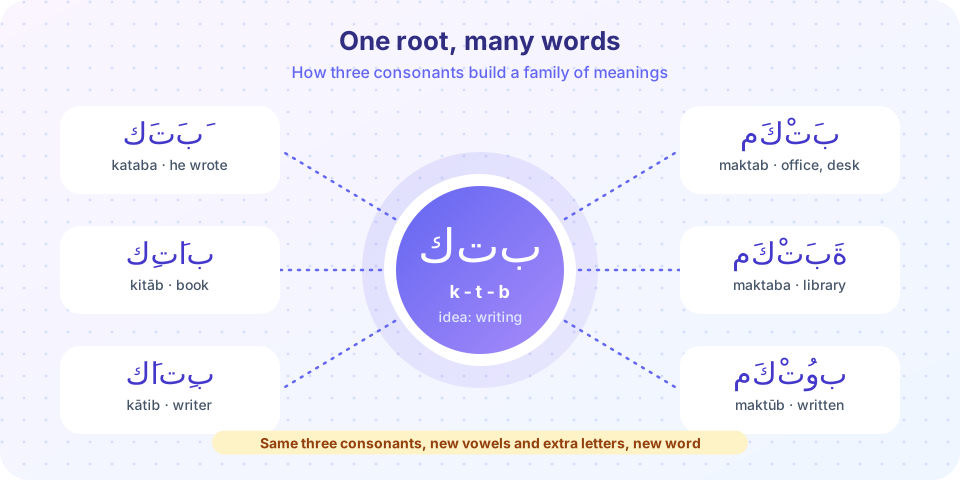
Take the root k-t-b, which has to do with writing. Insert its consonants into different patterns, and you get:
- kataba (he wrote): the pattern CaCaCa, where C stands for a root consonant
- kātib (writer): CāCiC, a pattern for "the one who does it"
- kitāb (book): CiCāC
- maktab (office, desk) and maktaba (library, bookshop): maCCaC, a pattern for a place
- maktūb (written, a letter): maCCūC, a pattern for "the thing that was done"
Other roots work the same way. d-r-s (study) gives dars (lesson), madrasa (school), mudarris (teacher) and dirāsa (study). ʿ-l-m (know) gives ʿilm (knowledge), ʿālim (scholar or scientist), muʿallim (teacher) and maʿlūm (known). Learn a root once and you recognize it in dozens of words, which makes Arabic vocabulary much less random than it first seems.
A fair warning: patterns are productive, but not every combination exists. A pattern may fit a root on paper and yet no one uses the word. Treat patterns as strong hints, and always check a new word in a dictionary.
Reading without vowels
When short vowels are omitted, a single string of letters can stand for several words. The consonants k-t-b, written كتب, could be kataba (he wrote), kutub (books) or kutiba (it was written). Context and grammar nearly always decide, in the way you instantly know whether "read" in an English sentence is present or past. The marks are added when ambiguity would be harmful: in the Qur'an, in children's textbooks, in dictionaries and in material for learners.
Digits and numbers
Two sets of digits are used. In much of the Middle East, the Eastern Arabic-Indic digits appear: ٠ ١ ٢ ٣ ٤ ٥ ٦ ٧ ٨ ٩ (0 to 9). In North Africa, and in many other contexts, the familiar 0 to 9, which Europe borrowed from the Arab world and called "Arabic numerals", are standard. Both sets are written and read from left to right, even inside right-to-left text, with the biggest place on the left, just like in English. So the year 2025 is ٢٠٢٥ in the Eastern set.
| 0 | 1 | 2 | 3 | 4 | 5 | 6 | 7 | 8 | 9 |
|---|---|---|---|---|---|---|---|---|---|
| ٠ | ١ | ٢ | ٣ | ٤ | ٥ | ٦ | ٧ | ٨ | ٩ |
Basic sentence shape
Arabic often allows sentences with no verb "to be" in the present tense. Al-bayt kabīr (البيت كبير) is literally "the house big", meaning "the house is big". A second common order starts with the verb, as in kataba al-walad (he wrote, the boy: "the boy wrote"). You will study both shapes in Chapters 4 and 7.
Try it
Press Run (or Ctrl + Enter) to see the result here.
Program input · what you'd type while the program runs
Type the answers before you press Run, one per line. Each time the program reads a line (with input()), it gets the next line from this box.
The second block shows exactly why vowel marks exist: three different words collapse into the same three letters once the marks are removed. Skilled readers use context to choose among them.
Common misconceptions
"Arabic has no vowels." It has three vowel qualities, each short or long. The long ones are written with letters; the short ones use optional marks.
"Arabic numbers are written right to left." Numbers are written and read left to right, even inside Arabic text.
"Every root word follows its pattern perfectly." Patterns are strong tendencies. Meanings can drift over time, and some combinations are never used.
Check your understanding
Quick check · 5 questions
of 5 answered You scored / 5 · perfect!
-
1. What is an abjad?
In an abjad, letters stand mainly for consonants; long vowels use a few letters, and short vowels are optional marks. -
2. Which word shares the root k-t-b with 'kitab' (book)?
Maktaba (library) is built from k-t-b; madrasa and mudarris come from d-r-s, and ʿalima from ʿ-l-m. -
3. How are the digits of a number read in Arabic text?
Numbers are read left to right, with the largest place first, even inside right-to-left text. -
4. Why can the letters كتب stand for several words?
Without vowel marks, kataba, kutub and kutiba look the same, so context decides. -
5. What does a pattern add to a root?
The root carries the core idea; the pattern gives the specific role, such as the doer, the place or the thing done.
Summary
- Arabic is an abjad: 28 consonant letters, with three of them doubling as long vowels.
- It runs right to left, joins letters like handwriting and has no capitals.
- There are three short and three long vowels; short ones are optional marks.
- Roots of three consonants plus patterns build most of the vocabulary.
- Numbers read left to right, in either Eastern Arabic-Indic or familiar 0 to 9 digits.
- Without vowel marks, a word may have more than one reading; context decides.
Track your progress
Create a free account to tick off lessons and pick up where you left off on any device.
of Arabic for Beginners lessons completed