Build, write and rehearse a short Arabic self-introduction using greetings, the present tense, possessives and numbers, with a builder tool and a checklist.
You have learned letters, nouns, verbs in two tenses, questions, numbers and a whole set of polite phrases. Now you will use them for the most useful speech act in any language: introducing yourself. This project guides you through writing a short Arabic introduction about you, checking it, and saying it aloud until it flows. By the end you will have something you can actually use at a language meeting, a café or an online class.
Treat it like a small craft project, not a test. The goal is a text you are proud to say, in your own words, with your own details.
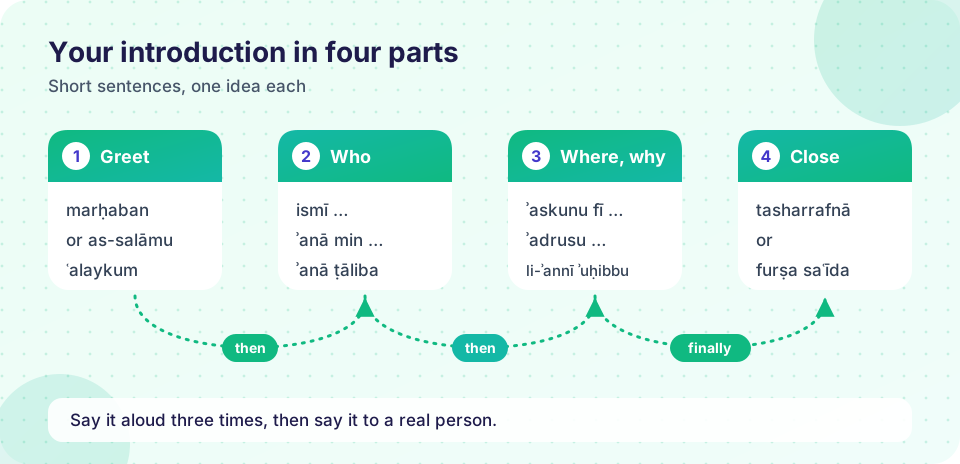
Each sentence uses something from this course: the greeting, the possessive ending -ī (اسْمِي, عُمْرِي), the preposition مِنْ, the feminine job ending, a number with a singular noun, the present tense (أَسْكُنُ, أَدْرُسُ, أُحِبُّ), and لِأَنِّي (because I).
The tool below builds a complete introduction from your choices and shows the English meaning. It is a stand-in for a tutor: it fills the template correctly, but it cannot judge your pronunciation. Change the settings and compare the Arabic.
Self-introduction builder
<divstyle="max-width:640px;margin:0 auto"><divclass="card"style="display:grid;grid-template-columns:1fr 1fr;gap:10px"><labelclass="mut">Your name (any script)<br><inputid="nm"value="Sara"style="width:100%;padding:8px;border-radius:10px;border:1px solid #c7d2fe;font:inherit"></label><labelclass="mut">I am<br><selectid="gd"style="width:100%;padding:8px;border-radius:10px;border:1px solid #c7d2fe;font:inherit"><optionvalue="f">a woman</option><optionvalue="m">a man</option></select></label><labelclass="mut">Country<br><selectid="co"style="width:100%;padding:8px;border-radius:10px;border:1px solid #c7d2fe;font:inherit"></select></label><labelclass="mut">Job<br><selectid="jb"style="width:100%;padding:8px;border-radius:10px;border:1px solid #c7d2fe;font:inherit"></select></label><labelclass="mut">Age (11 to 99)<br><inputid="ag"type="number"min="11"max="99"value="25"style="width:100%;padding:8px;border-radius:10px;border:1px solid #c7d2fe;font:inherit"></label><labelclass="mut">City where you live<br><inputid="ci"value="Cairo"style="width:100%;padding:8px;border-radius:10px;border:1px solid #c7d2fe;font:inherit"></label><labelclass="mut"style="grid-column:1/3">I love<br><selectid="lv"style="width:100%;padding:8px;border-radius:10px;border:1px solid #c7d2fe;font:inherit"></select></label></div><divclass="row"><buttonclass="go"id="mk">Build my introduction</button><buttonid="sp">Listen</button></div><divclass="card"style="margin-top:10px"><divid="out"class="ar"lang="ar"dir="rtl"style="font-size:26px;line-height:2"></div><divid="en"class="mut"style="margin-top:8px"></div></div></div><style>*{box-sizing:border-box}body{margin:0;padding:14px;font-family:system-ui,'Segoe UI',sans-serif;background:linear-gradient(135deg,#faf5ff,#eff6ff);color:#1e1b4b}.ar{font-family:'Noto Naskh Arabic','Segoe UI','Traditional Arabic',Amiri,serif}button{font:inherit;font-size:15px;border:0;border-radius:999px;padding:8px 16px;cursor:pointer;background:#fff;color:#1e1b4b;box-shadow:0 2px 8px rgba(67,56,202,.18)}button:hover{transform:translateY(-1px)}button.yes{background:linear-gradient(135deg,#10b981,#14b8a6);color:#fff}button.no{background:linear-gradient(135deg,#f59e0b,#ef4444);color:#fff}button.go{background:linear-gradient(135deg,#6366f1,#a78bfa);color:#fff}.card{background:#fff;border-radius:20px;box-shadow:0 10px 24px rgba(67,56,202,.16);padding:18px}.row{display:flex;gap:10px;flex-wrap:wrap;align-items:center;justify-content:center;margin-top:12px}.mut{color:#475569;font-size:14px}</style><script>const$=id=> document.getElementById(id);constCOUNTRIES=[['كَنَدَا','Canada'],['أَمْرِيكَا','the USA'],['بَرِيطَانِيَا','the UK'],['أَلْمَانِيَا','Germany'],['فَرَنْسَا','France'],['إِسْبَانِيَا','Spain'],['الهِنْد','India'],['الصِّين','China'],['اليَابَان','Japan'],['مِصْر','Egypt'],['المَغْرِب','Morocco'],['تُرْكِيَا','Turkey'],['البَرَازِيل','Brazil'],['أُسْتُرَالِيَا','Australia']];constJOBS=[['طَالِب','طَالِبَة','student'],['مُعَلِّم','مُعَلِّمَة','teacher'],['طَبِيب','طَبِيبَة','doctor'],['مُهَنْدِس','مُهَنْدِسَة','engineer'],['مُمَرِّض','مُمَرِّضَة','nurse'],['مُبَرْمِج','مُبَرْمِجَة','programmer']];constLOVES=[['السَّفَر','travelling'],['المُوسِيقَى','music'],['الكُتُب','books'],['الطَّبْخ','cooking']];COUNTRIES.forEach((c, i)=>$('co').add(newOption(c[1], i)));JOBS.forEach((j, i)=>$('jb').add(newOption(j[2], i)));LOVES.forEach((l, i)=>$('lv').add(newOption(l[1], i)));constEAST='٠١٢٣٤٥٦٧٨٩';consttoEast=s=>String(s).replace(/[0-9]/g,d=>EAST[+d]);functionbuild(){const fem =$('gd').value ==='f', c =COUNTRIES[+$('co').value], j =JOBS[+$('jb').value], l =LOVES[+$('lv').value];let age =parseInt($('ag').value,10);if(!(age >=11&& age <=99)) age =25;const name =$('nm').value.trim()||'...', city =$('ci').value.trim()||'...';const from = c[0].startsWith('ال')?'مِنَ':'مِنْ';const lines =['السَّلَامُ عَلَيْكُمْ.','اسْمِي '+ name +'.','أَنَا '+ from +' '+ c[0]+'.','أَنَا '+(fem ? j[1]: j[0])+'.','عُمْرِي '+toEast(age)+' سَنَة.','أَسْكُنُ فِي '+ city +'.','أَدْرُسُ العَرَبِيَّة لِأَنِّي أُحِبُّ '+ l[0]+'.','تَشَرَّفْنَا!'];$('out').innerHTML = lines.map(x=>'<div>'+ x.replace(/</g,'<')+'</div>').join('');$('en').textContent ='Peace be upon you. My name is '+ name +'. I am from '+ c[1]+'. I am '+(/^[aeiou]/.test(j[2])?'an ':'a ')+ j[2]+(fem ?' (f.)':' (m.)')+'. I am '+ age +' years old. I live in '+ city +'. I study Arabic because I love '+ l[1]+'. Pleased to meet you!';
window.lastText = lines.join(' ');}$('mk').onclick = build;$('sp').onclick=()=>{if(!window.lastText)build();try{const u =newSpeechSynthesisUtterance(window.lastText); u.lang ='ar-SA'; speechSynthesis.speak(u);}catch(e){alert('Speech is not available in this preview. Read it aloud yourself.');}};build();</script>
This is already understandable, but it can be improved. أَنَا اسْمِي is a common English-style habit: Arabic simply says اسْمِي عُمَر. The age is missing, and the reason for studying Arabic has not been connected to the music.
Draft 3 (polished):السَّلَامُ عَلَيْكُمْ. اسْمِي عُمَر. أَنَا مِنْ كَنَدَا وَأَسْكُنُ فِي تُورُونْتُو. أَنَا مُهَنْدِس وَعُمْرِي ثَلَاثُون سَنَة. أَدْرُسُ العَرَبِيَّة لِأَنِّي أُحِبُّ المُوسِيقَى العَرَبِيَّة. تَشَرَّفْنَا! Here he joined two ideas with وَ, added his age with عُمْرِي, linked the music to Arabic with لِأَنِّي and ended with a polite closing. The result sounds natural and takes about twenty seconds to say.
You can reuse the same skeleton in different settings. For a formal introduction, such as a class or a meeting, use the full forms and add your job: أَعْمَلُ مُهَنْدِسًا (I work as an engineer). For a friendly introduction, use مَرْحَبًا, shorten the sentences and add a question: وَأَنْتَ؟ مِنْ أَيْنَ أَنْتَ؟ For a written message, such as an email to a teacher or an online group, add شُكْرًا at the end. Keep a copy of each version, so that you always have a ready-made script that fits the situation.
Record yourself on a phone. Listen once for sound (are the long vowels long, are the final vowels clear?), once for grammar (did you use the right ending for your gender and person?) and once for flow (did you pause in the right places?). If you can, send the recording to a teacher or language partner and ask for two corrections only: a small list of fixes is easier to act on than a long one. Then record it again and compare. Most learners notice a clear improvement after only two or three rounds.
Before you call your introduction finished, check each point on this list. Does it start with a greeting? Does the first sentence say your name with اسْمِي? Is every job or description word in the correct gender? Did you use مِنْ or مِنَ correctly before the country? Does the age sentence use عُمْرِي and a singular noun after a number from 11 upwards? Do the present-tense verbs (أَسْكُنُ, أَدْرُسُ, أُحِبُّ) have the أَـ prefix for I? Does it end with a polite closing? If you can answer yes to all seven, your introduction is in good shape, and you can add a bonus sentence about your family or your favorite food from the lesson on daily life.
Rebuild some sentences from a model introduction by tapping the words in order.
Rebuild the introduction
<divstyle="max-width:640px;margin:0 auto"><divclass="row"style="justify-content:space-between;margin:0 0 10px"><spanclass="mut"id="prog"></span><spanclass="mut"id="score"></span></div><divclass="card"><divid="en"style="font-size:19px;text-align:center;margin-bottom:10px"></div><divid="ans"class="ar"lang="ar"dir="rtl"style="min-height:62px;border-bottom:3px dashed #c7d2fe;display:flex;flex-wrap:wrap;gap:8px;padding:6px"></div><divid="pool"class="ar"lang="ar"dir="rtl"style="display:flex;flex-wrap:wrap;gap:8px;margin-top:12px"></div><divid="fb"style="margin-top:10px;font-weight:600;min-height:24px;text-align:center"></div><divclass="row"><buttonclass="go"id="chk">Check</button><buttonid="rs">Reset</button><buttonid="nx"style="display:none">Next</button></div></div></div><style>*{box-sizing:border-box}body{margin:0;padding:14px;font-family:system-ui,'Segoe UI',sans-serif;background:linear-gradient(135deg,#faf5ff,#eff6ff);color:#1e1b4b}.ar{font-family:'Noto Naskh Arabic','Segoe UI','Traditional Arabic',Amiri,serif}button{font:inherit;font-size:15px;border:0;border-radius:999px;padding:8px 16px;cursor:pointer;background:#fff;color:#1e1b4b;box-shadow:0 2px 8px rgba(67,56,202,.18)}button:hover{transform:translateY(-1px)}button.yes{background:linear-gradient(135deg,#10b981,#14b8a6);color:#fff}button.no{background:linear-gradient(135deg,#f59e0b,#ef4444);color:#fff}button.go{background:linear-gradient(135deg,#6366f1,#a78bfa);color:#fff}.card{background:#fff;border-radius:20px;box-shadow:0 10px 24px rgba(67,56,202,.16);padding:18px}.row{display:flex;gap:10px;flex-wrap:wrap;align-items:center;justify-content:center;margin-top:12px}.mut{color:#475569;font-size:14px}</style><script>const items =[{"en":"Peace be upon you. My name is Layla.","words":["السَّلَامُ","عَلَيْكُمْ","اسْمِي","لَيْلَى"],"tr":"as-salāmu ʿalaykum. ismī laylā."},{"en":"I am from Egypt and I live in Cairo.","words":["أَنَا","مِنْ","مِصْر","وَأَسْكُنُ","فِي","القَاهِرَة"],"tr":"ʾanā min miṣr wa-ʾaskunu fī l-qāhira."},{"en":"I am a student and I am twenty years old.","words":["أَنَا","طَالِبَة","وَعُمْرِي","عِشْرُون","سَنَة"],"tr":"ʾanā ṭāliba wa-ʿumrī ʿishrūn sana."},{"en":"I study Arabic because I love books.","words":["أَدْرُسُ","العَرَبِيَّة","لِأَنِّي","أُحِبُّ","الكُتُب"],"tr":"ʾadrusu l-ʿarabiyya li-ʾannī ʾuḥibbu l-kutub."}];const$=id=> document.getElementById(id);let i =0, score =0, chosen =[], pool =[], solved =false, tried =false;functionshuffle(a){ a = a.slice();for(let k = a.length -1; k >0; k--){const j = Math.floor(Math.random()*(k +1));[a[k], a[j]]=[a[j], a[k]];}return a;}functionload(){const it = items[i]; solved =false; tried =false; chosen =[];$('nx').style.display ='none';$('fb').textContent ='';if(!it){$('en').textContent ='Finished: '+ score +' of '+ items.length +' sentences built correctly on the first check.';$('ans').innerHTML ='';$('pool').innerHTML ='';$('prog').textContent ='';return;}let p = it.words.map((w, k)=> k);if(p.length >1){let n =0;do{ p =shuffle(p); n++;}while(n <20&& p.every((v, k)=> v === k));}
pool = p;$('prog').textContent ='Sentence '+(i +1)+' of '+ items.length;$('en').textContent = it.en;draw();}functionchip(idx,from){const b = document.createElement('button'); b.className ='ar'; b.textContent = items[i].words[idx]; b.style.fontSize ='26px';
b.onclick=()=>{if(solved)return;if(from ==='pool'){ pool = pool.filter(x=> x !== idx); chosen.push(idx);}else{ chosen = chosen.filter(x=> x !== idx); pool.push(idx);}draw();};return b;}functiondraw(){$('ans').innerHTML ='';$('pool').innerHTML =''; chosen.forEach(k=>$('ans').appendChild(chip(k,'ans'))); pool.forEach(k=>$('pool').appendChild(chip(k,'pool')));$('score').textContent ='Score '+ score;}$('chk').onclick=()=>{const it = items[i];if(!it || solved)return;const ok = chosen.length === it.words.length && chosen.every((k, n)=> k === n);if(ok){ solved =true;if(!tried) score++;$('fb').style.color ='#059669';$('fb').textContent ='Correct. '+(it.tr ||'');$('nx').style.display ='';}else{ tried =true;$('fb').style.color ='#dc2626';$('fb').textContent ='Not yet. Check the word order. Arabic reads from right to left.';}draw();};$('rs').onclick=()=>{if(solved)return; pool = items[i].words.map((w, k)=> k); chosen =[];draw();};$('nx').onclick=()=>{ i++;load();};load();</script>