


















Lesson 16 of 45 · Reading and Writing
Chapter 3 Review: Reading and Writing
Review chapter 3: letter forms, short and long vowels, sukūn, shadda, tanwīn, hamza, tā' marbūṭa and alif maqṣūra, with a reading drill and a 10-question quiz.
This chapter turned a list of letters into a reading system. You learned how letters connect, how short and long vowels are written, how the sukūn and shadda change the rhythm of a word, how tanwīn marks indefinite nouns and how three special signs (hamza, tā' marbūṭa and alif maqṣūra) fit into everyday spelling. The review puts all of this into one picture and one short routine, followed by drills that make you decode real words from the script.
What you will learn
- A single table that holds the whole chapter.
- A reading routine you can use on any new word.
- A drill that trains you to read words from script to sound.
- Ten mixed questions covering all four lessons.
Key terms
Form: the shape a letter takes in a position (alone, start, middle, end).
Ḥarakāt: short-vowel marks (fatḥa, kasra, ḍamma).
Sukūn / shadda: no vowel / doubling.
Tanwīn: the -un, -an, -in noun endings.
Hamza, ة, ى: the glottal stop, the feminine ending and the dotless final yā' read ā.
The chapter in a table
| Topic | Rule to remember | Example |
|---|---|---|
| Joining | A letter joins backward if the previous letter is a joiner, forward if it is a joiner itself | كتاب = ك (start) ت (middle) ا (end) + ب (alone) |
| Non-joiners | ا د ذ ر ز و never join to the next letter | دار, ولد |
| Lām-alif | ل + ا is always لا | لَا, سَلَام |
| Short vowels | fatḥa a (above), kasra i (below), ḍamma u (above) | كَتَبَ kataba |
| Sukūn | no vowel; closes a syllable | مَكْتَب maktab |
| Shadda | doubles the consonant | مُدَرِّس mudarris |
| Long vowels | fatḥa+ا, kasra+ي, ḍamma+و | كِتَاب kitāb |
| Diphthongs | fatḥa + يْ = ay; fatḥa + وْ = aw | بَيْت bayt, يَوْم yawm |
| Tanwīn | -un, -an, -in on indefinite nouns | كِتَابٌ, كِتَابًا, كِتَابٍ |
| Hamza | glottal stop; seat by strongest vowel | سُؤَال suʾāl |
| ة | feminine ending, -a or -t | مَدْرَسَة |
| ى | final ā, written without dots | عَلَى ʿalā |
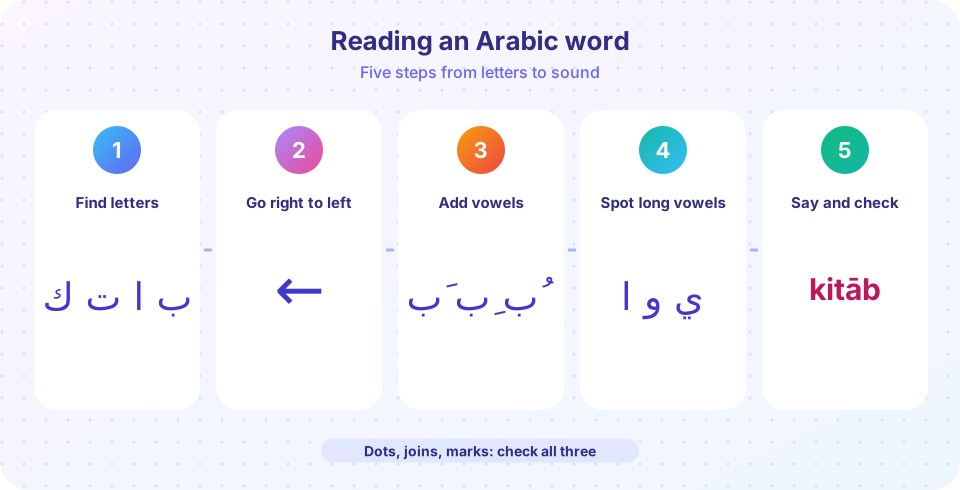
A decoding routine
When a new word appears, say these five things silently, in order.
- Letters: "These letters, with these joins, and these dots."
- Direction: "Starting from the right."
- Short vowels: "A fatḥa here, a sukūn there, a shadda on this one."
- Length and specials: "This alif is long; this ء is a hamza; this ة is a feminine ending."
- Sound: "Say it, check it, link it to its meaning."
Take مُعَلِّمَة: letters م ع ل م ة; right to left; ḍamma, fatḥa, kasra with shadda, then the ة; so mu-ʿal-li-ma, "female teacher". Because it ends in ة, it is feminine, a fact that will matter in the next chapter.
Mistakes to watch for
- Reading left to right. The first letter is on the right.
- Missing a dot. A single dot can turn ب into ن or ت.
- Forgetting the break after a non-joiner. The gap is not a space.
- Shortening a long vowel or lengthening a short one.
- Ignoring a shadda. It changes both sound and meaning.
- Confusing ة and ه, or ى and ي.
How to practice reading every day
Reading is a skill built from repetition. A good daily routine takes ten minutes: choose five words from this chapter, read each aloud twice, write each by hand once, and then cover the transliteration to see if you can read the word from the script. When you can do that with 50 words, you will be surprised by how fast you read a whole line. Keep a small list of words you got wrong and give them an extra pass at the start of your next session.
Try it
Press Run (or Ctrl + Enter) to see the result here.
Program input · what you'd type while the program runs
Type the answers before you press Run, one per line. Each time the program reads a line (with input()), it gets the next line from this box.
The report counts how many of the short marks are followed by the matching long-vowel letter, which is exactly how you spot a long vowel when reading: a fatḥa before ا, a kasra before ي or a ḍamma before و.
Common misconceptions
"If I can read vowelled words, I can read newspapers." Newspapers omit the vowels, so you also need vocabulary. That is the job of the next chapters.
"I can skip handwriting because I will type." Writing by hand builds recognition of forms faster than any other method.
"Mistakes with hamza mean I do not know Arabic." Even educated native speakers check hamza spelling. Focus on recognizing, then spelling.
Check your understanding
Quick check · 10 questions
of 10 answered You scored / 10 · perfect!
-
1. In بيت, what form does the ب take?
It begins the word and joins forward to ي, so it takes the start form. -
2. Which sequence makes the long vowel ī?
Kasra followed by yā' is ī. -
3. How is أُمّ read?
Hamza with ḍamma gives u, and the shadda doubles the m: umm. -
4. What does كِتَابٍ end with?
The doubled kasra is -in. -
5. Which letter is the glottal stop?
Hamza is the glottal stop; ʿayn is a pharyngeal. -
6. Which letters join only to the letter before them?
These six are the non-joiners. -
7. How is the last sound of عَلَى read?
Alif maqṣūra is read ā. -
8. What does the shadda mean?
The shadda doubles the consonant. -
9. Why is ة a clue to feminine nouns?
Tā' marbūṭa ends most feminine nouns and adjectives. -
10. Which pair of words differs only by the length of a vowel?
Kataba has short a; kātib has ā. Length changes the word.
Summary
- A letter's form depends on whether it joins backward, forward, both or neither.
- Short vowels are marks; long vowels are marks plus ا ي و; sukūn and shadda adjust syllables.
- Tanwīn adds -un, -an or -in to indefinite nouns.
- Hamza is a consonant with seats; ة is the feminine ending; ى is a final ā.
- The five-step routine decodes any vowelled word.
Track your progress
Create a free account to tick off lessons and pick up where you left off on any device.
of Arabic for Beginners lessons completed