


















Lesson 12 of 45 · Reading and Writing
Joining Letters: The Four Forms
Learn how Arabic letters join and change shape: the four forms, the six non-joiners, the lam-alif ligature, a full forms table and handwriting tips.
Arabic is written the way cursive English is written: letters are linked in one flowing movement. Unlike cursive English, the linking is mandatory, even in print, and each letter changes shape depending on whether it joins to the letter before it, the letter after it, both or neither. This lesson explains the rules so well that you will be able to predict the shape of a letter you have never seen in a particular position. That is the key skill for reading new words.
What you will learn
- How the four forms (alone, start, middle, end) are chosen.
- How to predict a form from the letter's neighbors.
- Why six letters never join forward.
- How the lām-alif ligature works.
- How to write joined words on a baseline.
Key terms
Isolated (alone): a letter with no neighbors it can join to.
Initial (start): joins to the next letter only.
Medial (middle): joins to both neighbors.
Final (end): joins to the previous letter only.
Ligature: two letters fused into one special shape, as in لا.
Kashīda / taṭwīl: a stretched horizontal connecting stroke (ـ), used to lengthen words for calligraphy or to justify lines.
The rule of the four forms
In a word, each letter looks at its two neighbors. In reading order (right to left), "before" means the letter to the right and "after" means the letter to the left.
| Joins to the letter before? | Joins to the letter after? | Form |
|---|---|---|
| no | no | alone |
| no | yes | start (initial) |
| yes | yes | middle (medial) |
| yes | no | end (final) |
A letter at the start of a word has no letter before it, so it is initial (or alone if it cannot join forward). A letter at the end has no letter after it, so it is final (or alone if the previous letter cannot join).
Take كتاب (kitāb): ك has no letter before and joins to ت, so it takes the start form; ت joins both sides: middle; ا joins to ت but cannot join forward: end; ب follows a non-joiner and has no letter after it: alone. That is why the printed word looks like two chunks, كتا and ب.
The six non-joiners
As Chapter 2 showed, the six letters ا د ذ ر ز و connect to the letter before them but never to the one after. They have only two forms, the isolated form and the end form (which is the same shape with a connecting stroke on the right). Here is how they appear in the word دَارَ (a form of dār, "house"): د is alone because it cannot join forward; ا follows a non-joiner so it is alone as well (it just looks like itself); ر follows ا (also a non-joiner), so it is alone too. The three letters are separate, written one after the other with small gaps.
Many shapes, one idea
Join the letters on the baseline: the line along which a word is written. Letters in the ba family (ب ت ث ن ي) show the join as a small upward "tooth" in the middle of a word. So the word بَيْت (bayt) is: ب (start tooth, one dot below), ي (middle tooth, two dots below), ت (end bowl, two dots above). In the middle position these letters all look the same, tiny teeth on the line, and only the dots tell them apart. That is why dot counts matter so much when reading.
Other letters make bigger changes:
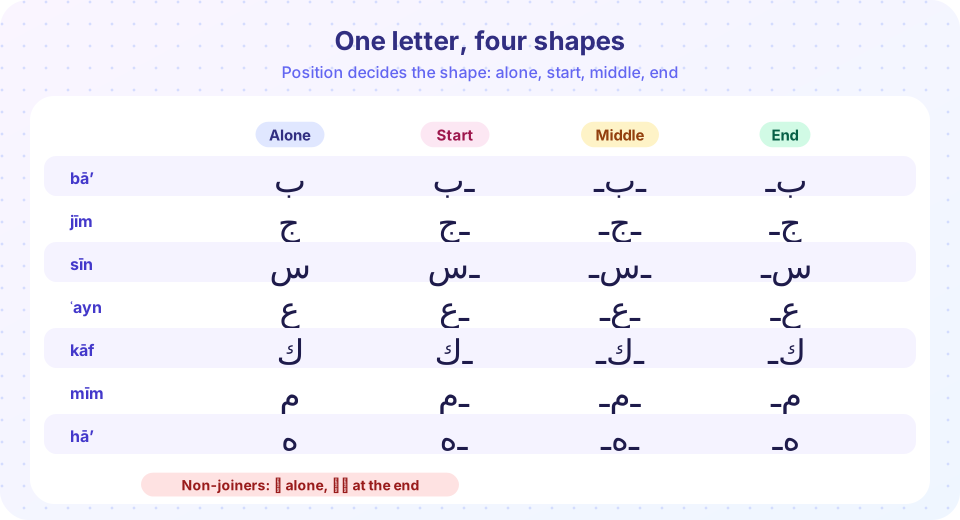
- ع غ (ʿayn, ghayn): the head becomes a small triangle at the start and middle, and the end form is a hook.
- ه (hā’): four very different forms: the loop (alone), a tiny knot (start), a figure-eight-like loop (middle) and a small hump (end).
- ك (kāf): the end form keeps the tall stroke and the zigzag; the start and middle forms are shorter.
- س ش (sīn, shīn): three teeth on the line in start and middle forms; a flowing tail at the end.
- ف ق (fā’, qāf): a small round head at start and middle; the end form has a tail.
- ي (yā’): the end form is a long swoop that curves back under the line, with two dots below.
Lām-alif: the one forced ligature
When ل is followed by ا, the two letters must fuse into لا. You never write ل ا apart. The ligature is read "lā", as in لَا ("no"). In the middle or at the end of a word it connects to the previous letter: for example سَلَام (salām, "peace") ends with the pair ـلام, where the lām and alif cross as a single shape. Do not confuse it with the definite article ال, which has the opposite order (alif first, then lām) and needs no ligature.
The complete forms table
Use this table as a reference, not something to memorize at once. The mark ـ (kashīda) simply shows where the letter connects.
| Alone | Start | Middle | End |
|---|---|---|---|
| ا | same as alone | same as end | ـا |
| ب | بـ | ـبـ | ـب |
| ت | تـ | ـتـ | ـت |
| ث | ثـ | ـثـ | ـث |
| ج | جـ | ـجـ | ـج |
| ح | حـ | ـحـ | ـح |
| خ | خـ | ـخـ | ـخ |
| د | same as alone | same as end | ـد |
| ذ | same as alone | same as end | ـذ |
| ر | same as alone | same as end | ـر |
| ز | same as alone | same as end | ـز |
| س | سـ | ـسـ | ـس |
| ش | شـ | ـشـ | ـش |
| ص | صـ | ـصـ | ـص |
| ض | ضـ | ـضـ | ـض |
| ط | طـ | ـطـ | ـط |
| ظ | ظـ | ـظـ | ـظ |
| ع | عـ | ـعـ | ـع |
| غ | غـ | ـغـ | ـغ |
| ف | فـ | ـفـ | ـف |
| ق | قـ | ـقـ | ـق |
| ك | كـ | ـكـ | ـك |
| ل | لـ | ـلـ | ـل |
| م | مـ | ـمـ | ـم |
| ن | نـ | ـنـ | ـن |
| ه | هـ | ـهـ | ـه |
| و | same as alone | same as end | ـو |
| ي | يـ | ـيـ | ـي |
A good approach is to learn the shapes of the end and start forms first, because they cover the beginning and the end of every word, which is where you most often start reading.
Handwriting tips
- Start at the right. Move your pen right to left along the baseline.
- Connect, don't lift. Finish the whole joined block before lifting the pen.
- Add dots and marks last. After you have written the word, add dots, then vowel marks.
- Keep letters to the same height. Tall letters (ا ل ك ط ظ) rise above the line; many others sit on or below it.
- Slow down at first. Copy ten examples slowly rather than a hundred quickly.
Three worked examples
It helps to run the rule on real words before you try the table. مَدْرَسَة (madrasa) has the letters م د ر س ة. م has nothing before it and joins to د, so it is in its start form. د joins to م but not forward, so it is a final form. ر follows د, a non-joiner, so nothing connects to its right; and ر cannot join forward either, so it is alone. س follows ر, again a non-joiner, so it starts a new group and joins to ة, which takes its final form. The word therefore looks like three pieces: مد · ر · سة.
مَكْتَبَة (maktaba, "library") has م ك ت ب ة, and none of the letters is a non-joiner, so all five connect in one flowing line: start, middle, middle, middle, end. وَرْدَة (warda, "rose") begins with و and ر, both non-joiners. و is alone, ر is alone, د is alone (it follows a non-joiner and cannot join forward), and ة, which follows the non-joiner د, is written alone as well. All four letters stand apart: و · ر · د · ة.
When you have trouble reading a long word, mark the places where it breaks into groups. That is much easier than trying to read letter by letter.
Try it
Press Run (or Ctrl + Enter) to see the result here.
Program input · what you'd type while the program runs
Type the answers before you press Run, one per line. Each time the program reads a line (with input()), it gets the next line from this box.
The program applies exactly the table in the lesson: a letter joins backward if the previous letter is a joiner, and joins forward if it is a joiner itself and has a next letter.
Common misconceptions
"Letters in the middle look completely different." They keep their body. Compare ب in بـ ـبـ ـب: the dot and the tooth stay.
"I can write ل then ا separately." Never. The lām-alif pair is always the ligature لا.
"Gaps in a word mean a space." A small gap after a non-joiner is inside one word. True spaces are wider.
Check your understanding
Quick check · 5 questions
of 5 answered You scored / 5 · perfect!
-
1. In كتاب, what form does ك take?
It begins the word and joins forward to ت, so it takes the start form. -
2. Why is the ب at the end of كتاب written in its alone form?
Alif is a non-joiner, so nothing connects to the ب that follows. -
3. What is لا?
Lām followed by alif must be written as the fused shape لا. -
4. How many forms do the six non-joiners have?
They only have the alone and end forms. -
5. In the middle of a word, which feature separates ب ت ث ن ي?
All have the same little tooth in the middle, so only the dots tell them apart.
Summary
- Each letter has up to four forms; the form depends on whether it joins before and after.
- ا د ذ ر ز و join only to the letter before them.
- ل + ا always becomes the ligature لا.
- ب ت ث ن ي look alike in the middle of a word; only the dots tell them apart.
- Write right to left on a baseline, then add dots and marks.
Track your progress
Create a free account to tick off lessons and pick up where you left off on any device.
of Arabic for Beginners lessons completed