


















Lesson 24 of 45 · Present Tense Verbs
Present Tense Conjugation
Conjugate regular Arabic verbs in the present tense: prefixes, endings and stem vowels for I, you, he, she, we and they, with drills.
In English you learn write, writes, writing, wrote as four separate words. In Arabic you learn one root and a handful of rules, and the rules do the rest. This lesson shows the complete recipe for the present tense of regular verbs. Once you can conjugate كَتَبَ (kataba, to write), you can conjugate hundreds of verbs that behave the same way.
We will build one word, يَكْتُبُ (yaktubu, he writes), step by step. Then we will change the prefix and the ending to reach every other person. The recipe never changes; only the pieces you plug in do.
What you will learn
- The four-step recipe for building a present-tense verb
- The prefixes and endings for all ten person forms (and a word about the dual)
- How to pick the right stem vowel, and why you learn verbs in pairs
- How to avoid the classic mix-ups: تَـ for "you" and "she", masculine versus feminine "you"
Key terms
Stem vowel (ḥarakat ʿayn al-fiʿl): the short vowel on the middle root letter in the present tense: u, a or i.
Sukun (ـْ): the small circle that shows a consonant has no vowel after it.
Person: who is acting. First person is "I/we", second is "you", third is "he/she/they".
Masculine plural ending (ـُونَ): the ending -ūna that marks "you all (men)" and "they (men)".
The four-step recipe
Start from the root letters. For write they are ك (k), ت (t), ب (b). The present tense for "he" is built like this:
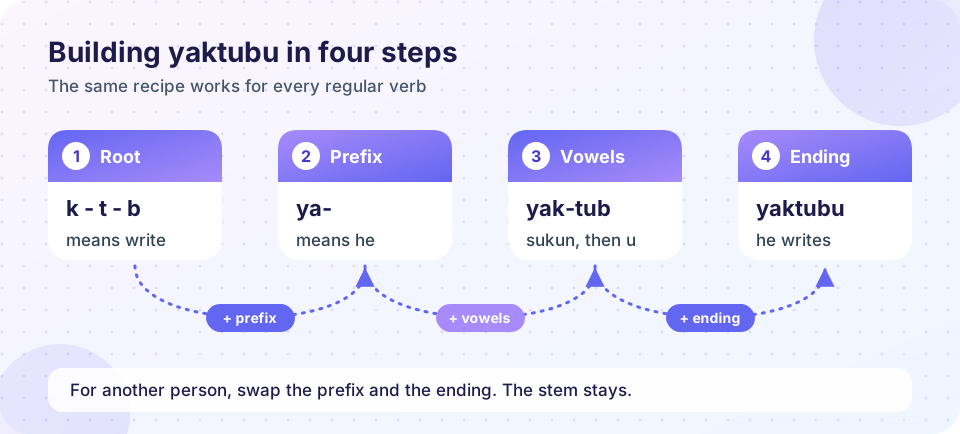
- Take the root: k-t-b.
- Add the prefix for the person. For "he" it is يَـ (ya-).
- Fit the vowels: the first root letter gets a sukun (no vowel), the middle letter gets the stem vowel (here damma, u), and the last letter takes the ending.
- Add the ending. For "he" it is a final damma, ـُ (-u).
Result: يَ + كْ + تُ + بُ = يَكْتُبُ (yaktubu). Notice the shape of the middle: a prefix with a short a, then a closed syllable (yak-), then tu-bu. Read it aloud a few times: yak-tu-bu.
All ten forms at a glance
Here is the full present tense of كَتَبَ. The Arabic pronoun is shown first, then the verb.
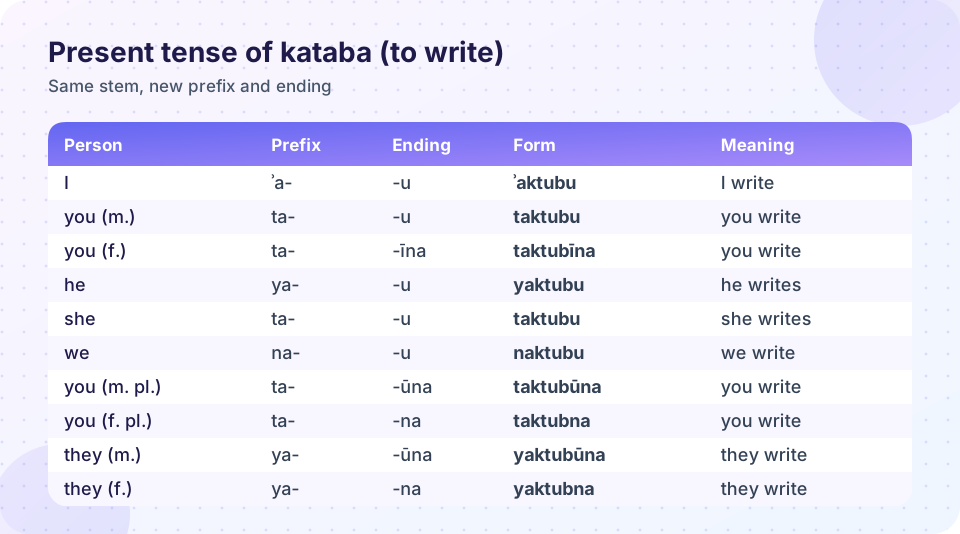
Look at what changes and what does not. The stem ـكْتُبـ (-ktub-) is identical in every row. Only the prefix at the front and the ending at the back move. That is why conjugation in Arabic is a matter of two small tags rather than a new word.
The four prefixes
| Prefix | Letter | Used for |
|---|---|---|
| أَـ (ʾa-) | alif with hamza | I |
| تَـ (ta-) | tāʾ | you (all forms), she |
| يَـ (ya-) | yāʾ | he, they |
| نَـ (na-) | nūn | we |
Notice that تَـ has two jobs: it shows you and she. تَكْتُبُ (taktubu) can mean "you (m.) write" or "she writes". Context and the pronoun tell you which. This is a good reason to keep saying the pronoun when you are unsure: هِيَ تَكْتُبُ (hiya taktubu, she writes).
The endings
Most forms end in a short -u (damma). Four forms have a special ending:
- أَنْتِ تَكْتُبِينَ (ʾanti taktubīna): you (f.) adds -īna, a long ī and a nūn.
- أَنْتُمْ تَكْتُبُونَ (ʾantum taktubūna) and هُمْ يَكْتُبُونَ (hum yaktubūna): masculine plural adds -ūna.
- أَنْتُنَّ تَكْتُبْنَ (ʾantunna taktubna) and هُنَّ يَكْتُبْنَ (hunna yaktubna): feminine plural adds a sukun and -na.
Masculine and feminine forms of "you" differ by only one vowel in writing (أَنْتَ with fatha, أَنْتِ with kasra), so be careful when you pronounce them. In unvowelled text the difference is carried by the verb ending: تَكْتُبُ against تَكْتُبِينَ.
The dual
Arabic has a special form for exactly two people: أَنْتُمَا تَكْتُبَانِ (ʾantumā taktubāni, you two write), هُمَا يَكْتُبَانِ (humā yaktubāni, the two of them write). You will meet it in reading, but everyday speech often uses the plural for two as well, so it is optional for now.
The stem vowel: learn verbs in pairs
The middle vowel is not fully predictable. English has a similar problem (sing, sang, sung but ring, rang, rung and bring, brought). Arabic dictionaries list a verb by two forms, the past "he" and the present "he", and you should learn them as a pair:
| Past (he) | Present (he) | Meaning | Stem vowel |
|---|---|---|---|
| كَتَبَ kataba | يَكْتُبُ yaktubu | write | u |
| دَرَسَ darasa | يَدْرُسُ yadrusu | study | u |
| ذَهَبَ dhahaba | يَذْهَبُ yadhhabu | go | a |
| فَتَحَ fataḥa | يَفْتَحُ yaftaḥu | open | a |
| شَرِبَ shariba | يَشْرَبُ yashrabu | drink | a |
| جَلَسَ jalasa | يَجْلِسُ yajlisu | sit | i |
| عَرَفَ ʿarafa | يَعْرِفُ yaʿrifu | know | i |
Two small patterns help. If the past has kasra in the middle (like شَرِبَ), the present almost always has fatha (يَشْرَبُ). If the past has fatha, the present can be any of the three. Whichever vowel you pick, the recipe for prefixes and endings stays exactly the same. A wrong stem vowel is understood by everyone, so do not let it stop you from speaking.
Verbs that do not fit the recipe
Some very common verbs bend the rules because one of their root letters is weak (و, ي, ء) or a hamza. Learn their present forms as separate items for now:
- أَكَلَ → يَأْكُلُ (yaʾkulu, eat); but "I eat" is آكُلُ (ʾākulu), with a long ā.
- قَرَأَ → يَقْرَأُ (yaqraʾu, read); the hamza spelling changes in some forms.
- قَالَ → يَقُولُ (yaqūlu, say).
- نَامَ → يَنَامُ (yanāmu, sleep).
- أَحَبَّ → يُحِبُّ (yuḥibbu, love, like).
- تَكَلَّمَ → يَتَكَلَّمُ (yatakallamu, speak).
- اشْتَرَى → يَشْتَرِي (yashtarī, buy).
Everything after the prefix is the same idea: prefix + stem + ending. You will just see the stem look a little different.
Sentences you can build now
- أَنَا أَدْرُسُ العَرَبِيَّة. (ʾanā ʾadrusu l-ʿarabiyya.) I study Arabic.
- هِيَ تَشْرَبُ القَهْوَة. (hiya tashrabu l-qahwa.) She drinks coffee.
- نَحْنُ نَسْكُنُ فِي المَدِينَة. (naḥnu naskunu fī l-madīna.) We live in the city.
- هُمْ يَلْعَبُونَ فِي الحَدِيقَة. (hum yalʿabūna fī l-ḥadīqa.) They (m.) play in the park.
- أَنْتِ تَفْتَحِينَ البَاب. (ʾanti taftaḥīna l-bāb.) You (f.) open the door.
Say each aloud and then cover the English. Notice that the verb comes right after the pronoun and agrees with it.
Worked example: from a root to a full sentence
Let us build she drinks tea from scratch so you can watch the recipe at work. First choose the verb. Drink is شَرِبَ / يَشْرَبُ (shariba / yashrabu), root ش-ر-ب (sh-r-b). Second choose the person: she uses the prefix تَـ (ta-) and the plain ending -u. Third build the stem: a sukun on the first root letter and the stem vowel of this verb, which is a fatha. The result is تَشْرَبُ (tashrabu). Finally add the rest of the sentence, the thing that is drunk: الشَّاي (ash-shāy). The pronoun is optional, so you may say تَشْرَبُ الشَّاي or, to stress who drinks, هِيَ تَشْرَبُ الشَّاي.
Now change one ingredient at a time and watch what moves. For they (f.) drink tea you choose يَـ and the ending ـْنَ: يَشْرَبْنَ الشَّاي. For you (f.) drink tea you choose تَـ and ـِينَ: تَشْرَبِينَ الشَّاي. The stem -shrab- stays exactly the same. This habit of changing one ingredient at a time is the fastest way to internalize conjugation, much faster than staring at a table. Try it with five different verbs a day and you will soon feel the pattern in your mouth.
Listening for the pattern
Because the prefix opens the word, a listener hears the person at once, which is why Arabic speakers often leave the pronoun out. When you listen to Arabic, train your ear on the very first sound of the verb: a short ʾa means I, na means we, and ya or ta are the two you must separate with context. Then listen to the end of the word: a long -ūna tells you "they or you all (men)", while -na after a sukun tells you the group is women. Together these two clues give you the whole subject before the verb has even finished.
Common misconceptions
"The prefix ta- always means you." It also means she. تَكْتُبُ alone is ambiguous; the pronoun or context settles it.
"Every masculine plural verb ends in -ūna with a silent alif." In the present tense, -ūna has no silent alif: يَكْتُبُونَ. The silent alif appears in the past tense (كَتَبُوا) and in some other moods.
"I must always say the pronoun." You do not. أَكْتُبُ already means I write. Add أَنَا only to stress or contrast.
Try it
Pick any verb from the list and switch between present and past. Turn on test mode, say the form aloud, and click to reveal it.
The next TryIt is a small Python program that applies the same rules. It is a stand-in conjugator that handles regular three-letter verbs only. Change the root and the vowels to see other verbs.
Press Run (or Ctrl + Enter) to see the result here.
Program input · what you'd type while the program runs
Type the answers before you press Run, one per line. Each time the program reads a line (with input()), it gets the next line from this box.
Finally, choose the correct form for each sentence.
Check your understanding
Quick check · 5 questions
of 5 answered You scored / 5 · perfect!
-
1. What is the present-tense form of كَتَبَ for "we"?
We is formed with the prefix na- and the ending -u: naktubu, نَكْتُبُ. -
2. Which pronoun does تَكْتُبِينَ (taktubīna) match?
The ending -īna marks the feminine singular "you": ʾanti taktubīna. -
3. How do you learn the stem vowel of a verb?
The stem vowel (u, a or i) is not fully predictable, so dictionaries and teachers give both forms together, such as kataba / yaktubu. -
4. What does هُنَّ يَكْتُبْنَ mean?
The feminine plural ending is a sukun plus -na, and hunna is the feminine "they". -
5. Which form means "I eat" (a special verb)?
Hamzated verbs such as akala merge the two hamzas into a long ā: ʾākulu, آكُلُ.
Summary
- Present tense = prefix + stem + ending; the stem (-ktub-) stays the same.
- The four prefixes are أَـ (I), تَـ (you, she), يَـ (he, they), نَـ (we).
- Special endings: -īna (you f.), -ūna (masculine plural), -na (feminine plural).
- Learn verbs as a pair (past he / present he) so you know the stem vowel.
- Weak and hamzated verbs look a little different; learn them as separate items.
Next: Negation and wishes
Track your progress
Create a free account to tick off lessons and pick up where you left off on any device.
of Arabic for Beginners lessons completed