


















Lesson 4 of 46 · Getting Started
Capacitors and the RC time constant
Understand how a capacitor charges and discharges through a resistor, what the time constant RC means, and how to predict any point on the curve.
Resistors respond instantly: change the voltage and the current follows at once. Capacitors do not. A capacitor stores energy in an electric field, and moving charge on or off it takes time. Put a resistor in the path and you get one of the most important behaviors in electronics: an exponential approach to a final value, with a speed set by a single number, the time constant τ = R·C.
The RC circuit appears everywhere: timers, debouncing switches, filters (chapter 7), coupling capacitors in amplifiers (chapter 5), and the gate of every MOSFET. Learn this one curve well.
What you will learn
- What a capacitor does and how current relates to the rate of change of voltage
- The charging and discharging equations of an RC circuit
- What the time constant means, and the 63 %, 86 %, 95 % and 99 % rules
- How to estimate rise time and how long you must wait for a circuit to settle
- How energy behaves when a capacitor charges
Key terms
Capacitance (C): charge stored per volt, in farads (F). Typical parts are pF to mF.
Time constant (τ): τ = R·C, in seconds. It sets how fast an RC circuit changes.
Transient: the temporary behavior of a circuit after something changes, before it settles.
Steady state: the final condition after all transients have died away.
Step response: the output when the input jumps suddenly from one value to another.
What a capacitor does
A capacitor is two conductors separated by an insulator. If you push charge Q onto one plate (and take it off the other), a voltage V = Q/C appears between them. The capacitance C is a property of the geometry and the insulating material. Differentiating, the current into a capacitor is
i = C · dv/dt
Read this in words: current flows only while the voltage is changing, and the faster it changes, the more current flows. Two consequences follow, and they are worth memorizing:
- In steady state with constant (DC) voltage, dv/dt = 0, so no current flows. A capacitor then looks like an open circuit. This is why a capacitor blocks DC.
- At the instant of a sudden voltage step, the capacitor voltage cannot jump (that would need infinite current), so an uncharged capacitor momentarily looks like a short circuit.
Charging through a resistor
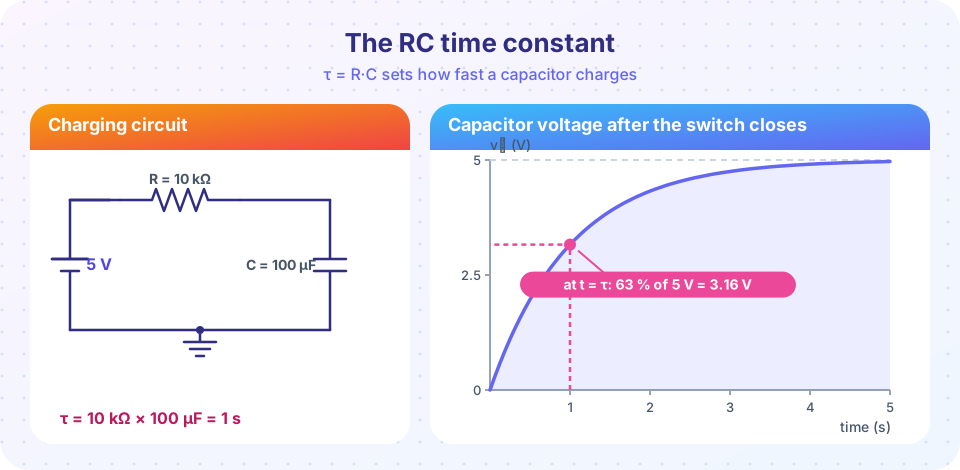
Connect a source V_s in series with a resistor R and an initially empty capacitor C. When the switch closes, the capacitor is at 0 V, so the full source voltage appears across R and the current starts at V_s/R. As the capacitor charges, its voltage rises, the voltage across R falls, and so does the current. Writing KVL: V_s = i·R + v_C, with i = C·dv_C/dt. The solution is
v_C(t) = V_s × (1 − e^(−t/τ))        τ = R·C
i(t)   = (V_s / R) × e^(−t/τ)
Take the circuit in the figure: V_s = 5 V, R = 10 kΩ, C = 100 µF. Then τ = 10 000 Ω × 0.0001 F = 1 s. The initial current is 5 V / 10 kΩ = 0.5 mA.
| Time | Fraction of final voltage | Capacitor voltage |
|---|---|---|
| 1 τ | 63.2 % | 3.16 V |
| 2 τ | 86.5 % | 4.32 V |
| 3 τ | 95.0 % | 4.75 V |
| 4 τ | 98.2 % | 4.91 V |
| 5 τ | 99.3 % | 4.97 V |
Notice the pattern: in every time constant the circuit closes about 63 % of the remaining gap to its final value. The curve never quite arrives, so engineers use a practical rule: after about 5τ the circuit has settled to within 1 %. Our circuit needs about 5 seconds.
Two more handy numbers: the 10 %-to-90 % rise time is t_r = 2.2·τ (exactly ln 9 ≈ 2.197), and the time to reach half of the final value is 0.693·τ.
Discharging
If the capacitor starts at V₀ and is allowed to discharge through R (with the source removed), the voltage decays toward zero:
v_C(t) = V0 × e^(−t/τ)
After one τ it is at 36.8 % of the starting value; after 5τ it is below 1 %. The same time constant governs both directions, because it depends only on R and C. A bigger R (less current) or a bigger C (more charge to move) makes everything slower.
Energy
A capacitor charged to V holds E = ½·C·V². Ours stores ½ × 100 µF × 25 V² = 1.25 mJ. When charged from a constant voltage source through a resistor, the source supplies C·V² (twice that); exactly half goes into the capacitor and half is turned into heat in the resistor, whatever the value of R. The resistance only changes how long it takes, not how much heat is made.
Using the RC circuit
- Delay and timing: a 555 timer or a microcontroller reset pin waits for a capacitor to reach a threshold. The delay is roughly τ times a factor that depends on the threshold.
- Switch debouncing: a small RC smooths the chatter of a mechanical switch.
- Filtering: an RC circuit passes slow changes and smooths fast ones. Its corner frequency is f_c = 1/(2π·R·C). For our values, f_c = 1/(2π × 1 s) = 0.159 Hz. Chapter 7 develops this fully.
- Coupling and bypass: capacitors pass the signal but block DC, as in amplifier input stages.
Common misconceptions
"The capacitor is full after one time constant." After one τ it is only at 63 %. Allow about 5τ to settle.
"A bigger resistor means more heat." Charging a capacitor from a voltage source always dissipates ½CV² in the resistor, regardless of its value.
"A capacitor stores current." It stores charge (and energy). Current is the flow of charge onto or off the plates.
Try it
First, an interactive RC explorer. Change R and C and watch τ and the charging curve move. The vertical marker shows one time constant.
Second, a numerical experiment. Computers solve circuit transients by stepping through time. This code charges and then discharges the capacitor with a simple step-by-step update and compares it with the exact formula. Try a larger time step and see the small error grow.
Press Run (or Ctrl + Enter) to see the result here.
Program input · what you'd type while the program runs
Type the answers before you press Run, one per line. Each time the program reads a line (with input()), it gets the next line from this box.
Check your understanding
Quick check · 5 questions
of 5 answered You scored / 5 · perfect!
-
1. What is the time constant of a 22 kΩ resistor with a 4.7 µF capacitor?
τ = R·C = 22 000 × 4.7×10⁻⁶ = 0.1034 s, about 103 ms. -
2. A capacitor charges from 0 V toward 10 V. What is its voltage after one time constant?
After one τ it has covered 63.2 % of the way: 6.32 V. -
3. Roughly how many time constants until an RC circuit has settled to within 1 % of its final value?
At 5τ the circuit is at 99.3 % of its final value. -
4. Which statement about a capacitor in DC steady state is correct?
With constant voltage dv/dt is zero, so i = C·dv/dt is zero: the capacitor blocks DC. -
5. A capacitor is charged to 12 V through a resistor. Doubling R changes the heat produced in R by what factor?
The heat is ½CV² for any R. Larger R only slows the charging.
Summary
- A capacitor's current is i = C·dv/dt: it passes changes and blocks steady DC.
- Charging: v = V_s(1 − e^(−t/τ)); discharging: v = V₀e^(−t/τ); τ = R·C.
- After 1τ the circuit is 63 % of the way; settle time is about 5τ; rise time is about 2.2τ.
- A charged capacitor stores ½CV²; charging through R wastes the same amount as heat.
- RC circuits make timers, filters and coupling networks.
Next: Chapter 1 review
Track your progress
Create a free account to tick off lessons and pick up where you left off on any device.
of Analog Electronics lessons completed