


















Lesson 10 of 46 · Diodes and Rectifiers
Chapter 2 review: Diodes and Rectifiers
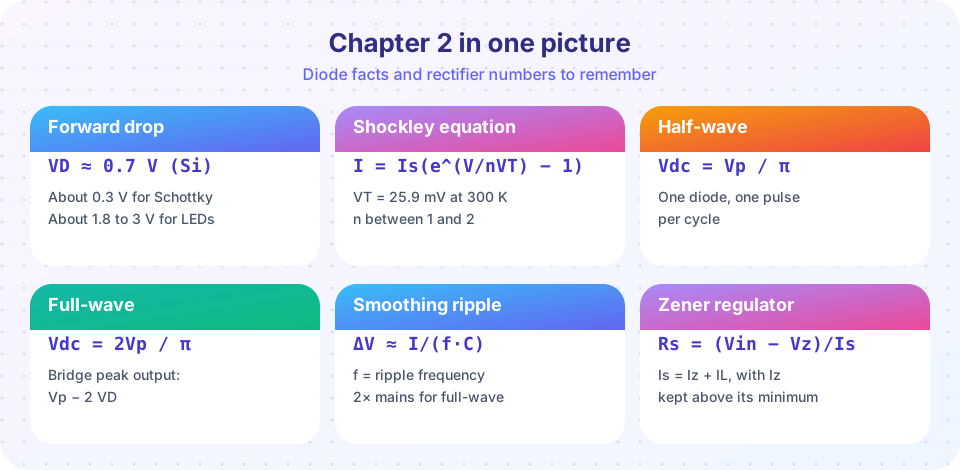
Review the diode curve, models, rectifiers, smoothing, Zener regulators and clippers with a one-page summary picture, recap table and a ten-question quiz.
You met your first nonlinear component in this chapter. A diode's current is an exponential function of its voltage, which is why a few simple models (ideal, constant 0.7 V drop, exact load line) are enough for nearly all work. You then used diodes to build rectifiers with smoothing capacitors, Zener regulators, clippers and protection circuits. This review collects the formulas, shows where each fits, and tests the whole chapter.
What you will learn
- Which model and formula fits each diode problem
- How the chapter's circuits relate to the one diode curve
- Where you need more practice, from a ten-question mixed quiz
Recap table
| Lesson | Key idea | Formula or rule | Watch out for |
|---|---|---|---|
| p-n junction and models | Exponential I–V curve; forward drop of about 0.7 V | I = I_s(e^(V/nV_T) − 1); 60 mV per decade | Drop falls about 2 mV/°C; Schottky and LED values differ |
| Rectifier circuits | Convert AC to pulsing DC; smooth with a capacitor | V_dc = V_p/π (half), 2V_p/π (full); ripple ≈ I/(f_r C) | Bridge drops two diodes; current flows in short pulses |
| Zeners and clippers | Breakdown gives a constant voltage; diodes limit and protect | R_s = (V_in − V_z)/I_s; I_z = I_s − I_L | Check both worst cases; use flyback diodes on coils |
The one idea behind it all
Every circuit in the chapter is the diode curve in a different costume. A rectifier uses the forward half (conduct) and the reverse half (block). A clipper uses the sharp forward knee as a voltage limit. A Zener uses the reverse breakdown knee as a voltage limit. A flyback diode uses the forward half to give current somewhere to go. If you can sketch the curve and mark the 0.7 V point on it, you can reason about any of them.
When a new diode circuit appears, run the loop from the overview: guess on or off, substitute the model, solve, check the guess.
Common misconceptions
"All diodes drop 0.7 V." Silicon rectifiers and signal diodes do; Schottky diodes drop about 0.3 V, and LEDs drop 1.8 V or more.
"The capacitor makes the rectifier output the RMS value." The smoothed output sits just below the peak.
"A Zener works like a battery at any current." It needs a minimum current to stay in breakdown and a maximum to stay within its power rating.
Try it
First, a table-driven design checker. Enter a transformer voltage, load current and ripple target and see the capacitor value and diode rating for a bridge supply.
Press Run (or Ctrl + Enter) to see the result here.
Program input · what you'd type while the program runs
Type the answers before you press Run, one per line. Each time the program reads a line (with input()), it gets the next line from this box.
Second, an interactive picture of the four lessons in one: an input sine, a choice of circuit, and the output waveform. Pick the circuit and compare.
Check your understanding
Quick check · 10 questions
of 10 answered You scored / 10 · perfect!
-
1. A silicon diode and a 330 Ω resistor are in series with a 5 V source. Using the constant-drop model, what is the current?
I = (5 − 0.7)/330 = 13.0 mA. -
2. By how much does a silicon diode's forward voltage change per degree of warming (at constant current)?
Roughly −2 mV/°C because I_s grows quickly with temperature. -
3. The ideal average output of a full-wave rectified sine with peak 10 V is about:
V_dc = 2V_p/π = 6.37 V. -
4. A bridge rectifier gets a 24 V peak sine. What is the peak of its unsmoothed output (silicon diodes)?
Two diodes conduct: 24 − 1.4 = 22.6 V. -
5. Ripple on a full-wave supply at 60 Hz mains with I = 120 mA and C = 1000 µF is about:
f_r = 120 Hz: ΔV = 0.12/(120 × 0.001) = 1.0 V. -
6. Why do rectifier diodes with smoothing capacitors need a high peak-current rating?
They only conduct near the peaks, so the pulse current is several times the average. -
7. A 9.1 V Zener is fed from 15 V through 560 Ω. What is the current in the Zener with no load?
I = (15 − 9.1)/560 = 10.5 mA. -
8. What does r_z (dynamic resistance) tell you about a Zener?
ΔV = r_z × ΔI: the smaller r_z, the steadier the regulated voltage. -
9. What protects a transistor from a relay coil's voltage spike?
A flyback diode across the coil gives the coil current a safe path. -
10. Which circuit shifts the DC level of a waveform without changing its shape?
A capacitor plus a diode clamps a waveform's peak to a fixed level.
Summary
- The diode's exponential curve gives a roughly constant forward drop; model it as ideal, constant-drop or by load line.
- Rectifiers convert AC to pulsing DC; capacitors smooth it with ripple ≈ I/(f_r·C).
- Zener regulators need a series resistor sized for the worst cases at both input and load limits.
- Clippers limit amplitude, clampers shift level and flyback diodes protect against inductive spikes.
Track your progress
Create a free account to tick off lessons and pick up where you left off on any device.
of Analog Electronics lessons completed