


















Lesson 5 of 46 · Getting Started
Chapter 1 review: Getting Started
Review Ohm's law, Kirchhoff's laws, voltage dividers, Thévenin equivalents and RC circuits with a recap table, a one-page picture and a ten-question quiz.
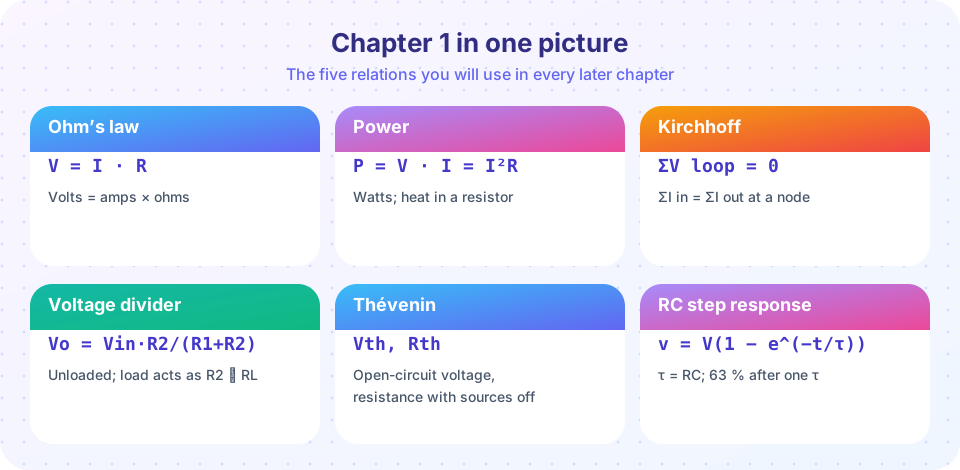
You now have the toolkit that every later chapter assumes: Ohm's law and power, Kirchhoff's two laws, dividers and Thévenin equivalents, and the exponential behavior of an RC circuit. Diodes, transistors and op amps will add new component equations, but you will keep using these tools to connect them. This review pulls the chapter into one picture, one table and one quiz, so you can see what you know and what to revisit.
What you will learn
- Which formula to reach for in each type of problem
- How the chapter's ideas connect to each other
- Where your gaps are, using a ten-question mixed quiz
Recap table
| Lesson | Key idea | Formula or rule | Watch out for |
|---|---|---|---|
| Ohm's law and Kirchhoff | Voltage, current and power in resistive circuits | V = IR, P = VI, ΣV = 0 around loops, ΣI in = ΣI out at nodes | Voltage is across, current is through; check resistor power ratings |
| Dividers and Thévenin | A load changes the output; any linear network is one source plus one resistor | V_out = V_in·R₂/(R₁+R₂); V_th, R_th | The divider formula ignores loads; R_th is found with sources off |
| RC time constant | Capacitors change gradually | v = V(1 − e^(−t/τ)), τ = RC | One τ is 63 %, not 100 %; settle in about 5τ |
How the pieces connect
KCL and KVL are the foundation: every other tool is a shortcut built on them. The divider is KVL plus Ohm's law applied to two resistors. Thévenin's theorem says every linear network you will ever see at a pair of terminals is a divider in disguise. The RC circuit is KVL again, but with a capacitor whose current depends on how fast its voltage changes, which turns the algebra into an exponential.
When you meet a new circuit, ask in order:
- Where is ground, and which nodes are unknown? (Node voltages.)
- Is it a divider? (Check whether a load is attached.)
- Can I simplify what I see from the terminals I care about? (Thévenin.)
- Does anything store energy? (Then there is a time constant.)
Common misconceptions
"Resistors in series share the same voltage." They share the same current. Parallel resistors share the same voltage.
"Thévenin's theorem works for any circuit." It works for linear circuits. A diode or a transistor must first be replaced by a linear model for the operating region you care about, which is exactly what later chapters do.
"Capacitors charge in 1τ." They are at 63 % after 1τ and need roughly 5τ to settle.
Try it
First, a self-check in code. This mini problem set solves a divider, a Thévenin load and an RC timing question, so you can compare with your own paper answers.
Press Run (or Ctrl + Enter) to see the result here.
Program input · what you'd type while the program runs
Type the answers before you press Run, one per line. Each time the program reads a line (with input()), it gets the next line from this box.
Second, a drill on metric prefixes. Slow down on unit conversions: most beginner mistakes in electronics are factor-of-1000 errors.
Check your understanding
Quick check · 10 questions
of 10 answered You scored / 10 · perfect!
-
1. A 220 Ω resistor carries 20 mA. What is the voltage across it?
V = I·R = 0.020 × 220 = 4.4 V. -
2. Which power rating is the minimum safe choice for a 100 Ω resistor with 12 V across it?
P = V²/R = 144/100 = 1.44 W. Parts rated below 1.44 W would overheat, so 2 W is the smallest standard choice here. -
3. Three loop voltages are +9 V, −2 V and −x. What is x?
KVL: 9 − 2 − x = 0, so x = 7 V. -
4. A node has 4 mA entering and two wires leaving, one carrying 1.5 mA. What does the other carry?
KCL: 4 = 1.5 + x, so x = 2.5 mA. -
5. Two resistors of 1 kΩ and 3 kΩ are in parallel. What is the total resistance?
R = (1k × 3k) / (1k + 3k) = 750 Ω. -
6. A 5 V supply feeds a divider of 2 kΩ over 3 kΩ (output across the 3 kΩ). What is the unloaded output?
V_out = 5 × 3/(2+3) = 3 V. -
7. Connecting a load equal to R₂ across the output of a divider does what to the output?
The load is in parallel with R₂, lowering the lower leg of the divider. -
8. A Thévenin source has V_th = 8 V and R_th = 2 kΩ. What load voltage appears across 6 kΩ?
V = 8 × 6/(2+6) = 6 V. -
9. An RC circuit has R = 1 kΩ and C = 10 µF. What is τ?
τ = 1000 × 10×10⁻⁶ = 0.01 s = 10 ms. -
10. After how long, in time constants, is a charging capacitor within about 1 % of its final voltage?
At 5τ the capacitor is at 99.3 % of the final value.
Summary
- Ohm's law, power and Kirchhoff's laws solve any resistor network.
- A divider's output assumes no load; a load acts in parallel with the lower resistor.
- A Thévenin equivalent (V_th, R_th) replaces any linear network at two terminals.
- RC circuits move exponentially with τ = RC; allow about 5τ to settle.
- Treat units carefully: kΩ with mA gives volts; µF with kΩ gives milliseconds.
Next: Chapter 2: the diode
Track your progress
Create a free account to tick off lessons and pick up where you left off on any device.
of Analog Electronics lessons completed