


















Lesson 6 of 46 · Diodes and Rectifiers
Chapter 2 overview: the diode
See the big picture of diodes and rectifiers: what a diode does, where it is used, and how the lessons in this chapter build from the junction to power supplies.
A resistor obeys a straight-line rule: double the voltage, double the current. A diode does not. It lets current through easily in one direction and blocks it almost completely in the other. That one-way behavior is the simplest example of a nonlinear component, and it is the reason your phone charger can turn the alternating current from a wall socket into the steady direct current that electronics need.
This chapter takes the diode from the inside (how a p-n junction works) to the outside (how to build rectifiers, regulators and clippers). It also introduces habits you will use for transistors: write a model, find the operating point, then check that your assumptions were true.
What you will learn
- What a diode is and why its current-voltage curve is not a straight line
- The main diode types and where each is used
- The map of this chapter, lesson by lesson
- How "model, solve, check" works as a problem-solving habit
Key terms
Diode: a two-terminal component that conducts mainly in one direction.
Anode and cathode: the two terminals. Conventional current flows from anode to cathode when the diode conducts. The stripe on a real diode marks the cathode.
Forward bias: the anode is more positive than the cathode; the diode conducts.
Reverse bias: the cathode is more positive; the diode blocks (apart from a tiny leakage).
Rectifier: a circuit that converts AC to a pulsing one-polarity voltage.
Where diodes live
Diodes are cheap, small and everywhere:
- Rectifiers in every wall adapter and power supply turn AC into DC.
- Zener diodes hold a voltage steady, used as references and protection.
- Light-emitting diodes (LEDs) convert current into light: indicators, displays, lighting.
- Photodiodes and solar cells convert light into current.
- Schottky diodes switch very fast and drop little voltage, used in efficient power supplies and radio.
- Protection diodes across relays, motors and inputs absorb spikes that would damage other parts.
- Signal diodes detect the envelope of radio waves in simple receivers.
Every one of these is a variation on the same junction physics. The first lesson shows where the curve comes from; the others put it to work.
The story in brief
Diodes began as vacuum tubes. John Ambrose Fleming patented the thermionic valve in 1904: a heated filament released electrons that could flow only toward a positively charged plate. Early radio also used crystal detectors, a thin wire touched against a mineral crystal, which are semiconductor diodes in disguise. The modern silicon p-n junction diode became standard after the transistor era began in the late 1940s, and today a diode costs a fraction of a cent.
Chapter map
Step 1: understand the junction
Step 2: model it
Step 3: build with it
Each circuit is the diode curve in disguise.
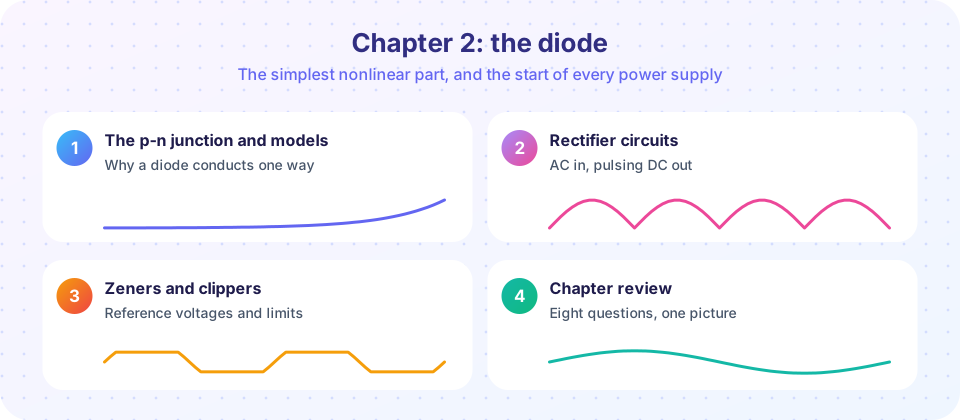
- The p-n junction and diode models: why current flows one way, the Shockley equation, and three models of increasing realism.
- Rectifier circuits: half-wave, full-wave and bridge rectifiers, ripple and smoothing capacitors.
- Zeners and clipping circuits: voltage regulation, clippers and protection.
- Chapter 2 review: a one-page picture and a ten-question quiz.
Model, solve, check
Because a diode is nonlinear, you cannot just write "V = I·R". The standard technique is:
- Guess whether the diode is on (forward biased) or off.
- Replace it with a simple model for that state (a short or a 0.7 V battery if on; an open circuit if off).
- Solve the now-linear circuit with the tools of chapter 1.
- Check the guess: if the diode is assumed on, the current must be positive; if off, the voltage across it must be below about 0.7 V. If the check fails, change the guess and repeat.
Hold on to this loop. Transistor circuits in chapters 3 and 4 follow the same pattern, with more states.
Common misconceptions
"A diode conducts as soon as the voltage across it is above zero." A silicon diode needs roughly 0.6 to 0.7 V forward before it conducts a useful current.
"A reverse-biased diode carries no current." It carries a tiny leakage current, often nanoamps, which rises with temperature.
"The diode voltage is exactly 0.7 V." It is about 0.7 V at milliamps of current, but changes with current and temperature. Schottky diodes and LEDs have different values.
Try it
First, a quick plot of the diode curve using the Shockley equation, on a linear and a logarithmic scale. The log scale shows that the current is exponential over many orders of magnitude.
Press Run (or Ctrl + Enter) to see the result here.
Program input · what you'd type while the program runs
Type the answers before you press Run, one per line. Each time the program reads a line (with input()), it gets the next line from this box.
Second, an interactive one-way valve. The input is an AC signal; the diode passes only the part that pushes current forward. Move the sliders to change the amplitude and the forward drop.
Check your understanding
Quick check · 4 questions
of 4 answered You scored / 4 · perfect!
-
1. Which terminal does the stripe on a diode mark?
The stripe marks the cathode, the terminal current flows toward when the diode conducts. -
2. Which is a nonlinear component?
Diode current is not proportional to voltage; it rises exponentially. -
3. What is the first step of the model, solve, check method?
You guess the state, use the matching simple model, solve and then verify the guess. -
4. Which diode type is designed to emit light?
An LED is a light-emitting diode; a photodiode does the reverse, converting light to current.
Summary
- A diode conducts mainly in one direction; its curve is exponential, not linear.
- Diodes appear in rectifiers, regulators, light sources, detectors and protection.
- Use "model, solve, check" for any nonlinear circuit.
- The chapter moves from the junction, to rectifiers, to Zeners and clippers.
Track your progress
Create a free account to tick off lessons and pick up where you left off on any device.
of Analog Electronics lessons completed