


















Lesson 34 of 46 · Filters and Oscillators
Oscillators: the Barkhausen criteria and the Wien bridge
Learn how an amplifier with positive feedback becomes a sine-wave oscillator: loop gain, phase, start-up, amplitude control, the Wien bridge, phase-shift and relaxation oscillators.
Every digital clock, radio transmitter, synthesizer and signal generator contains an oscillator: a circuit that creates a repeating signal from a steady DC supply. It seems like getting something from nothing, but there is no magic. An oscillator is an amplifier whose output is fed back to its own input through a frequency-selective network, and the loop is arranged so that it sustains itself at exactly one frequency.
You already have both ingredients from this chapter: an amplifier (the op-amp with gain set by two resistors) and a filter (an RC network with a defined response). This lesson combines them.
What you will learn
- State the Barkhausen criteria for sustained oscillation.
- Design a Wien-bridge oscillator and explain start-up and amplitude control.
- Compare the Wien bridge with the phase-shift and relaxation oscillators.
- Recognise where crystals and LC tanks are used.
Key terms
Loop gain: the product A · β of the amplifier gain and the feedback network gain around the whole loop.
Barkhausen criteria: for a steady oscillation, the loop gain must have magnitude 1 and phase 0° (or a multiple of 360°) at the oscillation frequency.
Wien bridge: a feedback network of a series RC branch and a parallel RC branch, with gain 1/3 and zero phase at f = 1 / (2π R C).
Amplitude stabilisation: a mechanism that reduces gain as the signal grows so the amplitude settles instead of clipping.
Relaxation oscillator: an oscillator that charges and discharges a capacitor between two thresholds, producing a square or triangle wave.
The Barkhausen criteria
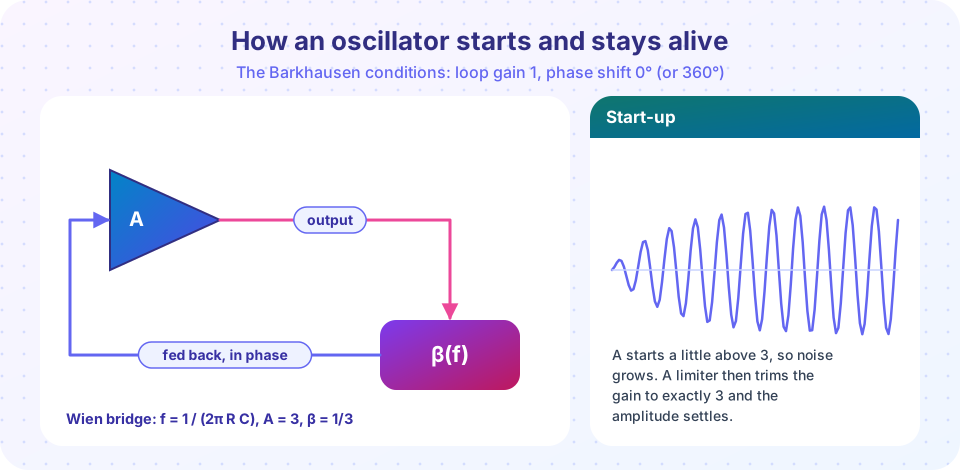
Consider the loop in the picture: an amplifier with gain A, a network with transfer β(f), and the network output returned to the amplifier input with positive feedback. A sinusoid at frequency f goes round the loop and comes back multiplied by A · β. If that factor is exactly 1, the signal reproduces itself with the same amplitude and phase every time round: a steady oscillation. So at f0:
|A · β| = 1- phase of
A · β= 0° (or 360°)
If the magnitude were below 1, the signal would shrink each lap and die out; above 1, it would grow each lap. That second case sounds bad but is the secret of starting up: the loop gain is made slightly greater than 1, so tiny electrical noise grows into a full signal. Then something, usually the amplifier's own limits or a deliberate circuit, reduces the gain back to exactly 1 and the amplitude settles.
The Wien-bridge oscillator
The Wien network has a series R-C branch and a parallel R-C branch. At the special frequency
f0 = 1 / (2π R C)
its gain is exactly 1/3 and its phase shift is 0°. A non-inverting op-amp amplifier supplies the gain: A = 1 + Rf / Rg. For loop gain 1, you need A = 3, so Rf = 2 Rg. In practice you set Rf a bit larger than 2 Rg so the oscillation starts, and add an amplitude-control element, which reduces gain as the output grows: a small incandescent lamp (resistance rises with heat) or back-to-back diodes in parallel with part of Rf.
Worked example. R = 10 kΩ, C = 15.9 nF. f0 = 1 / (2π × 10,000 × 15.9×10⁻⁹) = 1.00 kHz. Choose Rg = 10 kΩ and Rf = 20 kΩ + trimmer, so the gain can be adjusted just above 3 for reliable start-up. Using one pot of two ganged resistors R lets you tune the frequency across a decade with the same network.
Why amplitude control matters
If the gain is left at 3.3, the signal grows until the op-amp saturates. The output then looks like a clipped, distorted sine with strong harmonics. The closer the gain stays to 3.00 at the final amplitude, the lower the distortion. This is why precision oscillators use a smoothly acting limiter. Distortion of a few tenths of a percent is easy; 0.001% requires careful design.
Other oscillators
Phase-shift oscillator
An inverting amplifier already provides 180°. Three cascaded RC sections can supply another 180°, 60° each, at
f0 = 1 / (2π R C √6)
but the network attenuates by a factor of 29 at that frequency, so the amplifier gain must be at least 29. Simple and cheap, but the distortion is higher than the Wien bridge.
LC and crystal oscillators
At radio frequencies, a tuned circuit of inductor and capacitor (an LC tank) replaces the RC network: f0 = 1 / (2π √(L C)). Colpitts and Hartley are two classic arrangements. When you need a stable frequency, a quartz crystal acts as a very high-Q tuned circuit, stable to a few parts per million; every microcontroller clock, wristwatch and computer uses one.
Relaxation oscillators
Not all oscillators make sine waves. In the op-amp astable circuit, an op-amp comparator with positive feedback (a divider β = R2 / (R1 + R2)) flips between the supply rails, while an RC network charges toward the output. When the capacitor voltage crosses the threshold, the output flips and the capacitor reverses. The period is
T = 2 R C · ln((1 + β) / (1 - β))
For β = 0.5, T = 2 R C ln 3 = 2.197 R C. The famous 555 timer does the same job.
Common misconceptions
"Oscillators need an input signal to start." They need only noise and a loop gain just above 1; the signal grows on its own.
"Loop gain exactly 1 is enough." With exactly 1.000 the circuit might never start, and component drift can kill it later. Design for a little over 1 plus amplitude control.
"The oscillation frequency depends on the supply voltage." For a good RC or crystal oscillator the frequency is set by the passive components; the supply sets the amplitude limit.
Try it
The first example is a real numerical simulation of the Wien-bridge oscillator. It integrates the network equations and uses a smooth tanh limiter as the amplitude control. The op-amp is modelled as an ideal gain block with a soft limit at ±5 V; no real chip is simulated.
Press Run (or Ctrl + Enter) to see the result here.
Program input · what you'd type while the program runs
Type the answers before you press Run, one per line. Each time the program reads a line (with input()), it gets the next line from this box.
The second example is a calculator for the three oscillator types in this lesson. Choose a type and component values to get the frequency and the gain you need.
Check your understanding
Quick check · 5 questions
of 5 answered You scored / 5 · perfect!
-
1. What must be true of the loop gain for a steady oscillation?
These are the Barkhausen criteria: the signal returns to the input exactly as it left. -
2. A Wien-bridge oscillator uses R = 4.7 kΩ and C = 10 nF. What is the approximate frequency?
f = 1 / (2π × 4700 × 10⁻⁸) = 3.39 kHz. -
3. Why is the amplifier gain set slightly above 3 in a Wien oscillator?
A loop gain just above 1 lets tiny noise grow into a full oscillation; amplitude control then holds the gain at 3. -
4. What does the amplitude-control element (lamp or diode limiter) do?
As amplitude rises, the lamp resistance or diode conduction lowers the gain toward 3 so the output stops growing without hard clipping. -
5. Which oscillator type gives the most stable frequency, to a few parts per million?
A quartz crystal behaves as a very high-Q resonator.
Summary
- Barkhausen: a steady oscillation needs loop gain magnitude 1 and phase 0° at one frequency.
- Wien bridge:
f0 = 1 / (2π R C), network gain 1/3, amplifier gain 3 plus amplitude control. - Phase-shift oscillator:
f0 = 1 / (2π R C √6)with gain at least 29; LC and crystal oscillators serve high frequencies. - Relaxation oscillators make square waves with period
T = 2 R C ln((1 + β)/(1 - β)).
Next: Chapter review
Track your progress
Create a free account to tick off lessons and pick up where you left off on any device.
of Analog Electronics lessons completed