


















Lesson 35 of 46 · Filters and Oscillators
Chapter 7 review: filters and oscillators
Review RC filters, the -3 dB point, Sallen-Key active filters, Q, the Barkhausen criteria and Wien-bridge oscillators with a recap table, design tools and a ten-question quiz.
This chapter followed one thread: frequency-dependent gain. A capacitor makes a divider frequency dependent, which gives a filter. An op-amp buffers the filter and adds positive feedback, which gives sharper active filters. Close the loop around a filter and an amplifier, and the same circuit sustains its own signal, which gives an oscillator. Here is the chapter in one picture, followed by the numbers worth remembering.
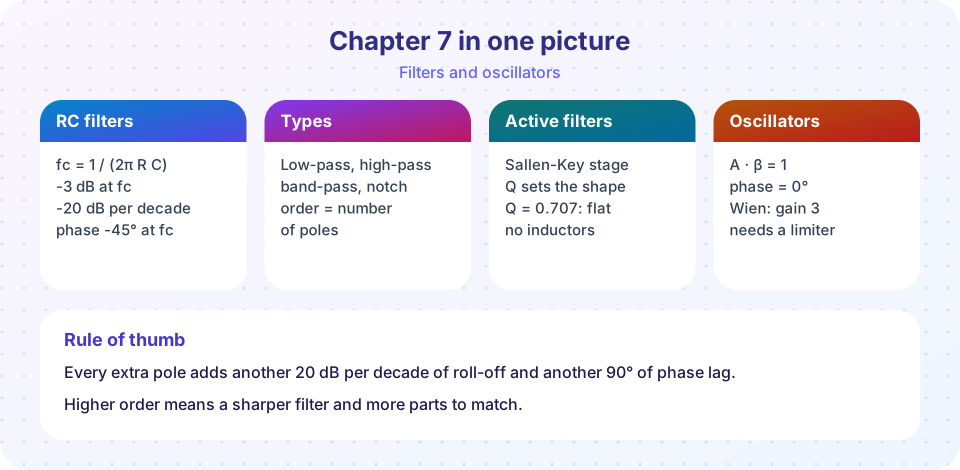
Recap table
| Idea | Key result | Lesson |
|---|---|---|
| RC cutoff | fc = 1 / (2π R C), gain -3 dB, phase ∓45° at fc |
RC filters |
| Roll-off | 20 dB per decade per pole | same |
| Time constant | τ = R C, rise time 0.35 / fc |
same |
| Loading | Buffer between cascaded passive stages | same |
| Second-order filter | f0, Q; far above f0 falls 40 dB/decade |
Active filters |
| Sallen-Key (equal R) | f0 = 1/(2πR√(C1C2)), Q = ½√(C1/C2) |
same |
| Butterworth | Q = 0.707, flat; Bessel 0.577; peaking Q > 1 |
same |
| Barkhausen | A·β = 1 in magnitude, phase 0° at f0 |
Oscillators |
| Wien bridge | f0 = 1/(2πRC), gain 3 |
same |
| Phase shift | f0 = 1/(2πRC√6), gain at least 29 |
same |
| Relaxation | T = 2RC ln((1+β)/(1−β)) |
same |
Choosing a filter: a quick guide
- Remove hiss or noise above the signal band: low-pass; for audio, Butterworth second or fourth order.
- Remove DC or rumble: high-pass; the coupling capacitor is the simplest.
- Pick one station or tone: band-pass with high Q.
- Kill 50/60 Hz hum: notch at the mains frequency.
- Before an analog-to-digital converter: a low-pass "anti-aliasing" filter below half the sampling rate.
Try it
The first tool is a small designer that gives matching component values for a target frequency: an RC filter, a Butterworth Sallen-Key and a Wien oscillator. It applies the formulas from this chapter and checks the result by recomputing the frequency from the nearest standard capacitor.
Press Run (or Ctrl + Enter) to see the result here.
Program input · what you'd type while the program runs
Type the answers before you press Run, one per line. Each time the program reads a line (with input()), it gets the next line from this box.
The second tool is practice, not an exam: a quick "which filter?" game. Pick the circuit that fits each scenario.
Check your understanding
Quick check · 10 questions
of 10 answered You scored / 10 · perfect!
-
1. An RC low-pass uses R = 22 kΩ and C = 4.7 nF. What is fc approximately?
fc = 1 / (2π × 22,000 × 4.7×10⁻⁹) = 1,539 Hz. -
2. At twice the cutoff frequency, a first-order low-pass has gain of about:
|H| = 1/√(1 + 4) = 0.447, which is -7 dB. -
3. A third-order filter rolls off at:
Each pole adds 20 dB per decade, so three poles give 60 dB per decade. -
4. For an equal-resistor Sallen-Key low-pass, Q = 0.707 needs which capacitor ratio C1/C2?
Q = 0.5 √(C1/C2); Q = 0.707 gives C1/C2 = 2. -
5. Which low-pass response has no overshoot in its step response and the most linear phase?
Bessel (Q = 0.577 for second order) is designed for minimal ringing and linear phase. -
6. A Wien-bridge oscillator has R = 15.9 kΩ and C = 10 nF. The frequency is about:
f = 1 / (2π × 15,900 × 10⁻⁸) = 1.0 kHz. -
7. Why must the amplifier of a Wien oscillator have gain slightly above 3 at start-up?
The Wien network has β = 1/3; loop gain above 1 allows start-up. -
8. What happens to a Wien oscillator with gain 3.3 and no amplitude control?
Loop gain above 1 keeps growing until the op-amp saturates. -
9. How do you stop two cascaded passive RC stages from interacting?
A buffer (voltage follower) has high input and low output resistance, isolating the stages. -
10. Which circuit would remove 50 Hz mains hum while leaving the rest of the audio nearly untouched?
A notch rejects a narrow band; a high-pass or low-pass would remove far more of the signal.
Summary
- A capacitor-based divider is a filter;
fc = 1 / (2π R C), -20 dB per decade per pole. - Active filters use an op-amp; Q (set by capacitor ratio or gain) decides peaking and ringing.
- Oscillators need loop gain 1 at 0° phase, with start-up gain slightly above 1 and amplitude control.
- Pick the filter type from the job: low-pass, high-pass, band-pass or notch.
Next: Chapter 8 overview: power supplies and practical design
Track your progress
Create a free account to tick off lessons and pick up where you left off on any device.
of Analog Electronics lessons completed