


















Lesson 7 of 46 · Diodes and Rectifiers
The p-n junction and diode models
Learn how a p-n junction makes a diode, use the Shockley equation, and solve diode circuits with ideal, constant-drop and load-line methods, with simulations.
Why does a diode conduct one way? The answer lies in a thin region inside a crystal where two differently prepared pieces of silicon meet. Understanding it gives you the shape of the diode's curve, the 0.7 V rule, and the reason diodes change with temperature. Then comes the practical question: given a circuit with a diode in it, how do you find the current? You will learn three methods, from a quick estimate to an exact numerical solution, and know which to use when.
What you will learn
- How doping and the depletion region create a one-way junction
- The Shockley diode equation and what each term means
- Why the forward voltage is about 0.7 V and falls with temperature
- Three ways to solve a diode circuit: ideal, constant drop and graphical load line
- How other diode types differ
Key terms
Doping: adding a small amount of another element to silicon to give it mobile electrons (n-type) or mobile holes (p-type).
Depletion region: a thin zone at the junction with no mobile charge, left with fixed ions that create a built-in electric field.
Saturation current (I_s): the tiny reverse current scale in the diode equation, roughly 10⁻¹⁵ to 10⁻⁹ A for small-signal diodes.
Thermal voltage (V_T): kT/q, about 25.9 mV at 300 K.
Operating point: the DC current and voltage at which a device sits in a circuit.
From silicon to a junction
Pure silicon is a poor conductor. Doping fixes that. Add a little phosphorus (five valence electrons) and each atom donates one free electron: the result is n-type, with electrons as the mobile carriers. Add a little boron (three valence electrons) and each atom leaves a missing electron, a hole, that behaves like a mobile positive charge: p-type.
Join a p-type and an n-type region and something happens at once. Electrons near the junction diffuse from n to p, where electrons are scarce. Holes diffuse from p to n. When an electron crosses and meets a hole, they annihilate. What remains near the junction are the fixed donor and acceptor ions: positive ions on the n side and negative ions on the p side. This depletion region has an electric field that opposes further diffusion. The system settles into equilibrium with a built-in potential of roughly 0.6 to 0.8 V for silicon, depending on the doping levels.
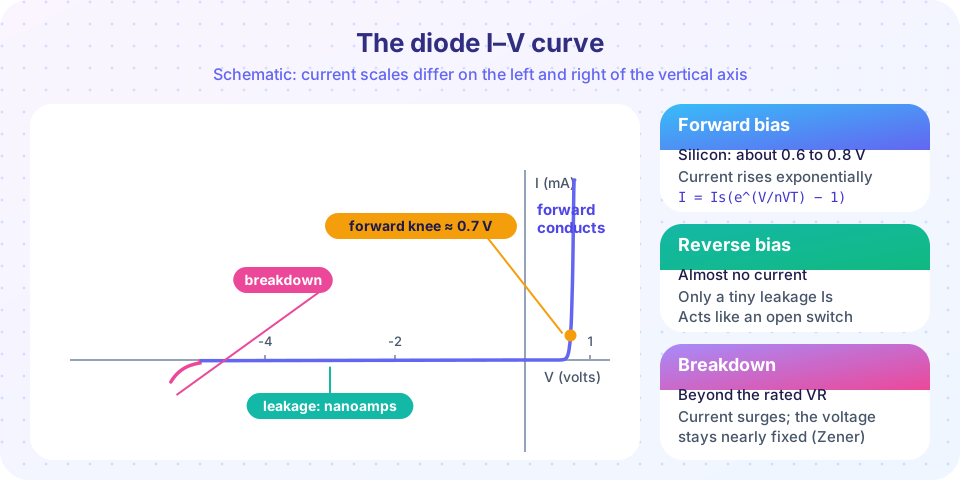
Forward bias. Connect the p side (anode) to the positive terminal. The external voltage opposes the built-in potential, shrinks the barrier, and carriers pour across. The current grows exponentially with voltage.
Reverse bias. Connect the anode to the negative terminal. The external voltage adds to the barrier, widening the depletion region. Only a minuscule leakage current, thermally generated carriers, flows until the voltage is high enough to cause breakdown.
The Shockley equation
William Shockley's ideal diode equation describes the curve:
I = Is × ( e^(V / (n·VT)) − 1 )
VT = k·T / q ≈ 25.9 mV at 300 K
Here I_s is the saturation current, n is the ideality factor (1 to about 2), k is Boltzmann's constant, T the temperature in kelvin and q the charge of an electron. Read it in two regimes:
- For V negative by more than a few V_T, the exponential vanishes and I ≈ −I_s: the tiny reverse leakage.
- For V greater than a few V_T, the −1 is negligible and I ≈ I_s·e^(V/(nV_T)).
The exponential has a striking consequence: every increase of about 60 mV (that is V_T·ln 10 = 59.5 mV for n = 1) multiplies the current by ten. Whether the current is 10 µA or 10 mA, the voltage is nearly the same: it only changes by 0.12 V for a factor of a hundred. That is why a silicon diode seems to have a fixed "forward drop" of about 0.7 V. With I_s = 10⁻¹⁴ A, the current at 0.6 V is about 0.1 mA, and at 0.7 V it is about 6 mA.
Temperature
Both I_s and V_T depend on temperature. I_s grows quickly (roughly doubling every few degrees), so the forward voltage at a given current falls by about 2 mV per degree Celsius. That is useful (a diode can serve as a temperature sensor) and dangerous (a hot diode takes more current, which heats it further, so power diodes can run away if they are paralleled carelessly).
Three ways to solve a diode circuit
Take a 5 V source in series with a 1 kΩ resistor and a diode. What current flows?
Method 1: the ideal diode
Treat a forward-biased diode as a wire and a reverse-biased one as an open circuit. Then I = 5 V / 1 kΩ = 5 mA. This is quick and fine when the supply voltage is much larger than 0.7 V and you only need an estimate.
Method 2: the constant-drop model
Treat a conducting diode as a switch in series with a fixed 0.7 V source. KVL gives I = (5 − 0.7) / 1 kΩ = 4.3 mA. This is the workhorse method: accurate to a few percent for most circuits, and easy to do on paper. Use 0.3 V for Schottky diodes and about 2 V for a red LED.
Method 3: the exact (load-line) solution
The diode has to satisfy two equations at once: the circuit's KVL, I = (V_s − V_D)/R, and the diode's own curve. Plotted on one graph, the straight load line and the exponential curve cross at the operating point. Solve it numerically: iterate V_D = V_T·ln(I/I_s + 1) with the new I each time, and it converges in a few steps. For I_s = 10⁻¹⁴ A: V_D ≈ 0.693 V and I ≈ 4.31 mA. The constant-drop answer (4.3 mA) was almost perfect.
The result teaches a useful habit: when the answer is insensitive to the exact diode voltage, use the simple model, and save the exact solution for cases where the supply voltage is only slightly above the diode drop.
Other diode types
| Type | Typical forward drop | Typical use |
|---|---|---|
| Silicon signal/rectifier | 0.6 to 0.8 V | Rectifiers, general purpose |
| Schottky (metal-semiconductor) | 0.15 to 0.45 V | Fast switching, efficient power supplies |
| Germanium | 0.2 to 0.3 V | Old radio detectors |
| Red/yellow/green LED | 1.8 to 2.4 V | Indicators |
| Blue/white LED | 2.8 to 3.4 V | Lighting, displays |
Real diodes also have maximum ratings: peak reverse voltage, average forward current and power. A 1N4148 is a small fast signal diode rated for roughly 100 V reverse and 200 mA; a 1N4007 is a rectifier rated for 1000 V reverse and 1 A. Always check the datasheet.
Common misconceptions
"The diode has a resistance of 0.7 V divided by the current." The static ratio V/I is meaningless as a fixed resistance. What matters is the dynamic resistance, r_d = n·V_T / I, about 26 Ω at 1 mA and 2.6 Ω at 10 mA.
"An LED needs no resistor if the supply is the right voltage." A small change in voltage causes a huge change in current. Always use a series resistor to set the current.
"Reverse breakdown always destroys a diode." Ordinary diodes can be damaged by excess reverse power; Zener diodes are designed to run in breakdown safely.
Try it
First, the load line and operating point for the 5 V, 1 kΩ circuit. The plot shows the diode curve, the straight load line and their intersection. Try a smaller supply, such as 1 V, and see the ideal and constant-drop models become inaccurate.
Press Run (or Ctrl + Enter) to see the result here.
Program input · what you'd type while the program runs
Type the answers before you press Run, one per line. Each time the program reads a line (with input()), it gets the next line from this box.
Second, the effect of temperature on the forward voltage at a fixed current of 1 mA. The code uses the standard temperature scaling of the saturation current (with a silicon bandgap of 1.12 eV).
Press Run (or Ctrl + Enter) to see the result here.
Program input · what you'd type while the program runs
Type the answers before you press Run, one per line. Each time the program reads a line (with input()), it gets the next line from this box.
Check your understanding
Quick check · 5 questions
of 5 answered You scored / 5 · perfect!
-
1. What creates the built-in barrier in a p-n junction?
Diffusion leaves uncompensated donor and acceptor ions, which create the field that opposes further flow. -
2. In the Shockley equation, what does the current approach for a large negative voltage?
When the exponential term vanishes, I ≈ −I_s. -
3. By about how much must the forward voltage rise to increase the diode current tenfold (n = 1, room temperature)?
ΔV = V_T·ln 10 ≈ 59.5 mV. -
4. A 9 V supply, a 470 Ω resistor and a silicon diode are in series. Using the constant-drop model, what is the current?
I = (9 − 0.7) / 470 = 17.7 mA. -
5. What happens to the forward voltage of a silicon diode at constant current as it warms up?
I_s rises quickly with temperature, so less voltage is needed for the same current.
Summary
- A p-n junction forms a depletion region with a built-in potential of about 0.6 to 0.8 V.
- Forward bias lowers the barrier and the current rises exponentially: I = I_s(e^(V/nV_T) − 1).
- Each 60 mV multiplies the current by 10, which gives the "0.7 V" rule.
- Solve diode circuits with the ideal, constant-drop or load-line (exact) method.
- The forward voltage falls about 2 mV per °C; Schottky diodes and LEDs have different drops.
Next: Rectifier circuits
Track your progress
Create a free account to tick off lessons and pick up where you left off on any device.
of Analog Electronics lessons completed