


















Lesson 17 of 46 · MOSFETs
MOSFET structure, regions and the square-law I-V curves
Learn how an n-channel MOSFET is built, how the channel forms above threshold, the triode and saturation equations, and how to find the operating point.
A BJT's behavior comes from carriers diffusing across a junction. A MOSFET's behavior comes from something simpler to visualize: an electric field creating a conducting layer. This lesson builds the MOSFET from the cross-section upward. You will see where the threshold voltage comes from, why the current rises as the square of the gate overdrive in saturation, and why the same transistor looks like a resistor at small drain voltages.
We use an n-channel enhancement MOSFET throughout. A p-channel transistor works the same way with every voltage and current reversed.

What you will learn
- How the MOSFET's layers create a channel and what V_th means
- The three regions: cutoff, triode and saturation
- The square-law equations and the meaning of K and overdrive voltage
- Channel-length modulation and output resistance
- How to find a MOSFET's operating point and check its region
Key terms
Threshold voltage (V_th): the gate-source voltage at which an inversion channel forms (about 0.4 to 2 V for typical enhancement devices).
Overdrive voltage (V_ov): V_ov = V_GS − V_th, how far the gate is above threshold.
Triode (ohmic) region: V_DS < V_ov; the channel is continuous and the device acts like a voltage-controlled resistor.
Saturation: V_DS ≥ V_ov; the channel is pinched off at the drain and the current becomes nearly independent of V_DS.
K: K = μ_n·C_ox·(W/L), the device's current-gain factor in A/V².
The structure
Look at the figure. A p-type silicon body (substrate) contains two heavily doped n⁺ regions, the source and the drain. Above the gap between them sits a thin insulating layer of silicon dioxide (a few nanometers in modern processes) and, above that, the gate, historically aluminum and today usually polysilicon or a metal. The distance between source and drain is the channel length L; the width into the page is W.
With V_GS = 0 the source and drain are separated by two back-to-back p-n junctions, so no current flows. A positive gate voltage repels the holes from the surface under the oxide and, once large enough, attracts electrons there. At the threshold voltage the surface becomes n-type: an inversion layer, a thin conducting channel that connects the source to the drain.
A MOSFET has four terminals (gate, drain, source, body). In discrete devices the body is wired to the source inside the package, and in most analysis we treat it as a three-terminal device.
Triode region
For V_GS above V_th, the channel exists. Apply a small drain-to-source voltage V_DS. Electrons flow from source to drain, with current proportional to both the channel's conductivity (set by the overdrive) and V_DS:
ID = K · ( Vov · VDS − VDS² / 2 ) for VDS < Vov
For very small V_DS the quadratic term vanishes and I_D ≈ K·V_ov·V_DS, a straight line: the transistor behaves like a resistor
RDS = 1 / ( K · Vov )
whose value is set by the gate voltage. This is useful as a voltage-controlled resistor and the basis of the MOSFET switch (next lesson).
Saturation
As V_DS increases, the voltage across the oxide at the drain end (V_GD = V_GS − V_DS) falls. When V_DS = V_ov, V_GD equals V_th, and the channel at the drain end just vanishes: it is pinched off. Beyond this the electrons still flow, accelerated through the narrow pinch-off region by the field, but additional drain voltage no longer increases the current by much. The current saturates at
ID = ½ · K · Vov² = ½ · K · (VGS − Vth)² for VDS ≥ Vov
This is the square law. Double the overdrive and the current quadruples. Compare with the BJT's exponential: a MOSFET's current responds more gently to gate voltage, which is why its g_m is lower at the same current.
The numbers
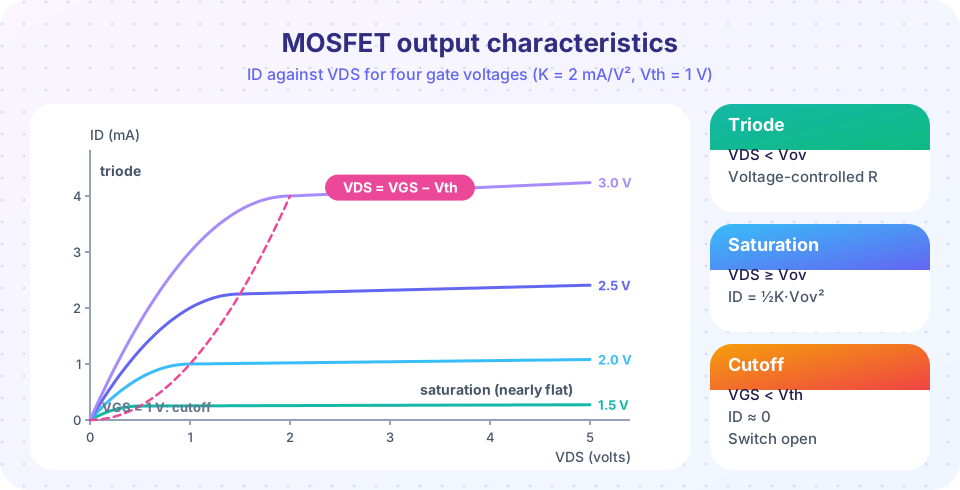
The factor K = μ_n·C_ox·W/L combines process properties (the electron mobility μ_n and the oxide capacitance per area C_ox) with the geometry W/L. A typical process transconductance parameter μ_n·C_ox is 100 to 300 µA/V² for older processes. With μ_nC_ox = 200 µA/V² and W/L = 10, K = 2 mA/V². With V_th = 1 V and V_GS = 2 V, V_ov = 1 V and I_D = ½ × 2 mA/V² × 1² = 1 mA. This is the transistor drawn in the curves below.
Channel-length modulation
Real saturation curves are not perfectly flat. Increasing V_DS shortens the effective channel slightly (the pinch-off point moves toward the source), raising the current:
ID = ½ · K · Vov² · (1 + λ · VDS) ro = 1 / (λ · ID) = VA / ID
with λ typically 0.01 to 0.1 V⁻¹. For λ = 0.02 V⁻¹ at 1 mA, r_o = 50 kΩ. Short-channel transistors have larger λ. This is the MOSFET's version of the BJT's Early effect.
Finding the operating point
As with the diode and BJT, assume a region, calculate, and check.
Example 1. V_DD = 9 V, R_D = 4.7 kΩ, V_GS = 2 V, V_th = 1 V, K = 2 mA/V². Assume saturation: I_D = ½ × 2 mA × 1² = 1 mA; V_D = 9 − 1 mA × 4.7 kΩ = 4.3 V. Check: V_DS = 4.3 V ≥ V_ov = 1 V. ✓ Saturation.
Example 2. Same transistor, but R_D = 10 kΩ. Assume saturation: I_D = 1 mA would drop 10 V across R_D, impossible with a 9 V supply, so the check fails. Assume triode: I_D = K(V_ov·V_DS − V_DS²/2) with V_DS = 9 − 10 kΩ·I_D. Substituting gives 10·V_DS² − 21·V_DS + 9 = 0, so V_DS = 0.6 V or 1.5 V. Only 0.6 V is below V_ov = 1 V (the triode condition). I_D = (9 − 0.6)/10 kΩ = 0.84 mA. The check passes, and the transistor is in the triode region, acting like a resistor of about 1/(K·V_ov) = 500 Ω.
Other types
| Type | Channel | Needs V_GS | Used for |
|---|---|---|---|
| n-channel enhancement | n | Positive, above V_th | Most common NMOS: logic, low-side switches |
| p-channel enhancement | p | Negative, below − | V_th |
| Depletion mode | Exists at V_GS = 0 | Negative (n-channel) turns it off | Rarely used discretes, some analog parts |
Common misconceptions
"Saturation means the same as in a BJT." In a MOSFET, saturation (current nearly independent of V_DS) is the amplifier region. In a BJT, saturation is the switch-on region. The names clash, so check which device you are talking about.
"V_th is a fixed number." It varies with process, temperature (falling about 2 mV/°C), body voltage and between devices. Datasheets give a range.
"I_D = K·V_ov² in saturation." The factor is ½: I_D = ½K·V_ov². Some books absorb the ½ into K; always check the definition.
Try it
First, the transfer and output characteristics of the transistor in the figure: I_D against V_GS and against V_DS, with the saturation boundary. Extend the plot to a different K or V_th to see how it moves.
Press Run (or Ctrl + Enter) to see the result here.
Program input · what you'd type while the program runs
Type the answers before you press Run, one per line. Each time the program reads a line (with input()), it gets the next line from this box.
Second, an operating-point finder. Slide the supply, gate voltage and drain resistor; the program tries saturation, then the triode region, checks the answer and reports the region. Example 2 from the lesson is the setting R_D = 10 kΩ.
Check your understanding
Quick check · 6 questions
of 6 answered You scored / 6 · perfect!
-
1. A MOSFET has V_th = 1.5 V and V_GS = 3.5 V. What is the overdrive voltage?
V_ov = V_GS − V_th = 3.5 − 1.5 = 2 V. -
2. With K = 2 mA/V² and V_ov = 2 V in saturation, what is I_D?
I_D = ½ × 2 mA/V² × 2² = 4 mA. -
3. In which condition is an n-channel MOSFET in saturation?
Saturation needs an existing channel (V_GS > V_th) that is pinched off at the drain (V_DS ≥ V_ov). -
4. What happens to I_D in saturation if you double V_ov?
I_D ∝ V_ov², so doubling V_ov quadruples the current. -
5. A MOSFET in saturation has λ = 0.05 V⁻¹ and I_D = 2 mA. What is r_o?
r_o = 1/(λ·I_D) = 1/(0.05 × 0.002) = 10 kΩ. -
6. Which resistance does a MOSFET show for small V_DS, with V_ov = 2 V and K = 2 mA/V²?
R_DS = 1/(K·V_ov) = 1/(0.002 × 2) = 250 Ω.
Summary
- A gate voltage above V_th forms an inversion channel under the oxide, connecting source to drain.
- Triode (V_DS < V_ov): I_D = K(V_ov·V_DS − V_DS²/2), a voltage-controlled resistor of 1/(K·V_ov) at small V_DS.
- Saturation (V_DS ≥ V_ov): I_D = ½K·V_ov²·(1 + λV_DS) with r_o = 1/(λI_D).
- K = μ_nC_ox·W/L; V_th varies with temperature and process.
- Assume a region, solve, check V_DS against V_ov, and switch if the check fails.
Track your progress
Create a free account to tick off lessons and pick up where you left off on any device.
of Analog Electronics lessons completed