


















Lesson 21 of 46 · Amplifier Basics and Biasing
Chapter 5 overview: amplifier basics and biasing
A map of chapter 5: what an amplifier does, how gain and decibels work, why transistors need biasing, and how the common-emitter stage ties it all together.
Up to now you have met the parts: diodes that steer current, bipolar transistors that control a large current with a small one, and MOSFETs that control current with a voltage. This chapter puts those parts to work. An amplifier takes a weak signal, such as the few millivolts from a microphone, and produces a stronger copy of it. Everything in analog electronics, from radio receivers to sensor interfaces, grows from this idea.
Building a good amplifier is less about the transistor and more about the set-up around it. A transistor only amplifies faithfully when it sits in the right place on its curves, and getting it there is called biasing. By the end of this chapter you will be able to pick resistor values that place a transistor at a sensible operating point, predict the gain of the stage, and explain why the output looks the way it does.
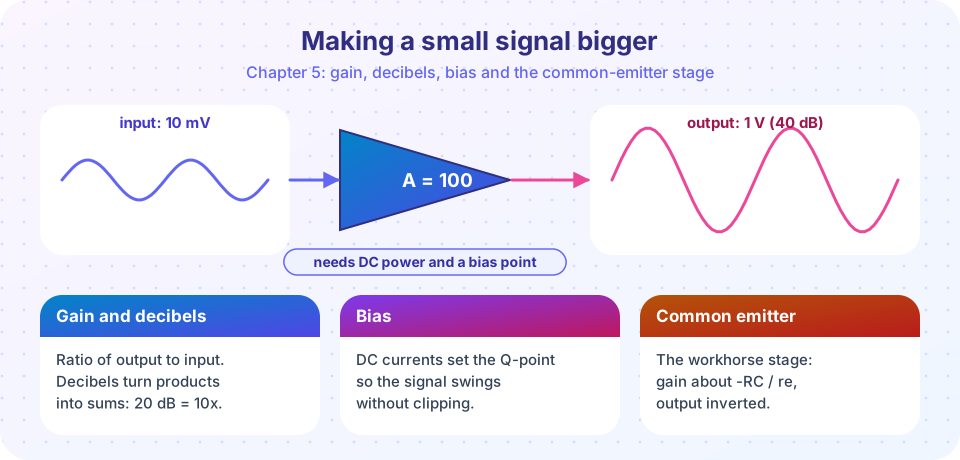
What an amplifier does
Gain and decibels
Bias
The common-emitter stage
What you will learn
- What gain is and how to express it as a plain ratio and in decibels.
- Why a transistor needs DC bias before it can amplify AC signals.
- How to design divider bias and read a load line.
- How a common-emitter stage behaves and where its gain comes from.
The lessons in this chapter
| Lesson | What it covers |
|---|---|
| Gain and decibels | Voltage, current and power gain; the decibel scale; cascaded stages |
| Biasing a bipolar transistor | Q-point, load line, voltage-divider bias and stability |
| The common-emitter amplifier | Small-signal model, gain, input and output resistance, bypass capacitor |
| Chapter review | One-page recap and a ten-question check |
The big idea: DC first, then AC
Every amplifier in this chapter lives a double life. There is a DC life: batteries and resistors establish steady currents and voltages, the bias. And there is an AC life: a small signal wiggles around those steady values. Analysts keep the two apart on purpose. You first solve the DC circuit with capacitors treated as open circuits, and then you solve the AC circuit with capacitors treated as short circuits and DC supplies treated as ground. This separation, justified by the superposition principle for linear circuits, is the single most useful habit in analog design, and you will use it in every lesson that follows.
Why not just use more gain?
It is tempting to think "more gain is always better". Real amplifiers disagree. A stage with gain 100 and a 5 V supply cannot output more than about 5 V, so any input larger than 50 mV peak will make the output clip. Clipping flattens the peaks of the wave and adds harmonics you can hear as harsh distortion. Gain also trades against bandwidth and noise, a theme that returns in the operational amplifier chapter. Good design is choosing enough gain, in the right place, with room to swing.
Try it
The first example is a simulation that applies a gain of 100 to a 50 mV, 1 kHz sine wave and then limits the result to the supply rails. It is a model of an ideal amplifier with a hard limit, not a transistor circuit.
Press Run (or Ctrl + Enter) to see the result here.
Program input · what you'd type while the program runs
Type the answers before you press Run, one per line. Each time the program reads a line (with input()), it gets the next line from this box.
The second example is an interactive version. Drag the sliders and watch the output wave flatten as soon as gain × input exceeds the supply limit.
Check your understanding
Quick check · 3 questions
of 3 answered You scored / 3 · perfect!
-
1. What is biasing?
Bias is the DC set-up. Without it the signal would push the transistor into cutoff or saturation and the output would be distorted. -
2. A stage has a gain of 100 and a ±4 V output limit. What happens to a 60 mV peak input?
100 × 60 mV = 6 V, which is more than the 4 V limit, so the peaks are flattened. -
3. When you analyse the AC behaviour of an amplifier, how are DC supplies treated?
An ideal DC supply holds its voltage constant, so it has no AC component and acts as an AC ground.
Summary
- An amplifier makes a larger copy of a signal using power from a DC supply.
- Bias sets the DC operating point; the signal then varies around it.
- Analyse DC first (capacitors open), then AC (capacitors shorted, supplies grounded).
- Too much gain or too big an input causes clipping near the supply rails.
Next: Gain and decibels
Track your progress
Create a free account to tick off lessons and pick up where you left off on any device.
of Analog Electronics lessons completed