


















Lesson 38 of 46 · Power Supplies and Practical Design
Linear regulators: Zener, 78xx and low-dropout
Design with linear regulators: Zener shunt regulators, the 7805 three-terminal regulator, dropout voltage, power dissipation, heat sinks and when an LDO is better.
A filter capacitor leaves you with a DC voltage that still ripples and drifts with the mains and the load. A regulator holds the output at a fixed value regardless. The simplest class is the linear regulator, which works like an automatic variable resistor in series with the load: if the input rises or the output tries to climb, the resistor increases and drops the extra voltage. The excess energy becomes heat, which is both the weakness and the design problem of every linear regulator.
In this lesson you will build a Zener regulator by hand, meet the ubiquitous 7805 and its low-dropout cousins, and learn the one calculation that decides whether your design works or cooks itself: the thermal budget.
What you will learn
- Size a Zener shunt regulator and predict its regulation.
- Use a 78xx or LDO regulator with the correct capacitors and headroom.
- Compute power dissipation, efficiency and junction temperature.
- Choose between a standard regulator and a low-dropout one.
Key terms
Dropout voltage: the minimum difference Vin - Vout needed for the regulator to stay in regulation (about 2 V for a 7805, 0.1-0.5 V for an LDO).
Line regulation: how much the output changes when the input voltage changes.
Load regulation: how much the output changes when the load current changes.
Quiescent current (Iq): the current the regulator itself consumes from the input.
Thermal resistance (θ): the temperature rise per watt, in °C/W, between two points (junction to ambient, junction to case).
The Zener shunt regulator
A Zener diode in reverse breakdown holds nearly constant voltage Vz across itself over a wide current range. Put a series resistor Rs from the supply and connect the Zener across the load:
Rs = (Vin(min) - Vz) / (Iz(min) + IL(max))
Worked example. Vin varies from 11 to 14 V, Vz = 5.1 V, the load takes up to 20 mA, and the Zener needs at least 5 mA to stay in breakdown.
Rs = (11 - 5.1) / (5 mA + 20 mA) = 236 Ω; choose 220 Ω. Check the worst case at Vin = 14 V with the load disconnected: Iz = (14 - 5.1) / 220 = 40 mA, so the Zener dissipates 5.1 × 40 mA = 206 mW (use a 400 mW or 1 W part) and Rs dissipates (8.9)² / 220 = 0.36 W (use a 1 W resistor).
The Zener regulator is cheap but inefficient and its output moves slightly with Iz because the Zener has a small dynamic resistance rz. It is common for references and low-current duties, not for powering circuits that draw an ampere.
Three-terminal regulators (78xx)
The 7805 (and 7812, 7905 for negative) contains a precision reference, an error amplifier and a power transistor in a package with three pins: IN, GND, OUT. The designer's job is almost trivial:
- Feed it an input at least
Vout + dropouthigher, at the minimum of the ripple. - Add a capacitor on the input (0.33 µF) and output (0.1 µF) located close to the pins to prevent oscillation; larger electrolytics are fine.
- Do not exceed the maximum input voltage (35 V for a 7805) or the power rating.
Typical performance for the 7805: output 5 V ±4%, line and load regulation of a few tens of millivolts, ripple rejection about 60-80 dB (a 1 V ripple at the input becomes a fraction of a millivolt), and a quiescent current of about 5 mA.
Power, efficiency and heat
The regulator passes the load current I from input to output, so the power it dissipates is
P = (Vin - Vout) · I + Vin · Iq ≈ (Vin - Vout) · I
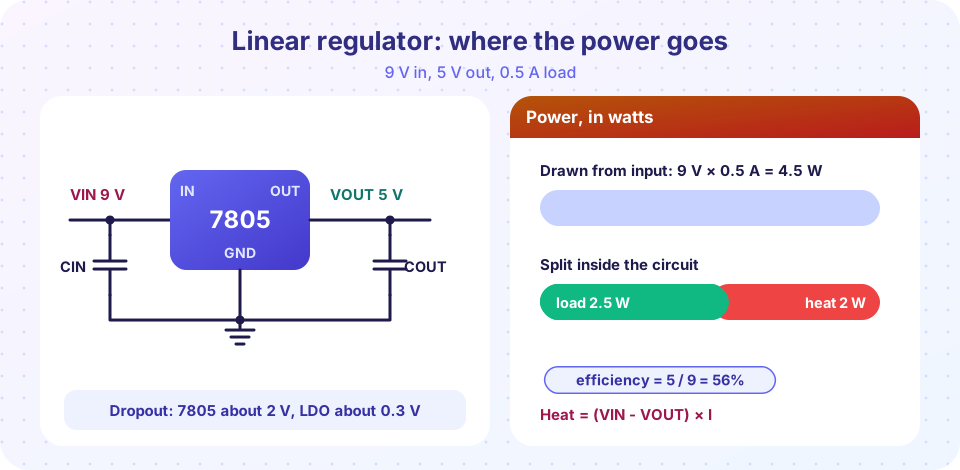
and the efficiency is at best Vout / Vin. In the picture, 9 V in and 5 V out at 0.5 A dissipates 4 × 0.5 = 2 W and delivers 2.5 W: 56% efficient. The picture also shows why a higher input voltage is worse: at 12 V in the same circuit wastes 7 × 0.5 = 3.5 W and is only 42% efficient.
Thermal design
The junction temperature is Tj = Ta + P · θJA. A TO-220 package without a heat sink has θJA of roughly 50-65 °C/W (check the datasheet). With P = 3.5 W and θJA = 65 °C/W the temperature rise is 227 °C, far beyond the 125 °C limit. With a heat sink, the thermal path is θJC (junction to case, about 5 °C/W) + θCS (case to sink, about 1 °C/W) + θSA (sink to air). For Ta = 40 °C and Tj(max) = 125 °C:
θtotal ≤ (125 - 40) / 3.5 = 24 °C/W → θSA ≤ 24 - 5 - 1 = 18 °C/W
Any heat sink rated 15 °C/W or better would do. Better still, reduce the input voltage, or use a switching pre-regulator (next lesson).
Low-dropout (LDO) regulators
A 7805 needs about 2 V of headroom because its pass element is an NPN Darlington-style follower. An LDO uses a PNP transistor or a P-channel MOSFET as the pass element and needs only 0.1-0.5 V. The benefits: less wasted power (running from a 5.5 V input to make 5 V), working from a battery down to the end of its charge, and smaller dissipation. The costs: LDOs are fussier about the output capacitor (its value and ESR can decide stability: read the datasheet) and are often rated for lower input voltages.
| Feature | 78xx | Typical LDO |
|---|---|---|
| Dropout | about 2 V | 0.1 - 0.5 V |
| Input range | up to 35 V | often 6 - 16 V |
| Quiescent current | about 5 mA | microamperes to a few mA |
| Capacitor needs | forgiving | check ESR and value |
Common misconceptions
"The regulator makes power." It does not; it wastes the excess as heat. Efficiency is limited to Vout / Vin.
"A bigger input voltage is safer." It increases dissipation and heat. Give the regulator just enough headroom, including the ripple minimum and low mains.
"Capacitors on the regulator are optional." Without the small input and output capacitors, many regulators oscillate or misbehave on load changes.
Try it
The first example simulates the Zener regulator from the worked example and plots output voltage against input voltage. The Zener is modelled with a knee voltage and a small dynamic resistance; it is a first-order model, not a datasheet curve.
Press Run (or Ctrl + Enter) to see the result here.
Program input · what you'd type while the program runs
Type the answers before you press Run, one per line. Each time the program reads a line (with input()), it gets the next line from this box.
The second example plots the junction temperature of a 7805 in a TO-220 package, with and without a heat sink, as the input voltage rises. The thermal resistances are typical, rounded values, not a datasheet guarantee.
Press Run (or Ctrl + Enter) to see the result here.
Program input · what you'd type while the program runs
Type the answers before you press Run, one per line. Each time the program reads a line (with input()), it gets the next line from this box.
The third example is a regulator planner. Set the input, output and current to see the power, efficiency and whether a 7805-class part survives in free air.
Check your understanding
Quick check · 5 questions
of 5 answered You scored / 5 · perfect!
-
1. A 7812 regulates from a 20 V input at 0.4 A. How much power does it dissipate (ignoring quiescent current)?
P = (20 - 12) × 0.4 = 3.2 W. -
2. What is the best-case efficiency of a linear regulator?
The regulator passes the load current at Vout out of Vin in, so the maximum efficiency is Vout/Vin. -
3. Why choose an LDO over a 7805 to make 3.3 V from a 4.2 V battery?
A 7805-type part needs about 2 V between input and output; 4.2 - 3.3 = 0.9 V is not enough. -
4. A Zener regulator has Vin(min) = 12 V, Vz = 6.2 V, IL(max) = 30 mA and Iz(min) = 5 mA. What is the largest allowed Rs?
Rs = (12 - 6.2) / (5 mA + 30 mA) = 5.8 / 0.035 = 166 Ω. -
5. A regulator dissipates 4 W, θJA = 25 °C/W with a heat sink, and Ta = 50 °C. What is Tj?
Tj = 50 + 4 × 25 = 150 °C, which exceeds a typical 125 °C limit.
Summary
- A Zener shunt regulator is simple but inefficient;
Rs = (Vin(min) - Vz) / (Iz(min) + IL(max)). - A 78xx needs about 2 V headroom at the ripple minimum and small capacitors at both pins; an LDO needs 0.1-0.5 V.
- Dissipation is
(Vin - Vout) · I; efficiency is at mostVout / Vin. - Check
Tj = Ta + P · θJAand add a heat sink or lower the input voltage when needed.
Track your progress
Create a free account to tick off lessons and pick up where you left off on any device.
of Analog Electronics lessons completed