


















Lesson 44 of 46 · Projects and Practice
Glossary of analog electronics
A searchable glossary of 45 analog electronics terms from gain and bias to op-amps, filters, oscillators and power supplies, each with a short definition and a lesson link.
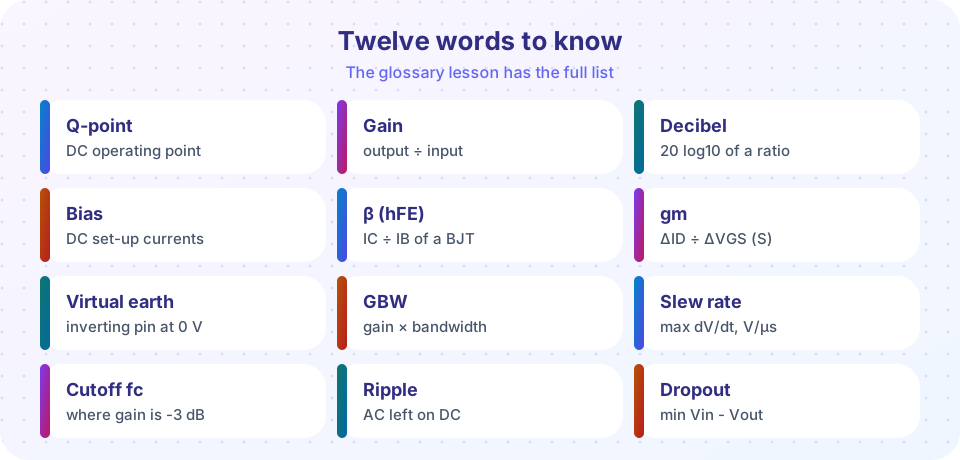
Analog electronics comes with a lot of vocabulary, and much of it is easy to mix up: gain and loop gain, bandwidth and cutoff, ripple and noise. This glossary collects the terms from chapters 5 to 8 with one-line definitions and a pointer to the lesson where each is explained. Use the search box below to find a term quickly, or the flashcard tool to quiz yourself.
What you will learn
- Recall the precise meaning of the main terms in amplifier, op-amp, filter and power-supply design.
- Distinguish look-alike terms.
- Find the lesson that explains each one.
Terms A to F
| Term | Meaning | Lesson |
|---|---|---|
| Active filter | A filter that uses an amplifier (usually an op-amp) as well as resistors and capacitors | Active filters |
| Active region | The BJT operating region where IC ≈ β·IB and the collector-base junction is reverse biased |
Biasing |
| Amplifier | A circuit that makes a larger copy of a signal using power from a supply | Chapter 5 overview |
| Anti-aliasing filter | A low-pass filter placed before an ADC to remove frequencies above half the sampling rate | Sensor chain |
| Bandwidth | The range of frequencies over which a circuit's gain stays within 3 dB of its mid-band value | Real op-amp limits |
| Barkhausen criteria | For sustained oscillation, loop gain of magnitude 1 and phase 0° (or 360°) | Oscillators |
| Bias | The DC currents and voltages that set a transistor's operating point | Biasing |
| Bode plot | A graph of gain (dB) and phase against frequency on a logarithmic axis | RC filters |
| Bridge rectifier | Four diodes that convert AC into pulsating DC using both half-cycles | Ripple |
| Buck converter | A switching regulator that steps a voltage down, Vout = D · Vin |
Switching regulators |
| Bypass capacitor | A capacitor that gives AC a short path around a resistor, such as RE | Common emitter |
| CMRR | Common-mode rejection ratio: differential gain divided by common-mode gain, usually in dB | Op-amp circuits |
| Closed-loop gain | The gain of an amplifier with its feedback network connected | Chapter 6 overview |
| Common-emitter stage | A BJT amplifier with input at the base, output at the collector, voltage gain about -RC / re |
Common emitter |
| Coupling capacitor | A capacitor that passes AC and blocks DC between stages | Common emitter |
| Cutoff frequency | The frequency where a filter's gain has fallen by 3 dB (to 0.707) | RC filters |
| Decibel | Ten times the base-10 logarithm of a power ratio, or twenty times for a voltage ratio | Gain and decibels |
| Decoupling capacitor | A capacitor across a chip's supply pins that supplies fast current and absorbs noise | Switching regulators |
| Dropout voltage | The minimum Vin - Vout a linear regulator needs to stay in regulation |
Linear regulators |
| Duty cycle | The fraction of a switching period during which the switch is on | Switching regulators |
| Feedback | Returning part of the output to the input; negative feedback opposes the change | Ideal op-amp |
| Full-power bandwidth | The highest frequency at which the full output amplitude is undistorted, SR / (2π Vp) |
Real op-amp limits |
Terms G to R
| Term | Meaning | Lesson |
|---|---|---|
| Gain | Output divided by input (voltage, current or power) | Gain and decibels |
| GBW | Gain-bandwidth product: closed-loop gain times bandwidth, constant for a voltage-feedback op-amp | Real op-amp limits |
| Input offset voltage | The small DC voltage between the inputs needed to zero the output | Real op-amp limits |
| Instrumentation amplifier | A high-CMRR, high-input-resistance difference amplifier, usually with three op-amps | Sensor chain |
| LDO | Low-dropout linear regulator: needs only a few hundred millivolts of headroom | Linear regulators |
| Load line | The straight line of all IC-VCE combinations the external circuit allows |
Biasing |
| Loop gain | The product A · β of amplifier gain and feedback fraction around the loop |
Oscillators |
| Noise gain | 1 + Rf / Rin: the gain seen by offsets and noise at the input |
Real op-amp limits |
| Op-amp | A high-gain differential amplifier designed to be used with feedback | Chapter 6 overview |
| Open-loop gain | The gain of the bare op-amp without feedback (about 100,000 at DC) | Chapter 6 overview |
| Oscillator | A circuit that generates a repeating signal from a DC supply | Oscillators |
| Q (quality factor) | How sharply a second-order filter or resonator peaks; related to damping by ζ = 1/(2Q) |
Active filters |
| Q-point | The quiescent DC values of IC and VCE with no signal |
Biasing |
| re | A BJT's small-signal emitter resistance, 25 mV / IE |
Common emitter |
| Ripple | The small AC variation left on a filtered DC supply, ≈ I / (fr · C) |
Ripple |
| Roll-off | How fast gain falls beyond the cutoff, in dB per decade (20 dB per pole) | RC filters |
Terms S to Z
| Term | Meaning | Lesson |
|---|---|---|
| Sallen-Key | A popular second-order active filter with one op-amp, two resistors and two capacitors | Active filters |
| Slew rate | The maximum rate of change of an op-amp's output, in V/µs | Real op-amp limits |
| Time constant | τ = R C: the time to reach 63% of the final value |
RC filters |
| Virtual earth | A node held at 0 V by feedback without being connected to ground | Ideal op-amp |
| Voltage follower | A non-inverting amplifier with gain 1 that buffers a source | Ideal op-amp |
| Wien bridge | An RC network with gain 1/3 at f = 1/(2πRC) used in sine oscillators |
Oscillators |
| Zener diode | A diode designed to conduct in reverse breakdown at a defined voltage, used for references and simple regulators | Linear regulators |
Look-alike terms
Gain versus loop gain. Gain is what the whole circuit does to a signal from input to output; loop gain is the gain once around the feedback loop (it decides stability and oscillation).
Bandwidth versus cutoff frequency. For a low-pass filter they are the same number; for a band-pass, bandwidth is the width of the passband between two cutoffs.
Ripple versus noise. Ripple is a periodic, predictable variation at the rectifier or switching frequency; noise is random and broadband.
Bias current versus bias (voltage). "Bias" for a transistor is the DC operating point; "input bias current" for an op-amp is the small current flowing into its input pins.
Try it
The first tool is a searchable glossary of the most important terms. Type part of a word and the list narrows.
The second tool is a set of flashcards. Click a card to flip it, then mark whether you knew the answer.
Check your understanding
Quick check · 4 questions
of 4 answered You scored / 4 · perfect!
-
1. Which term describes the gain of the signal once around a feedback loop?
Loop gain is A·β, the product of the amplifier gain and the feedback fraction. -
2. A node held at 0 V by feedback but not connected to ground is called:
It is the inverting input of an inverting op-amp amplifier. -
3. What distinguishes ripple from noise?
Ripple is predictable and tied to the mains or switching frequency. -
4. What is the quiescent operating point of a transistor called?
Q stands for quiescent: the DC values with no signal.
Summary
- Learn the vocabulary in pairs of look-alike terms: gain vs loop gain, ripple vs noise, bias vs bias current.
- Every term here links to its lesson; use the glossary as an index.
- Re-read the lesson when a definition feels vague.
Track your progress
Create a free account to tick off lessons and pick up where you left off on any device.
of Analog Electronics lessons completed