


















Lesson 43 of 46 · Projects and Practice
Practice problems: amplifiers, op-amps, filters and power
Fourteen worked-out practice problems on gain, biasing, op-amps, filters, oscillators and power supplies, with a five-step method, hints, an answer checker and a solver.
Reading about analog electronics is not the same as being able to do it. The fastest way to find out what you actually understand is to solve problems with a pencil and a calculator before you look at any answer. This lesson gives you fourteen problems that cover the second half of the track, a method for attacking them, and two tools: an answer checker that tells you whether you are within 2% of the right value, and a solver that prints complete solutions when you are ready.
What you will learn
- Apply a reliable method to analog circuit problems.
- Practise the key formulas from chapters 5 to 8 with numbers.
- Check your answers and find out which topics need review.
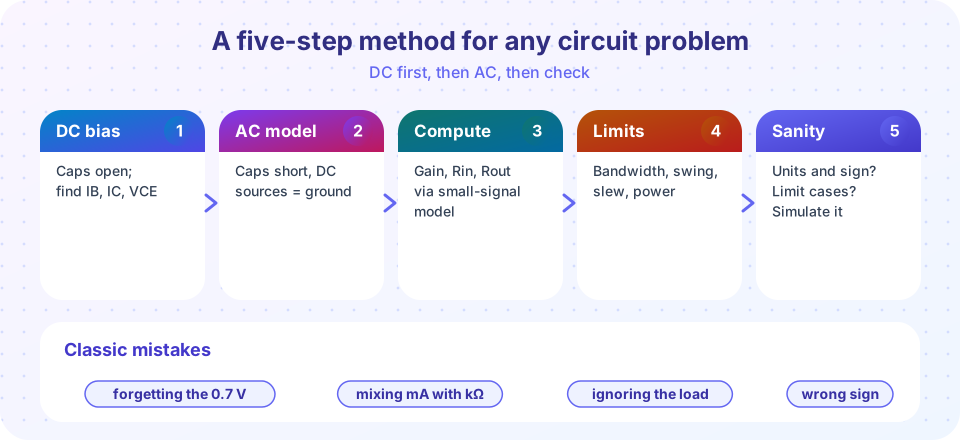
The five-step method
- DC first. Replace every capacitor by an open circuit and find the bias currents and voltages (or, for op-amp circuits, use the golden rules).
- Redraw for AC. Replace capacitors by shorts and DC supplies by ground; replace the transistor by its small-signal model.
- Compute the gain, input resistance, output resistance and corner frequencies.
- Check the limits: bandwidth, slew rate, output swing, power and temperature.
- Sanity-check. Do the units work? Is the sign right? What happens in the limiting cases (
Rf → 0,C → ∞)? Would a quick simulation agree?
Write down units at every line. Most wrong answers in electronics come from mixing mA with kΩ or forgetting a factor of 2π.
The problems
Give each answer to three significant figures. A reminder of useful constants: VBE = 0.7 V, VT = 25 mV, β = 150 when needed.
Chapter 5: amplifiers and biasing
- An amplifier has a voltage gain of 80. What is the gain in decibels?
- A 26 dB stage feeds a 14 dB stage, and a cable between them loses 3 dB. What is the total gain as a plain voltage ratio?
- A divider-bias stage:
VCC = 15 V,R1 = 47 kΩ,R2 = 10 kΩ,RE = 1.5 kΩ,RC = 4.7 kΩ. Ignoring base current, findVCE. - For the stage in problem 3, what is the voltage gain with the emitter bypassed (unloaded)?
Chapter 6: operational amplifiers
- An inverting amplifier must have a gain of -25 and an input resistance of 4 kΩ. What is
Rf? - A non-inverting amplifier must have a gain of 8, with
Rg = 2.2 kΩ. What isRf, and which standard E24 value would you use? - An op-amp has
GBW = 5 MHz. What bandwidth can a closed-loop gain of 50 reach? - A stage must output 2 V peak at 50 kHz. What minimum slew rate in V/µs does that need?
Chapter 7: filters and oscillators
- An RC low-pass needs
fc = 3.4 kHzwithC = 47 nF. What resistor? - A unity-gain Butterworth Sallen-Key with equal resistors
R = 22 kΩandf0 = 500 Hz. What areC2(to ground) andC1 = 2 C2? GiveC2in nF. - A Wien-bridge oscillator at 2 kHz with
C = 10 nF. WhatR?
Chapter 8: power supplies
- A bridge rectifier on 60 Hz mains supplies 1.5 A. What capacitor limits the ripple to 1 V? Give the answer in µF.
- A 7805 runs from 14 V at 0.8 A. How much power does it dissipate?
- A buck converter makes 5 V from 24 V;
L = 47 µH,fsw = 200 kHz. What is the inductor ripple current in amperes?
Hints
- 1-2:
dB = 20 log10(ratio); decibels add. - 3:
VB, thenVE = VB - 0.7,IE = VE / RE, thenVC = VCC - IE RC. - 4:
re = 25 mV / IE; gain is-RC / re. - 5-6:
-Rf / Rinand1 + Rf / Rg. - 7-8:
GBW / gain;SR = 2π f Vp. - 9-11:
1 / (2π R C); for ButterworthC1 = 2 C2,f0 = 1 / (2π R C2 √2). - 12-14:
ΔV = I / (fr C)withfr = 2f;(Vin - Vout) I;ΔIL = (Vin - Vout) D / (L fsw).
Try it
The first tool is an answer checker. Type your numerical answers; it tells you whether each is within 2% of the right value, without showing the answer (open the solver below if you want it). The answers are stored in the page, so this is a self-check, not a secure exam.
The second tool is the solver. It computes every problem from the formulas, so you can compare your working with the code. Run it after you have tried the problems.
Press Run (or Ctrl + Enter) to see the result here.
Program input · what you'd type while the program runs
Type the answers before you press Run, one per line. Each time the program reads a line (with input()), it gets the next line from this box.
How to use your results
If you got a problem wrong, locate it in the table below and re-read the lesson before trying again with new numbers (change the values and make your own variant).
| Problems | Topic | Lesson |
|---|---|---|
| 1-2 | Gain and decibels | Gain and decibels |
| 3-4 | Divider bias, CE gain | Biasing, Common emitter |
| 5-6 | Inverting and non-inverting amplifiers | Ideal op-amp |
| 7-8 | GBW and slew rate | Real limits |
| 9 | RC filter | RC filters |
| 10 | Sallen-Key | Active filters |
| 11 | Wien bridge | Oscillators |
| 12 | Ripple | Ripple |
| 13 | Linear regulator | Linear regulators |
| 14 | Buck converter | Switching regulators |
Check your understanding
Quick check · 4 questions
of 4 answered You scored / 4 · perfect!
-
1. In step 1 of the method (DC analysis), how are capacitors treated?
At DC a capacitor carries no steady current, so it is an open circuit. -
2. In the AC analysis, what happens to the ideal DC supply?
An ideal supply holds its voltage constant, so there is no AC voltage across it. -
3. Your answer for an op-amp gain stage is 1,000,000 V/V from a 1 MHz GBW part at 20 kHz. What is the quick sanity check?
GBW / 20 kHz = 50, so the claimed gain violates the gain-bandwidth limit. -
4. Which unit slip is most common in transistor bias problems?
1 mA across 1 kΩ is 1 V; confusing the prefixes gives answers that are off by 1000.
Summary
- Solve in the order DC, AC, limits, sanity.
- Write units on every line and keep prefixes straight.
- Use the checker for quick feedback and the solver to compare your method.
- Build your own variants of each problem by changing the numbers.
Track your progress
Create a free account to tick off lessons and pick up where you left off on any device.
of Analog Electronics lessons completed