


















Lesson 22 of 46 · Amplifier Basics and Biasing
Gain and decibels
Learn voltage, current and power gain, how decibels turn multiplication into addition, and how source and load resistance change the gain you actually get.
The first number anyone asks about an amplifier is its gain: how many times bigger is the output than the input? The question sounds simple, but real amplifiers can have gains from 2 to 1,000,000, and engineers often chain several stages together. Multiplying huge ratios in your head is awkward, so electronics uses a logarithmic scale, the decibel, where multiplying gains becomes simply adding numbers.
This lesson builds the vocabulary you need for the rest of the track: gain in three flavors, the decibel and its two formulas, cascaded stages, and the often-forgotten effect of the source and load on the gain you really get.
What you will learn
- Define voltage, current and power gain and compute each from measurements.
- Convert between a ratio and decibels using
20 log10and10 log10. - Use decibels to analyse cascaded stages and the -3 dB point.
- Account for the source resistance and load resistance in real gain.
Key terms
Voltage gain (Av): output voltage divided by input voltage, Av = vout / vin.
Power gain (Ap): output power divided by input power, Ap = Pout / Pin.
Decibel (dB): ten times the base-10 logarithm of a power ratio; for voltages, twenty times the logarithm of the voltage ratio.
Input resistance (Rin): the resistance the amplifier presents to the source.
Output resistance (Rout): the equivalent series resistance seen looking back into the amplifier output.
Three kinds of gain
For a small signal, voltage gain is Av = vout / vin, current gain is Ai = iout / iin, and power gain is Ap = Pout / Pin = Av · Ai when you use rms (or consistently peak) values. A gain below 1 is an attenuation, and a negative Av means the output is inverted: it moves down when the input moves up. The common-emitter stage you will build soon has a negative voltage gain.
Amplifiers are mostly specified by voltage gain because most signals are voltages. But keep in mind that an amplifier with Av = 1 can still have a big power gain: a buffer that copies a 1 V signal from a weak source to a heavy load takes almost no input current but delivers a lot of output current.
The decibel
The bel was named for Alexander Graham Bell and the decibel is a tenth of it. Because power ratios are the original use, the definition starts there:
gain in dB = 10 · log10(P2 / P1)
Power in a resistor is P = V² / R. If the voltage doubles across the same resistance, power quadruples. Substituting gives the voltage form, which is the one you will use most:
gain in dB = 20 · log10(V2 / V1) (same resistance at both points)
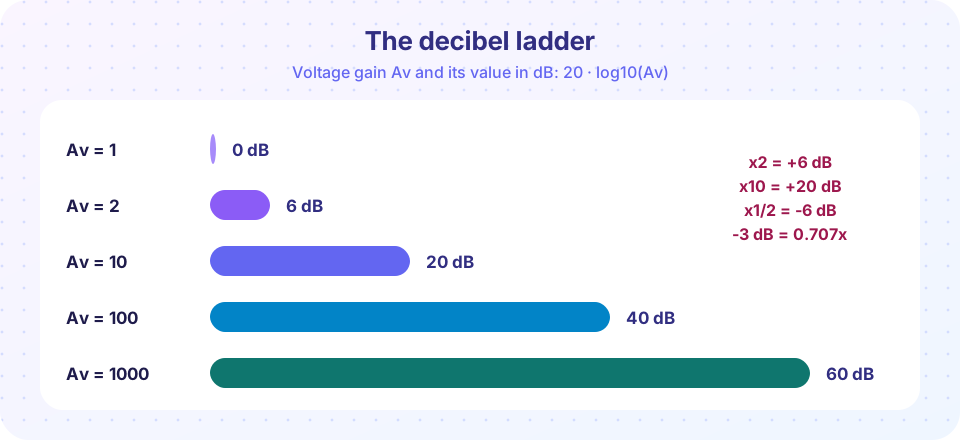
Memorize three anchors and you can estimate almost anything:
| Voltage ratio | Decibels | Why |
|---|---|---|
| 10 | +20 dB | 20 log10(10) = 20 |
| 2 | +6 dB | 20 log10(2) = 6.02 |
| 1.414 (√2) | +3 dB | 20 log10(1.414) = 3.01 |
| 0.707 | -3 dB | half the power |
| 1 | 0 dB | no change |
Notice the symmetry: a ratio of 1/2 is -6 dB, and 1/10 is -20 dB. Combine anchors to get others. A ratio of 20 is 2 × 10, so 6 + 20 = 26 dB. A ratio of 5 is 10 ÷ 2, so 20 - 6 = 14 dB (the exact value is 13.98 dB).
Worked example 1: converting a gain
An amplifier turns 8 mV into 2 V. Its voltage gain is 2 / 0.008 = 250. In decibels, 20 log10(250) = 20 × 2.398 = 47.96 dB, about 48 dB. Check with anchors: 250 ≈ 2.5 × 100, and 100 is 40 dB while 2.5 is about 8 dB, giving 48 dB.
Worked example 2: going back
A datasheet quotes a gain of 34 dB. The ratio is 10^(34 / 20) = 10^1.7 = 50.1. Again with anchors: 34 = 20 + 14, so 10 × 5 = 50.
Cascaded stages
If a 20 dB stage drives a 14 dB stage, the combined gain is 34 dB, because the ratios multiply (10 × 5.01 = 50.1) and logarithms turn products into sums. Losses are negative decibels, so a cable with -3 dB loss simply subtracts. This is why a signal chain from antenna to speaker is usually drawn as a "gain budget" in dB.
Reference levels
Decibels are always relative, so absolute levels name their reference in the unit:
- dBV: 0 dBV is 1 V rms, so 20 dBV is 10 V rms.
- dBu: 0 dBu is 0.7746 V rms (the voltage that gives 1 mW in 600 ohms).
- dBm: 0 dBm is 1 mW; 20 dBm is 100 mW.
Gain you actually get: loading
An amplifier's open-circuit gain Av0 is measured with nothing attached. In a real circuit the source has its own resistance Rs and the load has resistance RL, and two voltage dividers appear:
vout / vs = Av0 · [Rin / (Rs + Rin)] · [RL / (RL + Rout)]
Suppose Av0 = 100, Rs = 10 kΩ, Rin = 40 kΩ, Rout = 1 kΩ and RL = 4 kΩ. Then the input divider is 40 / 50 = 0.8 and the output divider is 4 / 5 = 0.8, so the real gain is 100 × 0.8 × 0.8 = 64, or 36.1 dB instead of 40 dB. You lose almost 4 dB just from loading. That is why designers want a high input resistance and a low output resistance: both keep the dividers close to 1.
Common misconceptions
"3 dB means twice as loud or twice as big." Not for voltage. +3 dB doubles power but multiplies voltage by only 1.414. Doubling voltage takes +6 dB.
"dB is a unit like volts." A decibel is a ratio, not a quantity. Saying "the signal is 20 dB" is meaningless without a reference (20 dB above what?).
"I can add gains in plain numbers." Gains multiply as ratios; they only add in decibels.
Try it
The first example is a decibel toolbox. It converts ratios to decibels, adds up a gain budget and works through the loading example above. It is a calculator that applies the formulas from this lesson.
Press Run (or Ctrl + Enter) to see the result here.
Program input · what you'd type while the program runs
Type the answers before you press Run, one per line. Each time the program reads a line (with input()), it gets the next line from this box.
The second example is an interactive slider. Move it and see the voltage and power ratios that belong to each decibel value.
Check your understanding
Quick check · 5 questions
of 5 answered You scored / 5 · perfect!
-
1. An amplifier's output is 5 V when the input is 50 mV. What is its voltage gain in dB?
Av = 5 / 0.05 = 100, and 20 log10(100) = 40 dB. -
2. A 12 dB stage feeds a -4 dB attenuator and then a 20 dB stage. What is the total gain?
Decibels add: 12 - 4 + 20 = 28 dB, which is a voltage ratio of about 25. -
3. By how much does voltage change at the -3 dB point?
-3 dB is a power ratio of 0.5, so the voltage ratio is the square root of 0.5, about 0.707. -
4. Why do designers want a high input resistance and a low output resistance?
The loading formula multiplies Av0 by Rin/(Rs+Rin) and RL/(RL+Rout); both factors approach 1 when Rin is large and Rout is small. -
5. A signal is at +14 dBm. How much power is that?
10^(14/10) = 25.1, and 0 dBm is 1 mW, so the power is about 25 mW.
Summary
- Gain is output divided by input; it can be a voltage, current or power ratio.
dB = 20 log10(voltage ratio) = 10 log10(power ratio).- Remember 20 dB = x10, 6 dB = x2, 3 dB = x1.41 in voltage, -3 dB = x0.707.
- Cascaded gains add in dB; the real gain also includes the loading dividers at input and output.
Track your progress
Create a free account to tick off lessons and pick up where you left off on any device.
of Analog Electronics lessons completed