


















Lesson 2 of 46 · Getting Started
What Is Social Psychology?
Define social psychology, see how it differs from sociology and personality psychology, and learn the central ideas of situation, construal and interaction.
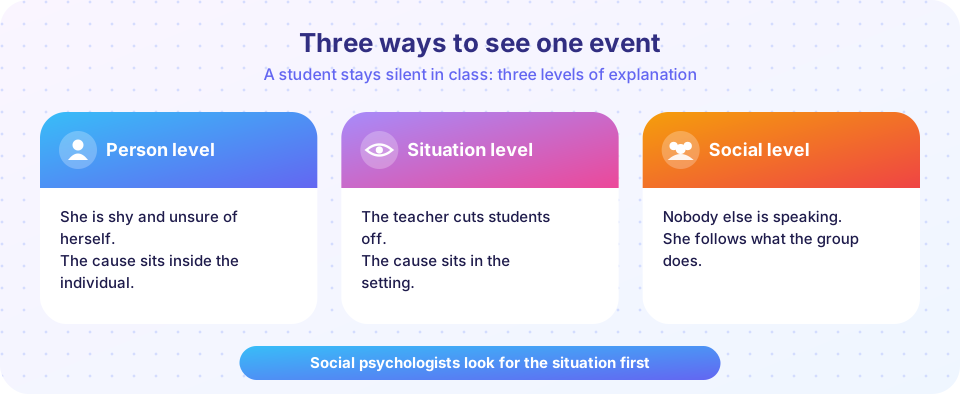
Imagine a student in a lecture hall who never speaks, even though she knows the answer. Why? Many people will say "she is shy." A social psychologist will ask a different set of questions: What did the teacher do the last time someone spoke? Is anyone else speaking? What does she expect others to think? The behavior is the same, but the explanation points in a different direction.
That shift, from "what kind of person is this?" to "what is going on around this person, and how do they see it?", is the heart of social psychology. This lesson defines the field, places it among its neighbors and introduces the main ideas that run through every chapter.
What you will learn
- A working definition of social psychology.
- How it differs from sociology and personality psychology.
- Lewin's person-and-situation idea, and what "interaction" means.
- Why construal and the power of the situation matter.
- A short history from the first experiments to today.
Key terms
Social psychology is the scientific study of how the thoughts, feelings and behavior of individuals are influenced by the actual, imagined or implied presence of others (a widely used formulation after Gordon Allport). Situationism is the view that situations strongly shape behavior. Disposition is a stable inner tendency, such as a trait. Interaction means the effect of one factor depends on the level of another. Level of analysis is the scale of explanation: individual, interpersonal, group or cultural.
A working definition
Gordon Allport's classic definition, written in the 1950s and refined later, says that social psychology tries to understand how people's thoughts, feelings and actions are shaped by others. Notice three words: actual (someone is there), imagined (you picture a friend's reaction) and implied (a rule or a custom reminds you that others expect something). You obey a "Quiet please" sign in an empty library because the sign implies a community.
Neighbors in the family
Personality psychology asks how individuals differ in stable ways (extraversion, anxiety) and what predicts those differences. Sociology studies large groups and institutions: classes, cultures, family structures. Social psychology sits in between. It usually studies the individual, but asks how the individual is affected by the social setting, and it uses experiments to find out.
| Field | Main question | Typical unit |
|---|---|---|
| Personality psychology | How do people differ consistently? | Individual traits |
| Social psychology | How do situations and other people influence an individual? | Person in a setting |
| Sociology | How do groups and institutions work? | Societies and groups |
The boundaries are porous. Cultural psychologists, for instance, compare how people in different societies think about the self.
Person and situation together
Kurt Lewin, a founder of the field, wrote B = f(P, E): behavior is a function of the person and the environment. The word function matters. It does not mean "person plus situation" like adding two numbers. It means the two combine. Psychologists call this an interaction.
Suppose we measure how often people help a stranger who drops papers. Kind people might help in both a quiet street and a rushed crowd. But in the crowd, helping drops sharply for everyone, and the gap between kind and unkind people becomes smaller or larger depending on the setting. Neither factor alone tells the story.
The power of the situation
Research from the 1960s and 70s showed how strongly the setting can matter. Lee Ross and Richard Nisbett's 1991 book The Person and the Situation gathered the evidence: ordinary people can behave in surprising ways when pushed by roles, rules and group norms. You will meet the most famous studies, such as Asch on conformity and Milgram on obedience, in Chapter 5. At the same time, we should not swing too far. Individual differences are real and often predictive over long stretches of life. A good social psychologist keeps both in view.
Construal: the world as we see it
Two people can sit in the same situation and experience it differently. Another early thinker, Solomon Asch, argued that people respond to the meaning they give a situation. If you read a stranger's silence as shyness you respond kindly; if you read it as snobbery you respond coldly. The silence did not change; your construal did. Throughout the course you will see how construal is shaped by motives (we want to feel good), by thinking shortcuts (we are busy) and by culture.
A short history
- 1898 Norman Triplett reported that cyclists seemed to ride faster in company than alone. This is often credited as an early social psychology experiment, though modern readers note its small sample and weak controls.
- 1930s Muzafer Sherif studied how groups create shared norms; Kurt Lewin studied group climates.
- 1950s Asch, Festinger and Hovland made experiments on conformity, dissonance and persuasion central to the field.
- 1960s and 70s Milgram, Darley and Latané, Zimbardo and others produced dramatic findings, and also provoked ethics rules.
- 2010s A "replication crisis" led to more open, careful practice, which Chapter 1 covers.
Levels and cultures
Most classic research was done on university students in Western, educated, industrialized, rich, democratic societies. In 2010 Joseph Henrich, Steven Heine and Ara Norenzayan called this the WEIRD problem: a sample that is odd in world terms may not represent humanity. Cultural psychologists such as Hazel Markus and Shinobu Kitayama showed that some concepts, such as the self, can differ in emphasis across cultures. Treat any finding as a claim about some people in some settings until it has been tested more widely.
Common misconceptions
"It is all about the situation, so personality does not matter." The truth is an interaction: both matter, and their effects combine.
"Social psychologists excuse bad behavior." Explaining behavior is not excusing it. Understanding the forces on people helps us design better settings and take responsibility more wisely.
"Social psychology means studying society." That is sociology. Social psychology studies the individual in a social context.
Try it
First play with the person-by-situation idea, then see how an interaction looks in a graph. Both models use invented numbers to show the idea; they are not research results.
Press Run (or Ctrl + Enter) to see the result here.
Program input · what you'd type while the program runs
Type the answers before you press Run, one per line. Each time the program reads a line (with input()), it gets the next line from this box.
Check your understanding
Quick check · 5 questions
of 5 answered You scored / 5 · perfect!
-
1. Which is the best definition of social psychology?
Social psychology focuses on the individual in a social context. -
2. What does the word 'implied' mean in Allport's definition?
Implied presence includes norms and signs that point to what a community expects. -
3. What is an interaction in the person-and-situation view?
An interaction means one factor's effect depends on the other. -
4. What does the WEIRD problem warn about?
Western, educated, industrialized, rich, democratic samples are not representative of the world. -
5. Which field mainly studies large groups and institutions?
Sociology works at the level of groups, institutions and societies.
Summary
- Social psychology studies how actual, imagined and implied others shape individuals.
- It sits between personality psychology (individual differences) and sociology (societies).
- Lewin's
B = f(P, E)means behavior comes from the person and the situation interacting. - Construal, the meaning people give to events, drives behavior.
- Early research used narrow samples, so cultural breadth matters.
Track your progress
Create a free account to tick off lessons and pick up where you left off on any device.
of Social Psychology lessons completed