


















Lesson 27 of 46 · Group Behavior
Social Facilitation and Social Loafing
Why an audience can boost an easy task and hurt a hard one, why people put in less effort in teams, and what research says about fixing it.
Here are two everyday puzzles. A runner posts a better time in a race than alone on a training run. A musician plays a piece perfectly in the practice room and fumbles it on stage. In both cases, other people are present and performance changes, but in opposite directions. A third puzzle: five students share a group project and the combined result is less than five times what one student would produce. Social psychology explains all three with two related ideas, social facilitation and social loafing.
What you will learn
- What social facilitation is and how Zajonc's drive theory explains it.
- The evidence: Triplett, cockroaches, pool players and a meta-analysis.
- What social loafing is, how it was found and why it happens.
- Practical ways to reduce loafing.
Key terms
Social facilitation: a change in performance caused by the presence of others, either better or worse.
Dominant response: the response that is most likely, learned or natural, in a given situation.
Evaluation apprehension: concern about being judged by others.
Social loafing: reduced individual effort when working in a group compared with working alone.
Identifiability: whether your individual contribution can be seen.
Social facilitation
One of the first social psychology studies was by Norman Triplett in 1898. He noticed that cyclists often rode faster in races than alone against the clock, and he tested children winding fishing reels alone and in pairs. He concluded that competition could spur effort. Later work found a more complicated picture: sometimes others help, sometimes they hurt.
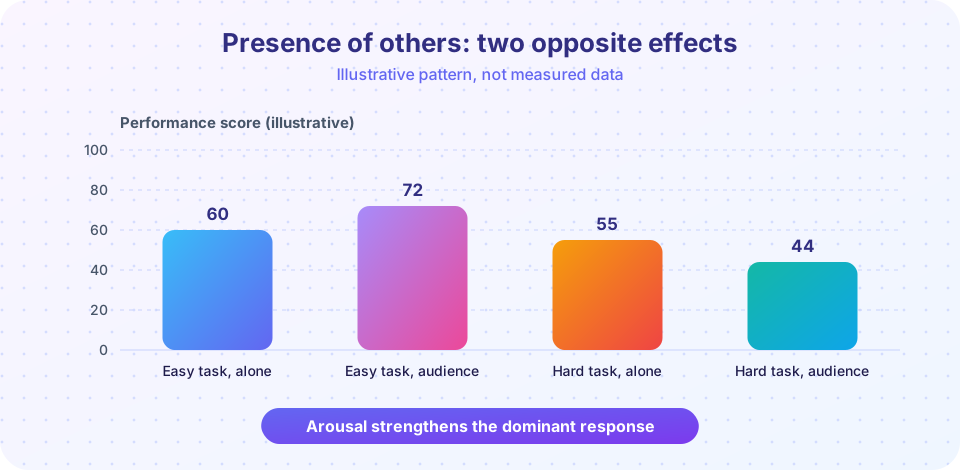
Robert Zajonc (1965) offered a tidy explanation. The mere presence of others raises physiological arousal. Arousal strengthens the dominant response, whichever one it is. If the task is simple or well practiced, the dominant response is correct, and performance improves. If the task is hard or new, the dominant response is wrong, and performance suffers.
Evidence came from surprising places. Zajonc and colleagues (1969) tested cockroaches: with an audience of other cockroaches, they ran a simple straight runway faster but a complicated maze slower. In another study, observers watched pool players. Better players tended to do even better when watched, while weaker players tended to do worse (roughly an improvement of several percentage points for experts and a drop for novices). A meta-analysis of hundreds of studies by Charles Bond and Linda Titus (1983) found the overall pattern: with others present, people were faster on simple tasks and slower and more error-prone on complex ones.
Other explanations
Arousal may not be the only route. Evaluation apprehension (Nickolas Cottrell, 1968) says that the effect comes from worry about being judged, so a blindfolded audience should matter less. Distraction-conflict theory says that attending to both the task and the audience overloads attention. These ideas can all be true in different settings.
Social loafing
In the late nineteenth century Maximilien Ringelmann had people pull on a rope alone and in groups, and found that the average pull per person decreased as groups grew. Part of this was a loss of coordination: people do not pull in perfect sync. But in the 1970s and 1980s researchers separated coordination from motivation.
Bibb Latané, Kipling Williams and Stephen Harkins (1979) asked students to shout or clap as loudly as they could, alone or in groups, with the people unable to hear each other (so coordination did not matter). People made less noise per person when they believed others were also making noise, and the effect grew with group size. This is social loafing: individuals reduce effort when their contributions are pooled and cannot be identified.
Why does loafing happen?
- Diffusion of responsibility: credit and blame are shared, so each person feels less accountable.
- Free riding: one can enjoy the group result without paying the effort cost.
- Fairness: a person who expects others to slack may slack too, to avoid being the "sucker".
- Low personal relevance: if the task does not matter to you, you invest less.
A meta-analysis by Steven Karau and Kipling Williams (1993) of dozens of studies supports a collective effort model. Loafing is weaker when individual output is visible, when the task is meaningful or interesting, when the group is small and cohesive, when personal standards matter to the person, and when members expect others to perform well. Studies in collectivist cultures often show smaller loafing effects than studies in individualist cultures, though not always.
What can groups do?
- Make individual contributions identifiable (own sections, visible logs).
- Set clear, challenging goals and give feedback.
- Keep groups small and assign distinct roles.
- Make the task meaningful: explain why it matters.
- Build cohesion and shared commitment.
- Use peer evaluation, with care.
Common misconceptions
"An audience always improves performance." It helps on well-learned tasks and can hurt on new or hard ones.
"Social loafing means people are lazy." It is a response to situations where effort is hidden and shared. In the right setting, the same people work hard.
"Group work is always worse." Teams can outperform individuals when tasks require different skills, when roles are clear and when contributions are visible.
Try it
Press Run (or Ctrl + Enter) to see the result here.
Program input · what you'd type while the program runs
Type the answers before you press Run, one per line. Each time the program reads a line (with input()), it gets the next line from this box.
Check your understanding
Quick check · 5 questions
of 5 answered You scored / 5 · perfect!
-
1. According to Zajonc, the presence of others raises arousal, which...
Arousal strengthens whatever response is dominant, which helps on easy tasks and hurts on hard ones. -
2. In cockroach studies with an audience, which result was found?
That pattern matches the idea that arousal helps simple tasks and hurts complex ones. -
3. Which finding most directly shows social loafing?
Latané, Williams and Harkins found reduced individual effort when contributions were pooled. -
4. Which change reduces social loafing?
Identifiability increases accountability. -
5. Evaluation apprehension is the idea that audience effects come from...
Cottrell proposed that concern about evaluation drives the effect.
Summary
- Others' presence tends to boost easy or well-practiced tasks and harm hard or new ones.
- Arousal, evaluation apprehension and distraction each help explain the effect.
- Social loafing: individuals reduce effort when their contributions are pooled and not identifiable.
- Make work visible, meaningful and well-structured to reduce loafing.
Track your progress
Create a free account to tick off lessons and pick up where you left off on any device.
of Social Psychology lessons completed