


















Lesson 36 of 46 · Relationships, Aggression and Helping
Chapter 8 Overview: Relationships, Aggression and Helping
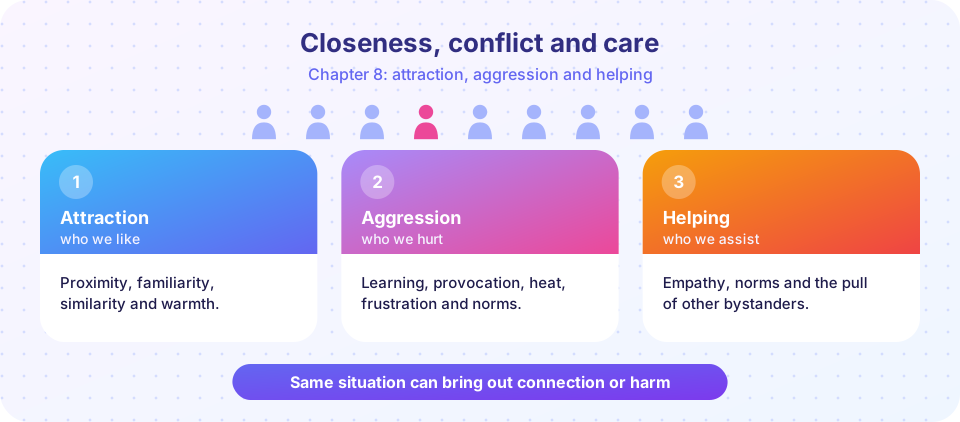
A map of chapter 8: what draws people together, what drives aggression, and when strangers help or hold back, with the main theories and studies.
How we treat other people ranges from deep affection to harm. Some of the most memorable stories in social psychology live here: a stranger who steps in, a crowd that does not, a friendship that formed because two people lived on the same stairwell. This chapter looks at three connected topics: attraction and close relationships, aggression, and helping. They are often called prosocial and antisocial behavior, and they share a theme: both the person and the situation matter.
This chapter is educational. It is not relationship counseling, and it does not diagnose anyone. If you or someone you know is in danger, contact local emergency services.
What you will learn
- The main factors in attraction and the theories of love and satisfaction.
- Theories of aggression and what the research says about triggers.
- Why bystanders sometimes fail to help, and the five-step model of helping.
- How to read the evidence on contested questions such as media violence.
Key terms
Prosocial behavior: voluntary action intended to benefit others.
Altruism: helping motivated by concern for the other's welfare.
Aggression: behavior intended to harm someone who wants to avoid it.
Attachment: an emotional bond, first studied between infants and caregivers and later in adult relationships.
A quick tour
Drawn together
Hurting others
Helping others
What each lesson covers
- Attraction and close relationships: proximity, similarity, love and relationship satisfaction.
- Aggression: causes and theories: learning, frustration, the General Aggression Model and media debates.
- Helping and the bystander effect: the Genovese story, Darley and Latané, and why people help.
- Chapter review.
Common misconceptions
"Opposites attract." In most research, similarity predicts liking and lasting relationships better than difference.
"People are either helpers or non-helpers." Situations such as hurry or crowds strongly shape who helps.
Try it
Press Run (or Ctrl + Enter) to see the console output here.
No output.
Press Run (or Ctrl + Enter) to see the result here.
Program input · what you'd type while the program runs
Type the answers before you press Run, one per line. Each time the program reads a line (with input()), it gets the next line from this box.
Check your understanding
Quick check · 3 questions
of 3 answered You scored / 3 · perfect!
-
1. Prosocial behavior is...
Helping and sharing are examples. -
2. Which factor predicts attraction well?
Similarity of attitudes and values predicts liking. -
3. Aggression is defined as...
Intent to harm is part of the definition.
Summary
- Attraction, aggression and helping are shaped by both persons and situations.
- Each topic has classic studies and modern refinements.
- Read contested findings, such as media effects, with care.
Track your progress
Create a free account to tick off lessons and pick up where you left off on any device.
of Social Psychology lessons completed