


















Lesson 38 of 46 · Relationships, Aggression and Helping
Aggression: Causes and Theories
What aggression is, how biology, learning, frustration, heat and culture contribute, what the General Aggression Model says, and where the evidence on media violence stands.
Aggression is a word used for everything from a shove in a queue to war. Researchers need a narrower definition to study it: aggression is behavior intended to harm another person who wants to avoid being harmed. The intent matters, so an accidental injury is not aggression and a dentist's drill is not either. Within that definition, psychologists distinguish hostile aggression (driven by anger, aimed at causing harm) from instrumental aggression (harm used as a means to another goal, such as money or status).
This lesson is educational. If you or someone near you is at risk of harm, contact local emergency services or a professional.
What you will learn
- The definition of aggression and the hostile versus instrumental distinction.
- Biological, learning and situational contributors.
- The General Aggression Model.
- What the evidence says about catharsis, media violence and the weapons effect.
- What helps reduce aggression.
Key terms
Hostile aggression: harm driven by anger, where harming is the goal.
Instrumental aggression: harm used as a tool to reach another goal.
Frustration-aggression hypothesis: blocking a goal can create a drive to aggress.
Catharsis: the idea that expressing anger "drains" it.
Biological contributors
Aggression has biological roots, but biology alone does not decide behavior. Twin and adoption studies suggest a moderate genetic influence on aggressive tendencies. Hormones such as testosterone show modest and context-dependent associations with dominance and aggression. Brain regions involved in emotion regulation, such as the prefrontal cortex and its links to the amygdala, are involved in controlling impulses. Alcohol, by reducing inhibition and narrowing attention, increases the likelihood of aggression in provoked situations (a meta-analysis by Brad Bushman and Harris Cooper, 1990). These factors raise or lower risk; they do not make aggression inevitable.
Learning
Social learning. Albert Bandura, Dorothea Ross and Sheila Ross (1961) showed nursery-age children an adult who either played quietly or hit and kicked a large inflatable "Bobo" doll. Children who had watched the aggressive adult were more likely to hit the doll themselves, often copying specific actions. The study (and its successors) showed that aggression can be learned through observation, especially when the model is rewarded.
Scripts and beliefs. People who have learned that aggression "works", or that others are hostile, tend to interpret ambiguous actions as threatening (a hostile attribution bias) and respond more aggressively.
Culture. Richard Nisbett and Dov Cohen (1996) proposed a culture of honor in parts of the southern United States, where insults are seen as threats to reputation. In their lab studies, Southern male students who were insulted showed stronger stress and more aggressive reactions than Northern ones. Culture influences when aggression feels called for.
Situational triggers
- Frustration. John Dollard and colleagues (1939) proposed that frustration leads to aggression. Leonard Berkowitz later refined this: frustration produces negative affect, which can lead to aggression, especially with aggressive cues and thoughts.
- Provocation and perceived threat. Insults and attacks are strong triggers.
- Heat. Craig Anderson and others found that hotter temperatures are associated with more violent behavior in a range of field and lab studies, with debate about size and mechanism.
- Weapons. Leonard Berkowitz and Anthony LePage (1967) reported that the mere sight of a gun increased aggression in provoked participants (the "weapons effect"). Later replications have been mixed, so it is treated as a plausible but contested effect.
- Pain, noise and crowding can add to negative affect and arousal.
Catharsis: a myth with a long life
Many people believe that hitting a punching bag or "venting" will drain anger. Studies by Brad Bushman (2002) found that people who hit a punching bag while thinking about someone who had angered them were more aggressive afterwards than people who did nothing or did something calming. Venting seems to keep anger rehearsed. Low-arousal activities and cognitive reappraisal tend to work better.
The General Aggression Model
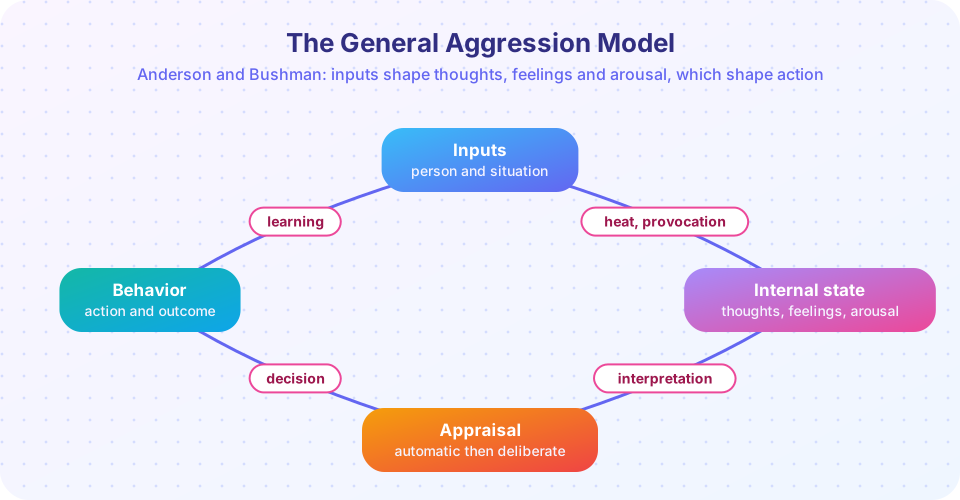
Craig Anderson and Brad Bushman developed the General Aggression Model (GAM) to bring these pieces together:
- Inputs: person factors (traits, beliefs, attitudes) and situation factors (provocation, aggressive cues, heat).
- Present internal state (the routes): thoughts, feelings and arousal.
- Appraisal and decision: an immediate, automatic appraisal, and sometimes a slower reappraisal if there is time and resources.
- Outcome: thoughtful or impulsive action, which then changes the social situation and feeds back into learning.
GAM explains why the same provocation can lead to different outcomes: it depends on who you are, how you feel and how you interpret what happened.
Media violence: what the evidence says
Does watching or playing violent media increase aggression? Anderson and Bushman (2001) meta-analyzed dozens of studies and reported a small-to-moderate association between violent video game exposure and aggressive thoughts, feelings and behavior. Other researchers, such as Christopher Ferguson, argue that effects are smaller than reported, partly because of publication bias and problems with measuring aggression in the lab (for example, giving someone a louder noise blast). Most scientists agree that the average effect on everyday aggression is small and that violent media are not by themselves a cause of serious violence; they disagree on how important the small effect is. In short: it is a contested area, and good answers need careful measures, long follow-ups and attention to individual differences.
Reducing aggression
- Teach skills for managing anger and solving conflicts.
- Reduce provocation and humiliation where possible; give people a way to save face.
- Encourage empathy and perspective-taking.
- Model nonviolent responses and avoid rewarding aggression.
- Limit alcohol and other triggers in high-risk settings.
- Rely on cooling-off and reappraisal, not on venting.
Common misconceptions
"Venting gets anger out of your system." Evidence suggests venting can keep anger alive.
"Aggression is purely instinct." Biology, learning and situation all play parts.
"Violent media prove why people commit violent crimes." The evidence does not support that strong claim.
Try it
Press Run (or Ctrl + Enter) to see the result here.
Program input · what you'd type while the program runs
Type the answers before you press Run, one per line. Each time the program reads a line (with input()), it gets the next line from this box.
Press Run (or Ctrl + Enter) to see the console output here.
No output.
Check your understanding
Quick check · 5 questions
of 5 answered You scored / 5 · perfect!
-
1. Which behavior counts as aggression by the standard definition?
Aggression involves intent to harm someone who wants to avoid it. -
2. In the Bobo doll study, children who saw an aggressive model...
Observation taught specific aggressive behaviors. -
3. Bushman's research on venting found that hitting a punching bag...
It tended to keep anger rehearsed rather than draining it. -
4. In the GAM, appraisal can be...
Reappraisal can change the outcome when there is time and capacity. -
5. The state of the evidence on violent media and everyday aggression is best summarized as...
Experts agree on a small average effect and disagree about its importance.
Summary
- Aggression is intended harm to someone who wants to avoid it; hostile and instrumental types differ.
- Biology, learning, culture and situations (provocation, heat, alcohol) all contribute.
- The General Aggression Model integrates inputs, internal states, appraisal and behavior.
- Venting does not reliably reduce anger; skills, empathy and reappraisal do better.
Track your progress
Create a free account to tick off lessons and pick up where you left off on any device.
of Social Psychology lessons completed