


















Lesson 29 of 46 · Group Behavior
Deindividuation, Crowds and Cooperation
How anonymity and crowds change behavior, what the SIDE model adds, and how social dilemmas such as the tragedy of the commons can be solved with trust and rules.
Why do people behave differently in a stadium, in a mask or behind a username than they would face to face? And why do shared resources, from fisheries to the climate, so often get overused even when everyone would be better off if they cooperated? This lesson covers two large ideas. The first is deindividuation, the loosening of self-awareness in crowds and under anonymity. The second is the social dilemma, where what is good for each person differs from what is good for the group.
What you will learn
- The classic deindividuation idea and the main experiments.
- Why the modern SIDE model says anonymity makes social identity, not chaos, more important.
- The structure of social dilemmas: public goods, prisoner's dilemma and the commons.
- What actually helps people cooperate, including Ostrom's findings.
Key terms
Deindividuation: a state of reduced self-awareness and weaker attention to personal standards, often linked to anonymity or large groups.
Social dilemma: a situation where individual self-interest conflicts with the group's best outcome.
Free rider: a person who benefits from a shared good without paying a fair share.
Tragedy of the commons: depletion of a shared resource when each user acts in self-interest.
Deindividuation
In 1895 Gustave Le Bon argued that crowds could turn rational people into impulsive followers. In 1952 Leon Festinger, Albert Pepitone and Theodore Newcomb gave the idea its modern name. The core claim: in a large group, or when anonymous, people feel less identifiable, less self-aware and less restrained, and so they follow situational cues more than personal standards.
Some well-known findings:
- Hooded participants (Zimbardo, 1969). Women in an experiment gave what they thought were electric shocks to another person. Those in large hoods and lab coats gave longer shocks than those wearing name tags and individual clothing.
- Halloween children (Diener, Fraser, Beaman and Kelem, 1976). Children trick-or-treating in a field study took more candy than allowed when they were anonymous and in a group, especially when the group was anonymous too.
- Costumes cut both ways (Johnson and Downing, 1979). Participants in outfits resembling the Ku Klux Klan gave more intense shocks than those in nurse uniforms, whose uniforms signaled care. The costume's meaning mattered.
What goes wrong with the simple story
A meta-analysis by Tom Postmes and Russell Spears (1998) found that deindividuating conditions did not consistently make people antisocial. The SIDE model (social identity model of deindividuation effects, Reicher, Spears and Postmes) offers a better account. When people are anonymous within a group, their personal identity fades and their shared social identity becomes more important, so they follow the norms of the group they identify with. If the group's norms are aggressive, behavior can be aggressive. If the norms are peaceful or helpful, it can be peaceful. Online, anonymity often leads to harsh or kind behavior depending on the community's norms.
Social dilemmas
A social dilemma has two features: each person is better off acting selfishly whatever others do, but everyone is worse off if all act selfishly. Three standard forms:
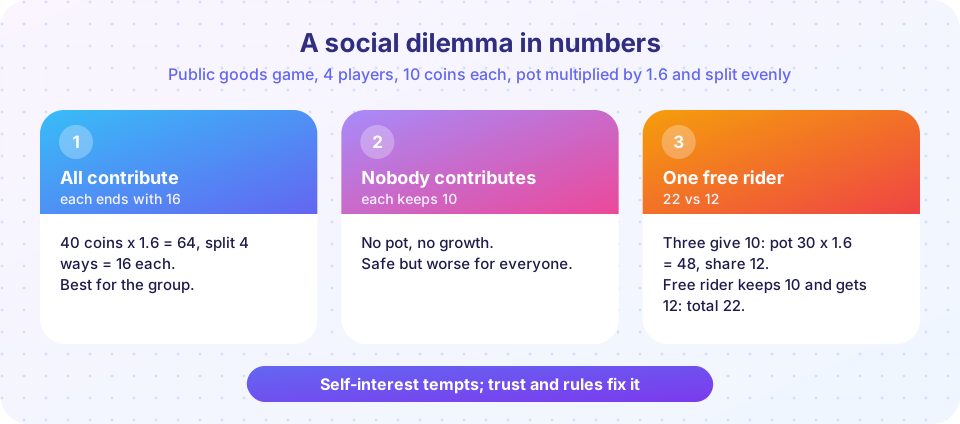
- Public goods games. Everyone chooses how much to contribute to a shared pot that is multiplied and divided. In our example, four players have 10 coins each, and the pot is multiplied by 1.6 and split evenly. If all contribute, each ends with 16. If none contribute, each keeps 10. If three contribute and one keeps theirs, the contributors get 12 each and the free rider gets 22. Free riding pays unless others respond.
- The prisoner's dilemma. Two players choose to cooperate or defect. Mutual cooperation beats mutual defection, but each is tempted to defect.
- The tragedy of the commons. Garrett Hardin (1968) described herders sharing a pasture: each gains from adding one more animal, while the cost of overgrazing is shared. The commons collapses.
What helps cooperation
- Communication. Robyn Dawes and colleagues found that discussion before choosing raises cooperation, partly through promises and trust.
- Repeated interaction and reciprocity. Robert Axelrod's computer tournaments (1980s) found that a simple strategy, tit for tat (cooperate first, then copy the other player's last move), did very well. It is nice, retaliatory, forgiving and clear.
- Reputation. People who are seen cooperating can gain status and future partners.
- Sanctions. Studies of public goods games show that many people will pay a small cost to punish free riders, and that punishment can sustain cooperation (though it can also cause counter-punishment in some settings).
- Rules and institutions. Elinor Ostrom (Nobel Prize in Economics, 2009) studied real communities that managed shared resources such as fisheries and irrigation systems. They did not need privatization or central control. Successful systems tended to have clear boundaries, rules fitted to local conditions, participation of users in rule-making, monitoring, graduated sanctions, easy conflict resolution and recognition by outside authorities.
Common misconceptions
"Anonymity makes people evil." It makes group norms more influential. Those norms may be harmful or helpful.
"The tragedy of the commons is inevitable." Ostrom's cases show that communities often solve it.
"People are purely selfish." Many people cooperate conditionally and punish free riders, especially when others also cooperate.
Try it
Press Run (or Ctrl + Enter) to see the result here.
Program input · what you'd type while the program runs
Type the answers before you press Run, one per line. Each time the program reads a line (with input()), it gets the next line from this box.
Press Run (or Ctrl + Enter) to see the console output here.
No output.
Check your understanding
Quick check · 4 questions
of 4 answered You scored / 4 · perfect!
-
1. What does the SIDE model add to deindividuation theory?
When personal identity fades, shared social identity and its norms guide behavior. -
2. In the four-player public goods game, what does a lone free rider earn when the other three give 10 each?
The pot is 30 x 1.6 = 48, so each share is 12. The free rider keeps 10 and gets 12, for a total of 22. -
3. Which strategy did well in Axelrod's tournaments?
It is nice, retaliatory, forgiving and clear. -
4. Which of these is one of Ostrom's design principles?
Successful commons systems fit rules to local conditions, among other principles.
Summary
- Deindividuation is reduced self-awareness under anonymity or in crowds, but its effects depend on group norms.
- The SIDE model says anonymity raises the influence of social identity.
- Social dilemmas pit individual gain against group welfare.
- Communication, reciprocity, reputation, sanctions and local rules help sustain cooperation.
Next: Chapter review
Track your progress
Create a free account to tick off lessons and pick up where you left off on any device.
of Social Psychology lessons completed