


















Lesson 39 of 46 · Relationships, Aggression and Helping
Helping and the Bystander Effect
Why people help or hold back: Darley and Latané's studies, the five-step helping model, Darley and Batson's hurry study, empathy and the latest evidence on bystanders.
In 1964 a young woman named Kitty Genovese was murdered in Queens, New York. A newspaper report said that dozens of neighbors had watched or heard and did nothing. Later investigations showed that the story was exaggerated: some people did not realize what was happening, some did call the police, and the number "38" was not a count of witnesses to the whole event. But the story shocked the public and prompted two psychologists, Bibb Latané and John Darley, to ask a better question: when does being surrounded by other people make it less likely that someone will help? Their answer launched decades of research on helping.
What you will learn
- The Darley and Latané experiments and the idea of diffusion of responsibility.
- The five-step model of helping.
- How situational pressures, such as hurry, affect helping.
- Theories of why people help: empathy, norms and self-interest.
- What recent research says about bystanders in real emergencies.
Key terms
Bystander effect: the finding that, in some emergencies, individuals are less likely to help when others are present.
Diffusion of responsibility: the feeling that responsibility is shared with others, so each person feels less responsible.
Pluralistic ignorance: everyone looks to others for cues and sees calm, so each concludes nothing is wrong.
Altruism: helping motivated by concern for the other person.
The seizure study
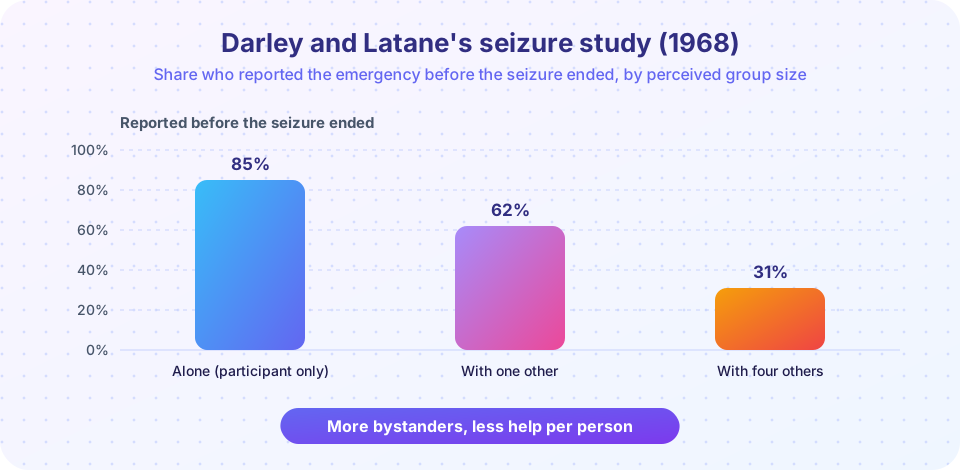
John Darley and Bibb Latané (1968) invited students to discuss personal problems over an intercom, each in a separate room. Some thought they were in a two-person conversation, some in a three-person group, and some in a six-person group. During the discussion, one "participant" (a recording) said he was prone to seizures and then appeared to have one and asked for help. Whether the real participant reported the emergency before the seizure ended depended on how many others they believed could help. Roughly 85 percent reported when they thought they were the only other person, about 62 percent with one other and about 31 percent with four others. More potential helpers, less help per person.
In a second study (Latané and Darley, 1968), people filling out a questionnaire saw smoke enter the room. Alone, most reported it within minutes; when sitting with two calm confederates who ignored the smoke, only about one in ten reported it. People appeared to look at each other, see no alarm, and conclude it was not serious. This is pluralistic ignorance.
The five steps to helping
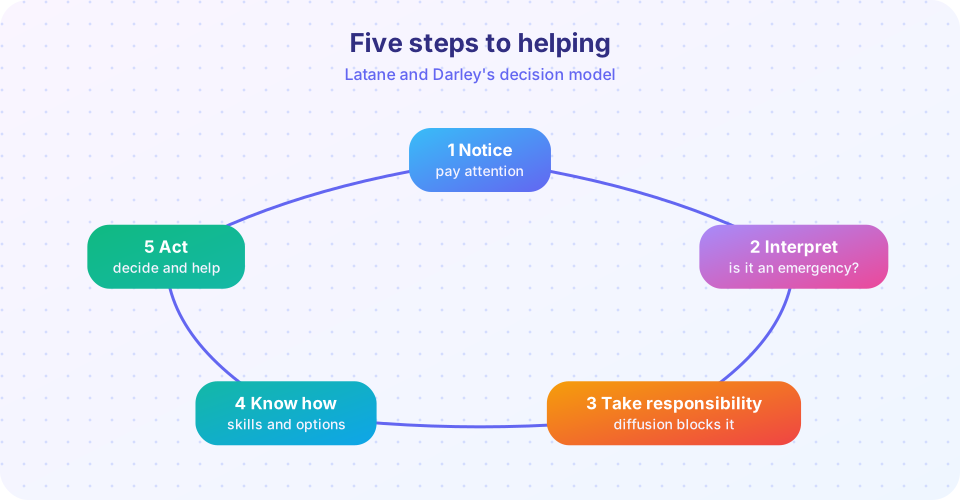
Latané and Darley proposed that a person helps only if they pass through five steps:
- Notice the event. (Hurrying people may not.)
- Interpret it as an emergency. (Ambiguity and the calm of others hinder this.)
- Take responsibility. (Diffusion of responsibility acts here.)
- Know how to help. (Skills and confidence matter.)
- Decide to act. (Costs such as fear of embarrassment or danger weigh in.)
A failure at any step stops help.
Situations, not just character: the Good Samaritan study
John Darley and Daniel Batson (1973) tested seminary students at Princeton. Each was asked to give a short talk, some on the Good Samaritan parable and some on job prospects, in another building. On the way, each passed a slumped, coughing man in an alley. The talk topic made little difference. What mattered was hurry: roughly 63 percent of those in no hurry stopped to help, about 45 percent of those in some hurry, and only about 10 percent of those told they were already late. Being in a rush reduces noticing and care, even in people thinking about helping.
Why do people help?
- Empathy-altruism. Daniel Batson argued that feeling empathic concern leads to genuinely other-focused helping. In his experiments, people high in empathy helped even when they could easily escape.
- Negative-state relief and self-interest. Robert Cialdini and others argued that helping can reduce our own distress or earn rewards or reputation. Researchers still debate whether pure altruism exists, and the answer may be that both motives operate.
- Norms. The norm of reciprocity (return help) and of social responsibility (help those who depend on you) push people to help.
- Evolution. Kin selection and reciprocal altruism offer evolutionary accounts of why helping evolved.
- Mood and personality. A good mood and certain traits make helping somewhat more likely, but the effects are modest relative to the situation.
Does the bystander effect hold in real life?
A meta-analysis by Peter Fischer and colleagues (2011) of about 50 studies confirmed the effect on average but found that it shrank or reversed when the situation was clearly dangerous, when the perpetrator was present, when the bystanders could interact, and when helping required the kind of skill that was obviously needed. A 2020 study by Richard Philpot and colleagues analyzed CCTV footage of public conflicts in three countries and found that bystanders intervened in the large majority of incidents, with more bystanders making intervention more likely on average. Together these results suggest a nuance: the classic effect is real in ambiguous and low-cost lab situations, while real-life emergencies often show more helping than the textbook story implies.
Increasing helping
- Make the emergency clear and direct a request at a particular person ("You in the red jacket, please call 112").
- Teach first aid and safe bystander intervention skills.
- Raise awareness of the five steps so people can recognize where they stall.
- Build norms that intervening is expected and safe.
Common misconceptions
"People in cities do not care." Situations such as hurry, ambiguity and unclear responsibility explain much of the variation.
"The Genovese story shows 38 people ignored a murder." The account was exaggerated; it inspired good research but should not be taught as fact.
"More bystanders always means less help." The effect depends on the situation; in clear and dangerous emergencies it can reverse.
Try it
Press Run (or Ctrl + Enter) to see the result here.
Program input · what you'd type while the program runs
Type the answers before you press Run, one per line. Each time the program reads a line (with input()), it gets the next line from this box.
Press Run (or Ctrl + Enter) to see the console output here.
No output.
Check your understanding
Quick check · 5 questions
of 5 answered You scored / 5 · perfect!
-
1. Diffusion of responsibility means that...
Shared responsibility reduces each person's sense of obligation. -
2. In Darley and Batson's study, what mattered most for helping?
Hurry strongly reduced helping; the topic of the talk did not. -
3. Pluralistic ignorance occurs when...
People use each other as cues, and the cues are misleading. -
4. Which is the third step in Latané and Darley's model?
Notice, interpret, take responsibility, know how, act. -
5. Recent work on real-life bystanders suggests that...
CCTV analysis found frequent intervention, increasing with the number of bystanders.
Summary
- Darley and Latané showed that people reported emergencies less when they believed others could help.
- Helping needs five steps: notice, interpret, take responsibility, know how, act.
- Hurry, ambiguity and pluralistic ignorance can block each step; empathy and norms promote helping.
- Real-world evidence shows more intervention than the classic story suggests, so avoid overgeneralizing.
Next: Chapter review
Track your progress
Create a free account to tick off lessons and pick up where you left off on any device.
of Social Psychology lessons completed