


















Lesson 5 of 46 · Getting Started
Chapter 1 Review: Getting Started
Review the definition of social psychology, the main research designs, replication and ethics, with a one-page summary and a ten-question mixed quiz.
You have finished the first chapter. Before moving on to the self, take a short pause to consolidate. Research on learning shows that retrieving ideas from memory, rather than rereading, makes them stick. Use the picture and the table below as prompts, try to recall each point before you read it, and then take the mixed quiz.
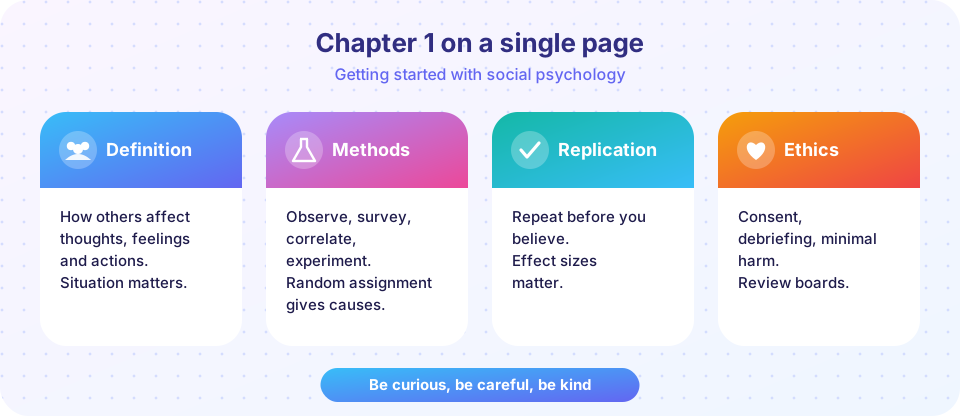
What you will review
- The definition and big ideas of social psychology.
- The four research designs and their limits.
- Why replication and open science matter.
- Ethics for protecting participants.
Recap table
| Lesson | Key idea | One thing to remember |
|---|---|---|
| Course map | Nine chapters, learn by predicting and retrieving | Demos are not diagnoses |
| What is social psychology? | B = f(P, E), construal |
Person and situation interact |
| Research methods | Observe, survey, correlate, experiment | Random assignment supports cause |
| Replication and ethics | Many effects shrank on replication | Consent, debriefing, ethics review |
Common misconceptions
"If a study was published, it is true." Published studies can be wrong or exaggerated; replication and effect size help.
"A correlation shows cause." It does not; look for a third variable and direction.
"Ethics rules slow science down for no reason." They exist because participants were harmed in the past.
Try it
Test yourself with a quick self-quiz, then see how sample size changes certainty.
Press Run (or Ctrl + Enter) to see the result here.
Program input · what you'd type while the program runs
Type the answers before you press Run, one per line. Each time the program reads a line (with input()), it gets the next line from this box.
Check your understanding
Quick check · 10 questions
of 10 answered You scored / 10 · perfect!
-
1. Social psychology differs from sociology because it mainly studies...
The individual's thoughts, feelings and behavior in social settings are its focus. -
2. In B = f(P, E), the letter E stands for...
E is the environment, the situation. -
3. Which statement about construal is correct?
Construal is subjective meaning. -
4. A researcher randomly assigns 100 volunteers to two conditions. This protects...
Random assignment makes the groups comparable. -
5. Ice cream sales and drownings both rise in summer. This is an example of...
Hot weather is the third variable. -
6. What does the WEIRD problem refer to?
Western, educated, industrialized, rich, democratic samples. -
7. The 2015 Open Science Collaboration found that replication effects were...
Effects shrank on average to about half. -
8. Which is NOT a part of ethical practice?
Debriefing is required, so hiding the purpose forever is not acceptable. -
9. A small, surprising study with p = 0.04 should be treated as...
Single small studies are suggestive only. -
10. A double-blind design hides condition information from...
That reduces demand characteristics and experimenter bias.
Summary
- Social psychology studies the individual within a social context; behavior comes from the person and the situation.
- Experiments with random assignment show cause; other designs show links or describe.
- Replication and open science improve reliability, and effect size beats bare significance.
- Ethical research protects participants through consent, withdrawal, confidentiality and debriefing.
Track your progress
Create a free account to tick off lessons and pick up where you left off on any device.
of Social Psychology lessons completed