


















Lesson 18 of 46 · Persuasion and Influence
Compliance Techniques and Cialdini's Principles
Learn foot-in-the-door, door-in-the-face, low-ball and reciprocity techniques, Cialdini's six principles of influence, and what the evidence says about each.
A charity volunteer hands you a small flower and says, "It's a gift, please keep it." A moment later, she asks for a donation. A salesperson shows you a very expensive sofa and then a cheaper one that suddenly looks reasonable. A website offers a price and adds fees only at the last step. None of these people argues much; each of them arranges the sequence of a request.
Researchers call these compliance techniques: ways to increase the chance that someone says yes to a request. Studying them is useful for two reasons. You will recognize them in daily life, and you will learn principles of social influence that run deeper than any single trick.
What you will learn
- Four classic techniques and the studies behind them.
- Cialdini's six principles of influence.
- Why the tricks work (and when they do not).
- Ethical uses and the difference between persuasion and manipulation.
Key terms
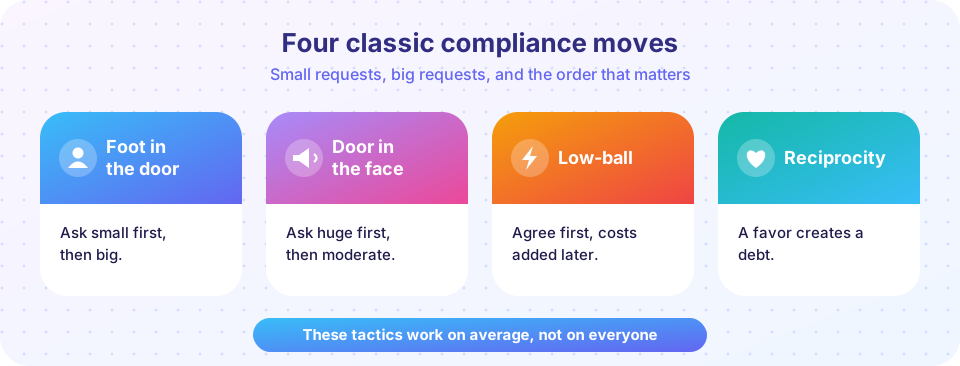
Foot-in-the-door is getting agreement to a small request first, to raise compliance with a larger one. Door-in-the-face is making a large request (refused) first, then a smaller one. Low-ball is securing agreement and then revealing hidden costs. Reciprocity norm is the felt obligation to repay what others give us. Commitment and consistency is the wish to act in line with prior actions. Social proof is following what many others do.
Four classic techniques
Foot-in-the-door
Jonathan Freedman and Scott Fraser (1966) asked homeowners to put a very large, ugly "Drive Carefully" sign on their lawn. Only about one in six agreed. But among homeowners who had earlier agreed to display a small sign or sign a petition, roughly three quarters agreed to the big sign. A small yes made a larger yes more likely.
Why? Partly self-perception (Chapter 2): "I must be the kind of person who supports this cause." Partly commitment: we like to be consistent. Later reviews show that the effect is real but variable; it is larger when the first request is moderate in size, when people comply willingly, and when they feel free. It is not guaranteed.
Door-in-the-face
Robert Cialdini and colleagues (1975) asked university students to volunteer two hours a week for two years as counselors for juvenile delinquents. Almost everyone refused. When a different group was then asked for a much smaller favor, chaperoning a trip to the zoo for two hours, about half agreed, compared with about one in six of those asked only for the small favor. A refused big request makes a smaller one seem like a concession, and reciprocity encourages us to make a concession in return.
Meta-analyses find that the effect is modest on average. It works better if the same person makes both requests, the requests are made by the same person soon after one another, and both are prosocial, as in the charity example.
Low-ball
Cialdini and colleagues (1978) invited students to take part in a psychology study. In the low-ball condition, students first agreed to take part, and only afterwards learned that it started at 7 a.m. In the control condition, they were told the time up front. Many more low-ball participants ended up showing up: about 56 percent versus 24 percent in the original report. Once we make a decision, we feel committed, even if the terms change. Used in sales, this becomes a classic trick: advertise a low price, then add fees. It is widely considered deceptive.
Reciprocity and "that's-not-all"
The reciprocity norm is found in nearly all societies: if someone gives you a favor, you feel obliged to return it. Dennis Regan (1971) found that students who received an unrequested soft drink from a (confederate) fellow participant later bought more raffle tickets from him than those who did not. The feeling of obligation worked even when they did not especially like him. Related is the that's-not-all technique: a seller adds a bonus before you answer, which makes the deal seem generous.
Cialdini's six principles
Robert Cialdini (1984, and later editions) summarized influence in six principles. They are patterns gathered from research and field observation, not laws.
| Principle | Idea | Everyday example |
|---|---|---|
| Reciprocity | We repay favors | A free sample |
| Commitment and consistency | We act in line with past statements | Signing a pledge |
| Social proof | We follow what others do | "Best seller", crowded restaurants |
| Liking | We say yes to people we like | A friendly, similar salesperson |
| Authority | We defer to experts and uniforms | A doctor's advice |
| Scarcity | We want what is rare or running out | "Only 3 left" |
Social proof in a hotel
Goldstein, Cialdini and Griskevicius (2008) tested signs in hotel bathrooms asking guests to reuse towels. A standard environmental message led to roughly 35 percent of guests reusing; a message saying that most guests in the hotel reused towels raised reuse to roughly 44 percent; a message about guests who had stayed in the same room raised it further. People are guided by what similar others do.
Scarcity
Stephen Worchel and colleagues (1975) found that cookies in a jar with only two cookies were rated as more desirable than the same cookies from a jar with ten. Things that are limited feel more valuable, which is why shops announce "limited edition".
Ethics: persuasion versus manipulation
Compliance tactics are tools. A health campaign that uses social proof to encourage handwashing is different from a scam that fakes scarcity. A simple test: Would the person be comfortable if they understood exactly what you were doing and why? Does the request serve their interests, too? Honest uses give accurate information, leave real choice and avoid hidden costs.
Common misconceptions
"These techniques always work." Effects are average tendencies, often modest, and vary with context and people.
"Resisting means saying no to everything." Reciprocity and consistency are healthy social norms; the skill is noticing when they are used against your interests.
"Only salespeople use them." Teachers, parents, charities and friends use them too, often unintentionally.
Try it
Simulate a foot-in-the-door effect, then test your own request-sequencing with a calculator. Both use invented numbers.
Press Run (or Ctrl + Enter) to see the result here.
Program input · what you'd type while the program runs
Type the answers before you press Run, one per line. Each time the program reads a line (with input()), it gets the next line from this box.
Check your understanding
Quick check · 5 questions
of 5 answered You scored / 5 · perfect!
-
1. Freedman and Fraser (1966) showed that agreeing to a small request...
This is the foot-in-the-door effect. -
2. In the door-in-the-face technique, the first request is...
A big refused request makes a smaller one seem reasonable. -
3. The low-ball technique works because...
Once committed, people often stay committed even if costs change. -
4. Which is NOT one of Cialdini's six principles?
The six are reciprocity, commitment, social proof, liking, authority, scarcity. -
5. In the hotel towel study, which message increased reuse the most compared with the standard one?
Descriptive social norms increased reuse.
Summary
- Order and framing of requests change compliance: foot-in-the-door, door-in-the-face, low-ball and that's-not-all.
- Reciprocity, commitment, social proof, liking, authority and scarcity are widely used principles.
- Effects are real but average and variable.
- Honest use means accurate information, no hidden costs and respect for choice.
Next: Resisting Influence
Track your progress
Create a free account to tick off lessons and pick up where you left off on any device.
of Social Psychology lessons completed