


















Lesson 33 of 46 · Prejudice and Stereotypes
Implicit Bias and How It Is Measured
Explicit versus implicit attitudes, how the Implicit Association Test works, what the evidence says about its reliability and predictions, and what stereotype threat is.
If you ask people whether they hold prejudiced attitudes, most say no. Some of them are being honest and some are not, but a deeper problem is that people may not have full access to their own associations, and may not want to report them. Researchers therefore developed indirect measures that infer attitudes from behavior such as response times. The best known is the Implicit Association Test (IAT). It is also one of the most debated tools in the field, so a careful reading is essential.
This lesson is about research. A score on any test discussed here is not a diagnosis of a person's character.
What you will learn
- The difference between explicit and implicit attitudes.
- How an IAT trial and score work.
- Strengths and limits of the IAT.
- What stereotype threat is, and why its effect size is debated.
- Why these topics matter for the way we talk about bias.
Key terms
Explicit attitude: an attitude you can report and endorse.
Implicit attitude: an association that is activated automatically and may differ from what you endorse.
IAT: a response-time test that compares how easily categories and attributes can be paired.
Stereotype threat: concern about confirming a negative stereotype about your group, which may impair performance.
Explicit and implicit
Patricia Devine (1989) argued that nearly everyone in a culture knows its stereotypes and that these can be activated automatically, even in people who sincerely reject them. What distinguishes people is whether they can control the response afterwards. This distinction between automatic and controlled processing underlies much implicit-bias research.
How the IAT works
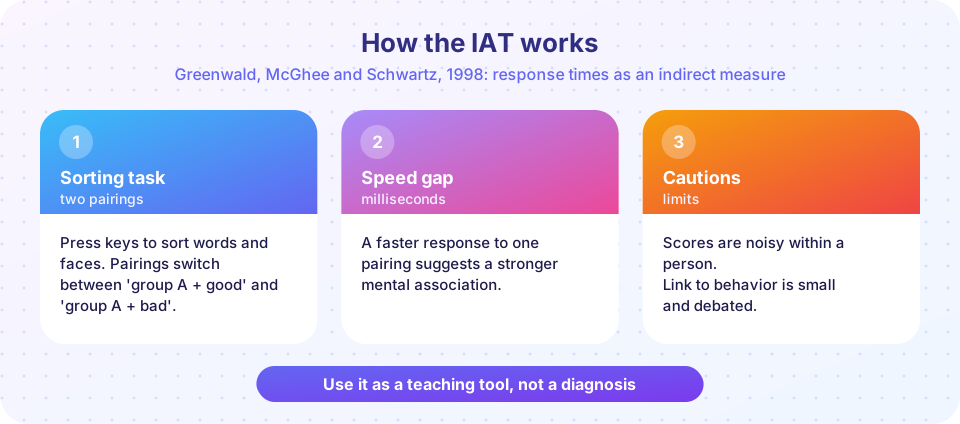
Anthony Greenwald, Debbie McGhee and Jordan Schwartz (1998) introduced the IAT. In a computer task you press one key for items in a category (for example, flowers) and another for items in a different category (for example, insects), then add pleasant and unpleasant words. In one block, "flower" and "pleasant" share a key; in another, "flower" and "unpleasant" share a key. If the first pairing is easier, you respond faster. The difference in average response time (adjusted by a scoring algorithm) is the IAT effect. Replace flowers and insects with social groups and you have a social IAT.
The logic is: associations that are strong in memory are quicker to pair. The test is popular because it is quick, hard to fake in certain ways, and has been taken by millions of people through the Project Implicit website.
What does the evidence say?
- Reliability. The score of one person can change from one occasion to the next. Test-retest reliability is modest, which makes it a poor tool for judging a single individual.
- Relation to explicit measures. Implicit and explicit scores are correlated, but only weakly to moderately.
- Prediction of behavior. Meta-analyses disagree somewhat, but they agree that the average relationship between IAT scores and behavior is small. A large meta-analysis by Oswald and colleagues (2013) concluded it was weak, while Greenwald and colleagues (2009) argued that the IAT predicts some discriminatory behavior at least as well as explicit measures in intergroup settings. A cautious reading is that average group-level patterns can be informative, while an individual's score is a noisy guide.
- Changing implicit scores. Patrick Forscher and colleagues (2019) reviewed hundreds of studies on interventions that aim to shift implicit measures. Effects were generally small and not clearly durable, and links to changes in behavior were uncertain.
Related research looks at split-second decisions. In "shooter bias" studies (Joshua Correll and colleagues, 2002), participants playing a video game decided whether to shoot or not shoot people holding objects. On average, participants were quicker to shoot armed Black targets and quicker to hold fire on unarmed White targets. Such studies are laboratory tasks, but they illustrate how stereotypes can bias fast decisions.
A fair summary
Implicit measures capture something real about patterns of association, and they are valuable for research at the group level and for teaching. But they are not lie detectors for prejudice, and they should not be used alone for hiring, selection or diagnosis.
Stereotype threat
Claude Steele and Joshua Aronson (1995) found that Black students performed worse on a difficult verbal test when it was described as diagnostic of ability than when it was not. They proposed that awareness of a negative stereotype adds pressure, which can reduce performance. Similar findings were reported for women and math tests. Later work has been mixed: some large replication attempts found small or no effects, and meta-analyses suggest publication bias may inflate the average. The current view is that stereotype threat may occur under certain conditions, but its size is uncertain and likely smaller than early headlines suggested.
What this means
Bias in behavior can come from many sources: explicit attitudes, automatic associations, habits, defaults and organizational design. Researchers therefore often recommend changing structures (clear criteria, structured interviews, anonymized review, accountability) rather than relying only on awareness training.
Common misconceptions
"A high IAT score proves you are prejudiced." It is a noisy indicator and does not reliably predict an individual's behavior.
"Implicit bias is the main cause of inequality." It is one factor among many, alongside structure, incentives and explicit bias.
"All priming and bias findings replicate." Some famous priming studies failed to replicate, which is why this field values large, preregistered studies.
Try it
Press Run (or Ctrl + Enter) to see the result here.
Program input · what you'd type while the program runs
Type the answers before you press Run, one per line. Each time the program reads a line (with input()), it gets the next line from this box.
Check your understanding
Quick check · 5 questions
of 5 answered You scored / 5 · perfect!
-
1. What does the IAT compare?
It uses response-time differences between pairings. -
2. Which is a fair conclusion about the IAT?
Evidence suggests small average links and modest reliability. -
3. Devine (1989) argued that...
What differs is control, not the knowledge. -
4. Stereotype threat is...
Steele and Aronson proposed this effect; its size is debated. -
5. Which approach do many researchers recommend over awareness training alone?
Changing structures can reduce the room for bias.
Summary
- Implicit measures infer associations from response times; the IAT is the best known.
- IAT scores are noisy for individuals and weakly predict behavior on average, so they are not diagnostic.
- Stereotype threat may exist but effect sizes are debated.
- Changing structures is a strong complement to changing attitudes.
Next: Reducing prejudice
Track your progress
Create a free account to tick off lessons and pick up where you left off on any device.
of Social Psychology lessons completed