


















Lesson 13 of 46 · Social Cognition and Attitudes
Attribution and Bias: Explaining Behavior
Heider and Kelley on how we explain behavior, the fundamental attribution error, actor-observer difference, self-serving bias, culture and the just-world belief.
A driver cuts in front of you and you think, "What a reckless jerk." An hour later you cut someone off yourself and think, "I was late and the lane was ending." Same behavior, two explanations. We are constantly explaining why things happen, and especially why people act as they do. The process is called attribution, and it is one of the richest topics in social psychology because our explanations shape our feelings, judgments and actions toward others.
What you will learn
- Dispositional and situational attributions.
- Kelley's covariation model.
- The fundamental attribution error and its classic studies.
- The actor-observer difference and self-serving bias.
- Cultural differences and the just-world belief.
Key terms
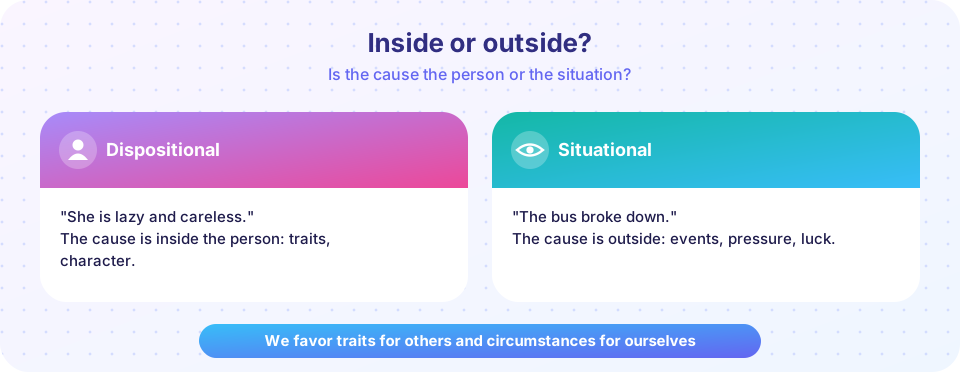
Attribution is an explanation of the cause of behavior or events. Dispositional attribution locates the cause in the person (traits, motives). Situational attribution locates the cause in circumstances. Fundamental attribution error (FAE) is overestimating dispositions and underestimating situations when explaining others (also called correspondence bias). Self-serving bias is crediting ourselves for success and blaming circumstances for failure. Just-world belief is the assumption that people get what they deserve (Melvin Lerner).
Heider and the naive scientist
Fritz Heider (1958) argued that people act like "naive scientists": we want to predict and control our world, so we seek causes. He distinguished internal causes (ability, effort, intention) from external ones (task difficulty, luck, pressure). These two categories form the basis of the field.
Kelley's covariation model
Harold Kelley (1967) described how we decide when we have information from several instances, like a detective comparing clues. Three kinds of information matter:
| Information | Question | Pattern that points to the person | Pattern that points to the situation |
|---|---|---|---|
| Consensus | Do other people act this way? | Few others do | Most others do |
| Distinctiveness | Does the person act this way in other situations? | Yes, in many | No, only here |
| Consistency | Does the person act this way every time? | Yes | (needed for either) |
Example: Sam criticizes a movie. If nobody else does (low consensus), Sam criticizes every movie (low distinctiveness) and always does (high consistency), we infer something about Sam. If everyone criticized this movie (high consensus), Sam does not criticize others (high distinctiveness), and he always criticizes this one (high consistency), we blame the movie. People use such logic reasonably well when the information is available, but often it is not.
The fundamental attribution error
The essay study
Jones and Harris (1967) asked students to read an essay either praising or criticizing Fidel Castro's Cuba. Some were told the writer chose the position; others were told that the writer had been assigned it. When the position was chosen, readers inferred the writer's real attitude, as expected. But even when readers knew the position had been assigned, they still inferred that the writer's attitude somewhat matched the essay. They underweighted the situational pressure.
The quiz game
Ross, Amabile and Steinmetz (1977) had students randomly assigned to be questioners (who wrote hard questions from their own knowledge) or contestants. Everyone knew roles were assigned by chance. Yet observers, and the contestants themselves, rated the questioners as more knowledgeable, ignoring that the role gave them an unfair advantage. The role created the appearance of ability.
Why does it happen?
The situation is often less visible than a person; we focus on the actor. We also first make an automatic dispositional inference and then adjust, and adjustment takes effort that we often lack. In everyday life: we assume a late colleague is irresponsible, and forget about traffic.
The actor-observer difference
Jones and Nisbett (1971) proposed that actors explain their own behavior by situations, while observers explain the same behavior by dispositions. The effect is not universal: it is stronger for negative events, and meta-analysis shows mixed support. The reasons include perspective (we see the world from our position, so the situation fills our view, while for an observer the person fills the view) and knowledge (we know our history and intentions).
Self-serving bias
We take credit for successes and blame failures on external factors: "I aced it because I'm smart; I failed because the test was unfair." It protects self-esteem and presentation. Miller and Ross (1975) reviewed the evidence; some researchers argue part of it is due to rational reasoning, but motivational effects seem real too. Its mirror in teams is group-serving bias. Interestingly, people with depressive symptoms sometimes show the reverse, blaming themselves for failures and not crediting themselves for successes, but this is a research finding, not a diagnostic tool.
Culture and attribution
Morris and Peng (1994) compared English-language and Chinese-language newspaper reports of two mass shootings. English reports emphasized the shooter's dispositions, such as his bad temper; Chinese reports emphasized situational and relational factors, such as his relationship with an advisor. Similar patterns appeared in how American and Chinese students explained the events. Joan Miller (1984) found that Indian adults, compared with American adults, offered more contextual explanations as they got older. This suggests that the FAE is stronger in some cultures, with more emphasis on traits in individualist cultures, though it appears in many cultures to some degree.
Defensive and just-world attributions
When bad things happen to others, we may blame the victim. Melvin Lerner's just-world belief (1980) says people want to believe the world is fair, so if something bad happens, the person must have deserved it. This makes the world feel safe, but it is unfair to victims. Defensive attribution goes similarly: we blame victims more when the event could happen to us. Being aware of this bias helps us respond with more empathy.
Hostile attribution bias
Some people, especially children who have experienced aggression, tend to read ambiguous acts as hostile ("he bumped me on purpose"). This can lead to conflict. Programs that teach children to consider alternative explanations can help. We return to this in Chapter 8.
Improving our explanations
- Ask: "What else could explain this?" Think of the situation first.
- Imagine yourself in the other person's place.
- Gather more information on consensus, distinctiveness and consistency.
- Slow down before judging, especially under stress.
Common misconceptions
"Dispositions never matter." The FAE is overestimating them, not denying them.
"The FAE is the same everywhere." Its strength varies across cultures and situations.
"Self-serving bias means people always lie about their causes." It is usually an unaware tendency, not a deliberate lie.
Try it
Use Kelley's logic on cases, and simulate the quiz-game effect. Both are teaching models.
Press Run (or Ctrl + Enter) to see the result here.
Program input · what you'd type while the program runs
Type the answers before you press Run, one per line. Each time the program reads a line (with input()), it gets the next line from this box.
Check your understanding
Quick check · 5 questions
of 5 answered You scored / 5 · perfect!
-
1. A dispositional attribution blames...
Dispositional means internal to the person. -
2. In Kelley's model, low consensus, low distinctiveness and high consistency suggest...
Only this person reacts this way, in all situations, every time. -
3. In the Jones and Harris (1967) study, readers...
They underweighted the situational constraint. -
4. Self-serving bias is...
It protects self-esteem. -
5. Morris and Peng (1994) found that Chinese-language reports of shootings emphasized...
Cultures differ in the emphasis on dispositions versus context.
Summary
- Attribution is explaining behavior as person-caused or situation-caused.
- Kelley's covariation model uses consensus, distinctiveness and consistency.
- The fundamental attribution error underweights situational forces on others.
- Actor-observer differences and self-serving bias shape how we explain our own and others' acts.
- Culture influences attribution; just-world and defensive attributions can lead to victim blaming.
Track your progress
Create a free account to tick off lessons and pick up where you left off on any device.
of Social Psychology lessons completed