


















Lesson 31 of 46 · Prejudice and Stereotypes
Chapter 7 Overview: Prejudice and Stereotypes
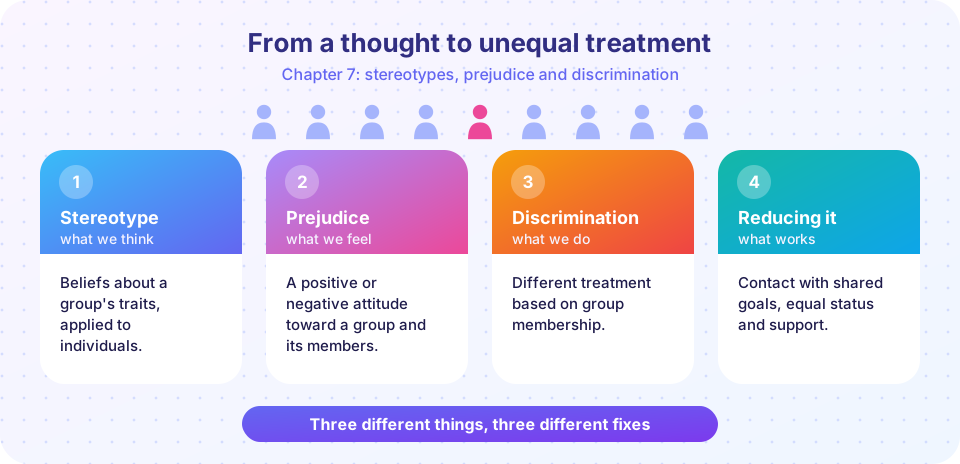
A map of chapter 7: the difference between stereotypes, prejudice and discrimination, where they come from, how they are measured and what reduces them.
People sort the world into categories. That is how minds cope with complexity: "dog", "doctor", "stranger", "tourist". But when we sort people into groups and attach beliefs, feelings and actions to those groups, we enter the territory of prejudice. Social psychologists study it with the same tools as any other topic: careful definitions, measurement, experiments, and an honest look at what the evidence shows and does not show.
This chapter separates three ideas that are often mixed up, looks at where biased thinking comes from, examines how it is measured (including the controversial Implicit Association Test), and then turns to what the evidence says about reducing prejudice.
This chapter discusses bias and discrimination in a scholarly way. It uses research language, not slurs, and it describes patterns across groups, not facts about any individual.
What you will learn
- The ABC model: cognition (stereotypes), affect (prejudice) and behavior (discrimination).
- Where bias comes from, in brief.
- How researchers measure explicit and implicit bias.
- Which interventions have the best evidence.
Key terms
Stereotype: a belief about the traits of a group, applied to its members.
Prejudice: an attitude, positive or negative, toward a group and its members.
Discrimination: unfair treatment based on group membership.
Ingroup / outgroup: the group you belong to, and a group you do not.
A quick tour
Three layers
Where it starts
How we study it
What helps
What each lesson covers
- Stereotypes, prejudice and discrimination: definitions, sources and the stereotype content model.
- Implicit bias and how it is measured: the IAT, its uses and limits, stereotype threat.
- Reducing prejudice: contact, common goals, the jigsaw classroom.
- Chapter review.
Common misconceptions
"Prejudice is a rare trait of a few bad people." Everyone learns stereotypes from their culture, whether or not they endorse them.
"If I have no ill will, I cannot discriminate." Behavior can be shaped by habit, structure and unexamined assumptions.
Try it
Press Run (or Ctrl + Enter) to see the console output here.
No output.
Press Run (or Ctrl + Enter) to see the result here.
Program input · what you'd type while the program runs
Type the answers before you press Run, one per line. Each time the program reads a line (with input()), it gets the next line from this box.
Check your understanding
Quick check · 3 questions
of 3 answered You scored / 3 · perfect!
-
1. Which is the behavioral component of the ABC model?
Behavior is discrimination; affect is prejudice; cognition is stereotype. -
2. A stereotype is mainly a...
It is the cognitive component. -
3. Which statement is accurate?
Cultural knowledge of stereotypes is widespread and not the same as endorsing them.
Summary
- Stereotype, prejudice and discrimination are three linked but separate things.
- Bias has many sources and shows up in explicit and implicit forms.
- Evidence-based approaches such as structured contact work, and need design to work well.
Track your progress
Create a free account to tick off lessons and pick up where you left off on any device.
of Social Psychology lessons completed