


















Lesson 44 of 46 · Projects and Practice
Glossary: Chapters 5 to 8
Plain-language definitions of key social psychology terms from the chapters on conformity, groups, prejudice, relationships, aggression and helping, with a flashcard drill.
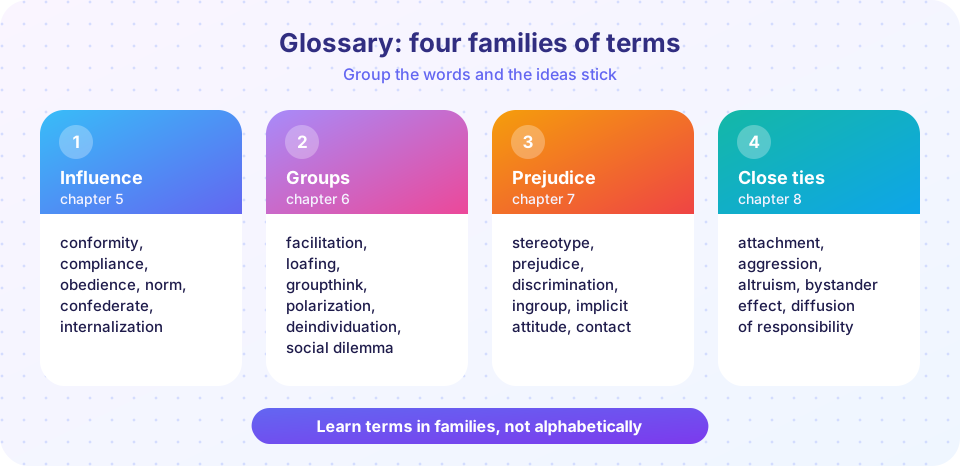
A good glossary is a tool for recall, not a replacement for understanding. Use this one after you have read the lessons, and group the terms into families so each word hangs on an idea. If a definition does not ring a bell, revisit the chapter overviews: conformity and obedience, group behavior, prejudice and relationships, aggression and helping.
What you will learn
- Precise, short definitions for about 40 terms.
- How terms relate within each chapter.
- A way to self-test.
Influence (chapter 5)
| Term | Meaning |
|---|---|
| Social influence | Any change in thoughts, feelings or behavior caused by others |
| Conformity | Changing behavior or belief to match a group |
| Compliance | Outward agreement without private change |
| Identification | Adopting views to be like someone you admire |
| Internalization | Accepting a belief as your own |
| Obedience | Following a direct order from an authority |
| Norm | An unwritten rule about what is expected |
| Normative influence | Conforming to be liked or accepted |
| Informational influence | Conforming because others are evidence |
| Confederate | A person secretly working with the researcher |
| Agentic state | Seeing oneself as carrying out another's wishes |
| Demand characteristics | Cues telling participants what is expected |
Groups (chapter 6)
| Term | Meaning |
|---|---|
| Social facilitation | Others' presence changing performance (better on easy tasks, worse on hard) |
| Dominant response | The most likely response in a situation |
| Evaluation apprehension | Worry about being judged |
| Social loafing | Less individual effort when contributions are pooled |
| Groupthink | Pressure for agreement overriding realistic appraisal |
| Group polarization | Discussion strengthening the average initial lean |
| Hidden profile | A problem where key information is spread across members |
| Deindividuation | Reduced self-awareness under anonymity or in crowds |
| SIDE model | Anonymity can raise the weight of salient group norms |
| Social dilemma | Individual and group interests conflict |
| Free rider | Someone who benefits from a shared good without paying |
| Tragedy of the commons | Depletion of a shared resource by self-interested use |
Prejudice (chapter 7)
| Term | Meaning |
|---|---|
| Stereotype | A belief about the traits of a group |
| Prejudice | An attitude toward a group and its members |
| Discrimination | Unfair treatment based on group membership |
| Ingroup, outgroup | A group you belong to, and one you do not |
| Minimal group paradigm | Favoritism toward arbitrary groups |
| Realistic conflict theory | Competition for scarce resources fuels hostility |
| Illusory correlation | Seeing a link that is not there |
| Stereotype content model | Judging groups on warmth and competence |
| Implicit attitude | An automatic association |
| IAT | A response-time test comparing pairings of categories |
| Stereotype threat | Pressure of confirming a negative stereotype |
| Contact hypothesis | Positive contact under conditions reduces prejudice |
| Superordinate goal | A goal needing the cooperation of both groups |
| Jigsaw classroom | A cooperative method where each student teaches a part |
Relationships, aggression and helping (chapter 8)
| Term | Meaning |
|---|---|
| Proximity effect | Liking people who are physically near |
| Mere exposure effect | Repeated exposure raises liking |
| Attachment style | A pattern of closeness and security (secure, anxious, avoidant) |
| Triangular theory of love | Intimacy, passion and commitment |
| Investment model | Commitment from satisfaction, alternatives and investment |
| Aggression | Behavior intended to harm someone who wants to avoid it |
| Hostile aggression | Harm as an angry goal |
| Instrumental aggression | Harm as a tool toward another goal |
| General Aggression Model | Inputs, internal states and appraisal shape aggression |
| Prosocial behavior | Voluntary action to benefit others |
| Altruism | Helping motivated by concern for the other |
| Bystander effect | Less individual help when others are present (in some situations) |
| Diffusion of responsibility | Feeling less responsible when others are present |
| Pluralistic ignorance | Everyone looks to others and sees calm, so no one acts |
Common misconceptions
"Memorizing definitions is the same as understanding." Practice using the terms on new cases.
"Two similar terms mean the same." Compliance and conformity, or prejudice and discrimination, differ in important ways.
Try it
Press Run (or Ctrl + Enter) to see the console output here.
No output.
Press Run (or Ctrl + Enter) to see the result here.
Program input · what you'd type while the program runs
Type the answers before you press Run, one per line. Each time the program reads a line (with input()), it gets the next line from this box.
Check your understanding
Quick check · 4 questions
of 4 answered You scored / 4 · perfect!
-
1. Which term means outward agreement without private change?
Compliance changes behavior, not belief. -
2. Which term fits 'feeling less responsible because others are present'?
It is the shared-responsibility effect. -
3. A belief about the traits of a group is a...
The cognitive component. -
4. Intimacy, passion and commitment are the parts of...
The triangle of love.
Summary
- Learn terms in families and test yourself by producing definitions.
- Distinguish near neighbors: compliance vs internalization, prejudice vs discrimination.
- Link every term to a study or example.
Next: Cheat sheet
Track your progress
Create a free account to tick off lessons and pick up where you left off on any device.
of Social Psychology lessons completed