


















Lesson 35 of 46 · Prejudice and Stereotypes
Chapter 7 Review: Prejudice and Stereotypes
A recap of chapter 7: the ABC model, sources of bias, the stereotype content model, the IAT and its limits, and contact-based ways to reduce prejudice, with a ten-question quiz.
This review summarizes the chapter on prejudice. Use the one-page picture and the recap table, then try the drill and the quiz.
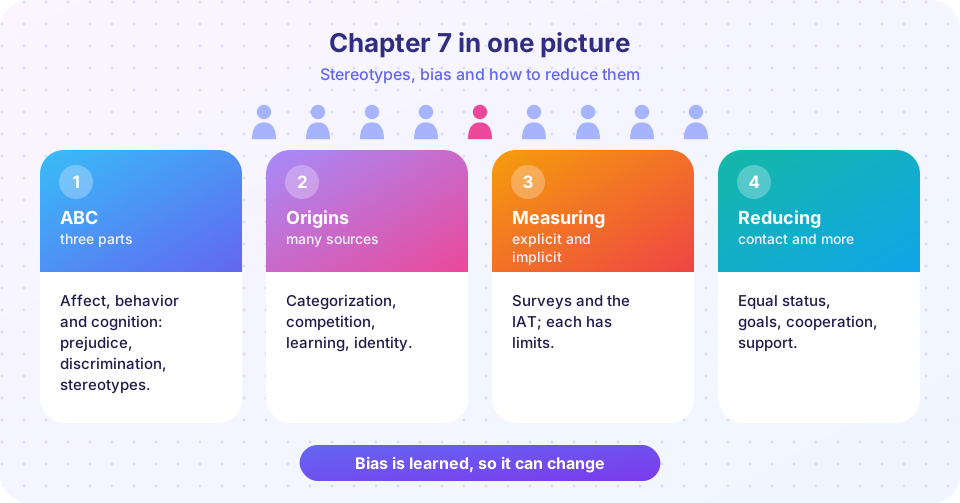
What you will learn
- One anchor idea per topic and its main caution.
- How to link a measure or intervention to the right layer of bias.
Recap table
| Topic | Key idea | Anchor | Caution |
|---|---|---|---|
| ABC model | Stereotype, prejudice, discrimination | Cognition, affect, behavior | Layers can diverge |
| Categorization | Minimal groups favor the ingroup | Tajfel (1971) | Lab setting |
| Competition | Scarce resources fuel conflict | Sherif, Robbers Cave | Adult influence criticized |
| Stereotype content | Warmth and competence | Fiske et al. (2002) | US-origin samples |
| Field evidence | Unequal treatment in real decisions | Bertrand and Mullainathan (2004) | Varies by context |
| IAT | Response-time associations | Greenwald et al. (1998) | Noisy, weakly predictive |
| Stereotype threat | Pressure of a negative stereotype | Steele and Aronson (1995) | Effect size debated |
| Contact | Equal status, goals, cooperation, support | Pettigrew and Tropp (2006) | Modest effects, negative contact risk |
Common misconceptions
"Prejudice is only conscious hatred." It includes pity, habits and structures.
"An IAT result tells me who is biased." It is a noisy indicator.
"Contact always works." Design matters.
Try it
Press Run (or Ctrl + Enter) to see the console output here.
No output.
Press Run (or Ctrl + Enter) to see the result here.
Program input · what you'd type while the program runs
Type the answers before you press Run, one per line. Each time the program reads a line (with input()), it gets the next line from this box.
Check your understanding
Quick check · 10 questions
of 10 answered You scored / 10 · perfect!
-
1. Which is the cognitive component of the ABC model?
Cognition = belief. -
2. Tajfel's minimal group studies showed that...
Even arbitrary groups produced favoritism. -
3. Robbers Cave: what reduced hostility?
Cooperation toward shared goals. -
4. In the stereotype content model, a group seen as warm but incompetent triggers...
Warm and low-competence groups are met with pity. -
5. Bertrand and Mullainathan found that identical résumés...
Names changed callback rates in their audit. -
6. The IAT's main limitation for individuals is...
Scores vary from occasion to occasion. -
7. Stereotype threat is...
Its effect size is debated. -
8. Which of Allport's conditions do jigsaw classrooms build in?
Each student holds a piece others need. -
9. Negative contact can...
Unpleasant encounters can strengthen bias. -
10. Which approach has the strongest evidence among those listed?
It has the best-supported, if modest, effects.
Summary
- Bias has thinking, feeling and acting layers and many sources.
- Measures such as audits and the IAT each have strengths and limits.
- Structured contact has the strongest support; other methods are promising but less proven.
- Pair attitude change with structural change.
Next: Chapter 8 overview: relationships, aggression and helping
Track your progress
Create a free account to tick off lessons and pick up where you left off on any device.
of Social Psychology lessons completed