


















Lesson 19 of 46 · Persuasion and Influence
Resisting Influence: Reactance and Inoculation
How people resist persuasion: reactance, forewarning, McGuire's inoculation theory, prebunking misinformation, and practical skills to protect your judgment.
You are told, "Everyone must do this, no exceptions," and a small voice says, "Oh, really?" You see a message that claims "Only today, buy now!" and wonder if it is true. Human beings are not passive targets of persuasion. We resist, sometimes wisely and sometimes stubbornly. Understanding how resistance works helps you decide when to trust your resistance and when to question it.
This lesson covers natural resistance, a clever way to build it up (inoculation) and practical habits that protect your judgment in a world of ads, rumors and online manipulation.
What you will learn
- Psychological reactance and the boomerang effect.
- Forewarning and attitude strength.
- McGuire's inoculation theory and modern prebunking.
- Skills to resist unwanted pressure while staying open-minded.
- How to resist without becoming closed-minded.
Key terms
Reactance is the motivation to restore freedom when we feel it is threatened (Jack Brehm, 1966). Boomerang effect is when pressure causes people to move in the opposite direction. Forewarning is telling people they are about to hear a persuasive message. Inoculation is exposing people to a weakened counter-argument to build resistance. Prebunking is warning people about misinformation techniques before they meet them. Misinformation is false or misleading information shared regardless of intent.
Reactance
Jack Brehm (1966) proposed that people value their freedom to choose. When that freedom is threatened, for example by a strong command, we feel reactance, an unpleasant arousal that motivates us to restore the freedom, sometimes by doing the forbidden thing or by liking the banned option more. This explains why heavy-handed warnings can backfire: "You must not read this" can make a book more attractive. In studies of health messages, highly controlling language ("you must", "you should") tends to produce more reactance than language that respects choice ("you might consider").
The boomerang effect appears in some campaigns that push too hard. For the communicator, the lesson is to preserve a sense of freedom.
Forewarning
If you know someone is about to try to persuade you, you are often harder to persuade. Forewarning of the topic or of the persuasive intent gives us time to prepare counter-arguments. Research suggests the effect is stronger when the topic matters to us. This is why many people are skeptical of obvious sales pitches. The downside: forewarning can also lead people to dismiss good arguments too fast.
Attitude strength
Strong attitudes (important to us, based on much knowledge, held with confidence and tied to our identity) resist change. Attitudes formed through central-route thinking (previous lesson) are usually more resistant. Commitment also helps: public statements and actions make attitudes harder to shake.
Inoculation
William McGuire (1961) noticed an interesting weakness: many of our beliefs are cultural truisms, such as "you should brush your teeth after every meal", which we rarely hear attacked, so we never practice defending them. McGuire proposed a biological analogy. Just as a weakened virus can build immunity, exposure to a weak version of an attack can build resistance. In his experiments, people who read a mild attack on a truism, together with a refutation, were later more resistant to a strong attack than those who had instead read supportive arguments only.
Inoculation has two parts: a threat (a warning that your belief may be attacked) and refutational preemption (practice refuting the arguments).
Prebunking misinformation
Modern researchers, including Sander van der Linden and Jon Roozenbeek, have applied inoculation to misinformation. Instead of correcting each false claim, they teach people the techniques used in manipulation, such as emotional language, fake experts, conspiracy framing, false dichotomies and scapegoating. In online games and short videos, participants practice spotting these techniques. Studies report that people become better at identifying manipulative content afterwards, though effects vary, can fade over time without reminders and are strongest for the tested techniques. This is an active research area, so treat claims about size and long-term effects with care.
Practical resistance skills
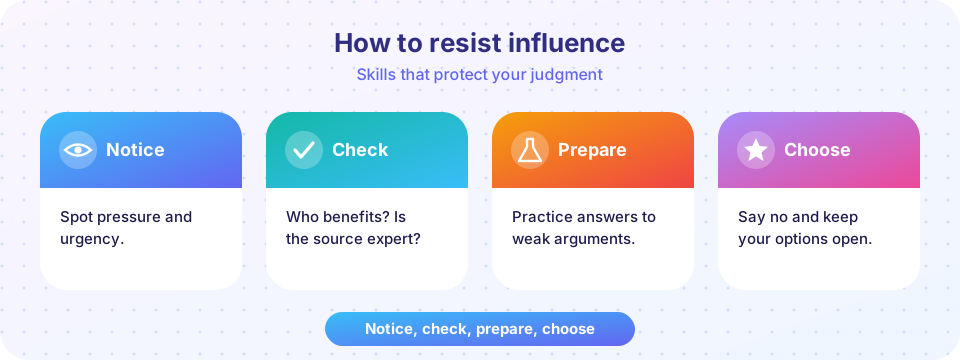
- Notice the pressure. Urgency ("act now"), artificial scarcity, appeals to authority or shame and emotional spikes are signals to slow down.
- Check the source. Who benefits? Is the person really expert in this area? Is there a conflict of interest? Can you verify the claim elsewhere?
- Separate the message from the packaging. Strip away the flattering photos and look at the argument.
- Take time. Sleeping on it, or waiting 24 hours, defeats many pressure tactics.
- Practice saying no politely and firmly: "Thanks, I'll think about it." You do not owe an immediate answer.
- Prepare for common tactics. Knowing that a free gift often invites a return favor lets you accept the gift while deciding freely.
Staying open-minded
Resistance is not the same as stubbornness. The goal is good judgment: yielding to strong evidence, resisting weak or manipulative pressure. A useful question: "What would convince me that I am wrong?" If the answer is "nothing", the belief may be a matter of identity rather than evidence, and it deserves reflection.
Common misconceptions
"I am immune to advertising." The third-person effect shows that most people think ads influence others more than themselves. Research suggests we are more affected than we believe.
"Warnings always work." Over-controlling warnings can cause reactance.
"Debunking is the only fix." Prebunking and media literacy help before misinformation spreads.
Try it
Test reactance with a message-wording demonstration, then simulate how inoculation changes resistance. Both use invented numbers.
Press Run (or Ctrl + Enter) to see the result here.
Program input · what you'd type while the program runs
Type the answers before you press Run, one per line. Each time the program reads a line (with input()), it gets the next line from this box.
Check your understanding
Quick check · 5 questions
of 5 answered You scored / 5 · perfect!
-
1. Psychological reactance is...
Brehm (1966) described reactance as a response to threatened freedom. -
2. Forewarning usually...
Knowing that persuasion is coming helps people prepare. -
3. McGuire's inoculation theory is based on the analogy of...
A weakened attack builds resistance, like a vaccine builds immunity. -
4. Prebunking teaches people...
It focuses on tactics such as emotional language and fake experts. -
5. Which is a good first response to high-pressure urgency?
Urgency is a classic pressure signal.
Summary
- Threats to freedom cause reactance, which can lead to boomerang effects.
- Forewarning and strong, committed attitudes increase resistance.
- Inoculation, a weakened attack plus refutation practice, builds resistance; prebunking applies it to misinformation.
- Practical skills: notice pressure, check the source, separate message from packaging, take time and say no politely.
- Resistance should be wise, not stubborn.
Next: Chapter 4 Review
Track your progress
Create a free account to tick off lessons and pick up where you left off on any device.
of Social Psychology lessons completed