


















Lesson 8 of 46 · The Social Self
Social Comparison and Social Identity
Festinger's social comparison, upward and downward comparison, the big-fish-little-pond effect, social identity theory, the minimal group paradigm and BIRGing.
How good are you at running? You can time yourself, but the number alone means little until you know how others run. A 5-kilometer time of 28 minutes is fast for a beginner and slow for a club racer. Much of what we believe about ourselves is relative: we find out who we are by looking at those around us. We also draw a sense of self from the groups we belong to, whether a football club, a school or a nation.
This lesson covers both ideas: social comparison, the process of evaluating ourselves against others, and social identity, the part of our self built from group membership.
What you will learn
- Festinger's theory of social comparison.
- Upward and downward comparison, and how each feels.
- The big-fish-little-pond effect.
- Social identity theory and the minimal group paradigm.
- Basking in reflected glory and its mirror image.
Key terms
Social comparison is judging our abilities and opinions by comparing them with others (Leon Festinger, 1954). Upward comparison is comparing with someone better off. Downward comparison is comparing with someone worse off. Social identity is the part of self-concept derived from group membership (Henri Tajfel and John Turner). In-group is a group you belong to; an out-group is one you do not. BIRGing means basking in reflected glory: associating with a successful group.
Festinger's theory
Leon Festinger (1954) proposed that people have a drive to evaluate their opinions and abilities, and when no objective standard exists, they use other people. He added that we prefer to compare with similar others, because a comparison with someone very different tells us little. A first-year student judges her essay against classmates, not against a professional novelist.
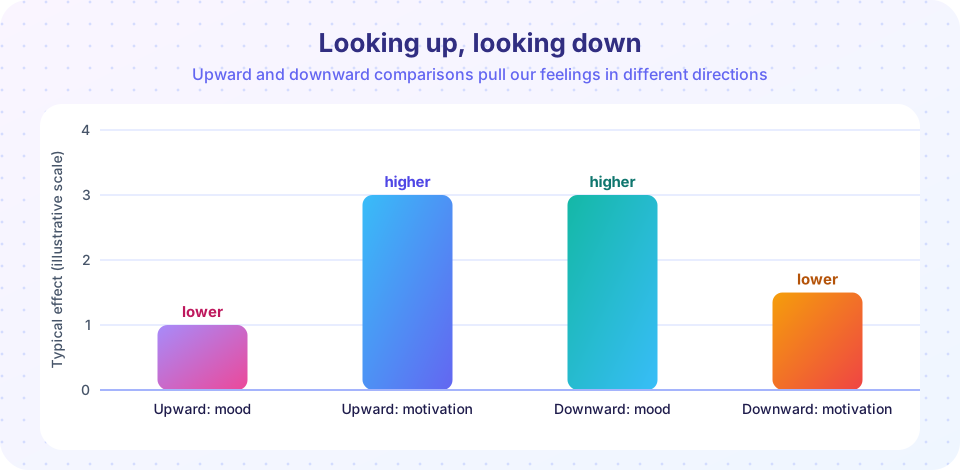
Upward and downward
- Upward comparison can inspire ("she improved, so can I") or hurt ("I'll never be that good"). It tends to lower mood in the short run but can raise motivation when the target seems attainable.
- Downward comparison (Thomas Wills, 1981) can protect mood after a setback: "At least I did better than most." People under threat often seek out worse-off others.
- Lateral comparison with similar others is the most common and informative.
The effect depends on how we construe the comparison. Whether a successful peer is an inspiration or a threat depends on how relevant the area is to the self and how attainable success seems. A student in love with painting feels worse seeing a brilliant classmate than a student who does not care about painting.
The big-fish-little-pond effect
Herbert Marsh and colleagues found that students of the same ability tend to have a higher academic self-concept in a school with lower-achieving peers than in a high-achieving school. Being average among top performers can reduce confidence, even though the education may be better. It is a reminder that self-evaluation is relative.
Comparison online
Social media supplies endless comparison targets, often polished highlights. Research on its effects is mixed: some studies link heavy passive scrolling and appearance comparison to lower mood, others find small or no overall effects, and the direction of cause is hard to establish. Safe conclusion: how people use platforms and who they compare with matter more than the amount of time alone.
Social identity theory
Tajfel and Turner (1979) argued that part of our self-concept comes from belonging to groups, and that we want a positive social identity. To get it, we tend to favor the in-group and judge out-groups less favorably.
The minimal group paradigm
Tajfel's experiments (1971) put teenage boys into groups on trivial grounds, such as a supposed preference for the painter Klee over Kandinsky (in fact the assignment was random). Even when participants did not know who was in their group, never met them and gained nothing personally, they still tended to allocate more points to their own group. Mere categorization can create in-group favoritism. We return to this in Chapter 7 on prejudice.
Reflected glory and its opposite
Robert Cialdini and colleagues (1976) observed that university students were more likely to wear school-branded clothes after the school's football team won, and used "we" for victories but "they" for losses. This is BIRGing, basking in reflected glory. The opposite, CORFing, means cutting off reflected failure. These behaviors protect self-esteem by managing association.
Many identities
Everyone has multiple social identities, and which one is active depends on context. In a foreign country, nationality becomes salient; at a family dinner, family role does. Intersecting identities can be a source of strength and, sometimes, of tension. Social identity also helps explain pride in group achievements and sensitivity to group insults.
Common misconceptions
"Comparison is always bad." It also teaches us, motivates us and builds empathy. The target and the framing matter.
"Group loyalty means hating other groups." Favoring the in-group is common, but it is not inevitable hostility; context shapes it.
"Social media always lowers self-esteem." The evidence is mixed and effects are generally small on average.
Try it
Experiment with how the comparison group changes your standing, and recreate a minimal-group allocation. Both are simulations with invented numbers.
Press Run (or Ctrl + Enter) to see the result here.
Program input · what you'd type while the program runs
Type the answers before you press Run, one per line. Each time the program reads a line (with input()), it gets the next line from this box.
Press Run (or Ctrl + Enter) to see the console output here.
No output.
Check your understanding
Quick check · 5 questions
of 5 answered You scored / 5 · perfect!
-
1. According to Festinger (1954), when there is no objective standard we...
We use similar others to evaluate our abilities and opinions. -
2. Downward comparison tends to...
Comparing with someone worse off can make us feel better. -
3. The big-fish-little-pond effect says that...
Relative standing affects self-concept. -
4. What did the minimal group paradigm show?
Even arbitrary groups led to favoring the in-group. -
5. BIRGing is...
Associating with a winning group to boost the self.
Summary
- We evaluate ourselves relative to others, especially similar others.
- Upward comparison can inspire or hurt; downward comparison can soothe.
- Relative standing shapes self-concept (big-fish-little-pond).
- Social identity theory says group membership forms part of the self and drives in-group favoritism.
- Online comparison effects are mixed and depend on use.
Track your progress
Create a free account to tick off lessons and pick up where you left off on any device.
of Social Psychology lessons completed