


















Lesson 24 of 46 · Conformity and Obedience
Milgram and the Obedience Studies
What Stanley Milgram's obedience studies did and found, how proximity and peers changed the results, how researchers explain them, and what critics say today.
In 1961 Stanley Milgram, then at Yale, began a series of experiments that have become some of the best known and most debated in psychology. They asked a disturbing question: how far will an ordinary person go when an authority tells them to hurt someone? The first results were so striking that they still appear in newspapers, films and classrooms more than sixty years later.
This lesson explains the procedure, the main results, the factors that moved obedience up and down, how researchers explain the findings, and what the best criticisms say. We will also look at the Stanford prison study, often paired with Milgram, and see why it is now treated with caution.
This lesson describes research with deception and distress. It is presented for education and discussion, not as a model for experiments.
What you will learn
- The design of the baseline Milgram study and its headline result.
- Which variations raised or lowered obedience.
- Explanations: the agentic state, gradual commitment and engaged followership.
- Ethical and methodological criticisms.
- Why the Stanford prison study is controversial.
Key terms
Obedience: complying with a direct instruction from a person seen as having legitimate authority.
Agentic state: Milgram's idea that people see themselves as agents carrying out another's wishes rather than as authors of their own actions.
Foot-in-the-door: agreeing to a small request makes agreeing to bigger ones more likely.
Demand characteristics: cues that tell participants what the study is "really" about and how to behave.
The baseline procedure
Participants were adult men recruited by advertisement and told they were taking part in a study of memory and learning. Each arrived with another "participant" (actually a trained confederate, a middle-aged man) and drew slips to decide who would be the teacher and who the learner. The draw was rigged: the real participant was always the teacher.
The learner was strapped into a chair in an adjoining room. The teacher sat at a shock generator with 30 switches labeled from 15 to 450 volts, in 15-volt steps, with verbal labels from "slight shock" to "XXX". The teacher read word pairs; every wrong answer meant a shock one level higher. No shocks were in fact delivered; the learner's protests were pre-recorded and followed a script.
When the teacher hesitated, the experimenter in a lab coat used four standard prods in order: "Please continue", "The experiment requires that you continue", "It is absolutely essential that you continue", and "You have no other choice, you must go on." If a person refused after the fourth prod, the session ended.
The headline result
In the best-known baseline condition (learner in the next room, heard through the wall) 65 percent of participants (26 of 40) went all the way to 450 volts. Many showed obvious distress: sweating, trembling, nervous laughter, arguing with the experimenter. Yet they continued. Everyone in this condition went at least to 300 volts.
Before the study, Milgram had asked psychiatrists and others to predict the result. They guessed that only a tiny fraction of people would go to the end. The gap between prediction and result is part of why the study was so striking.
What changed obedience
Milgram ran many variations, changing one thing at a time. The chart shows approximate figures for some of them.
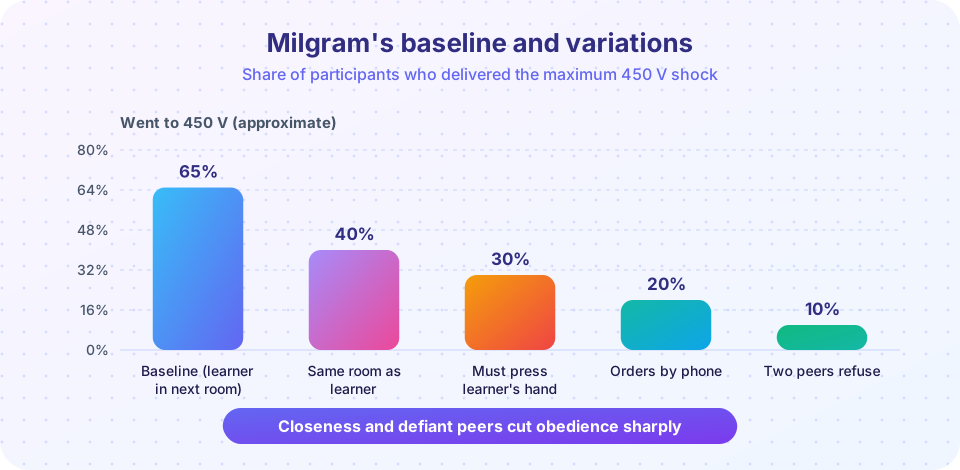
- Closer to the victim. Obedience fell when the learner was in the same room and fell further when the teacher had to press the learner's hand onto a shock plate.
- Farther from the authority. When the experimenter gave orders by telephone, obedience fell a lot (and some pretended to comply).
- Defiant peers. When two other "teachers" (confederates) refused, obedience dropped steeply. This echoes Asch: an ally makes disobedience easier.
- Setting. Moving the study to a rundown office building reduced obedience somewhat but not to zero, so institutional prestige helped but was not essential.
How do researchers explain it?
- The agentic state. Milgram suggested that once under authority, people feel more like instruments than decision makers and say "I was only following orders." This was influential but is now seen as incomplete.
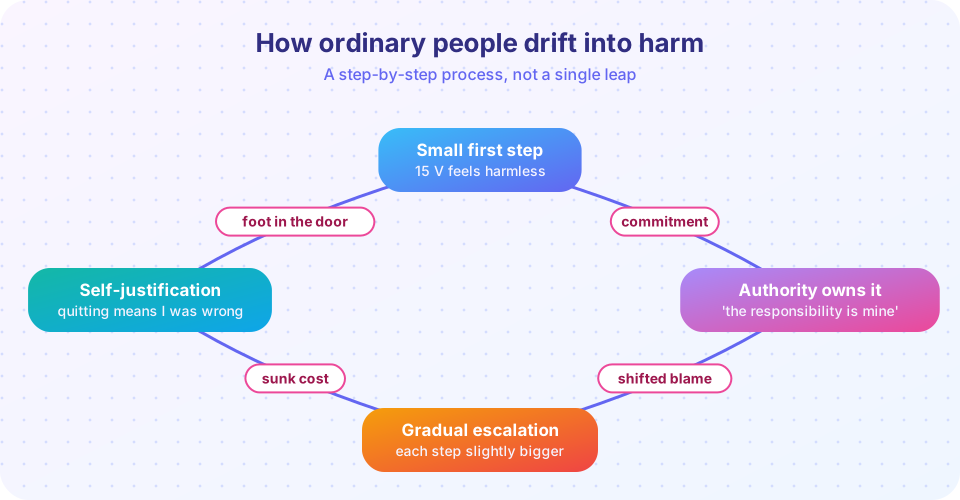
- Gradual commitment. The shocks rose in small steps. Each step was only slightly worse than the last, which makes stopping at any one point feel inconsistent with what you have already done (a foot-in-the-door effect). The cycle diagram below shows how the steps feed each other.
- Engaged followership. Alex Haslam, Stephen Reicher and colleagues point out that the prod "You have no other choice, you must go on" tended to fail, while appeals to the value of the science succeeded. On this view, people were not mindlessly obeying; they identified with the scientific project and believed they were contributing to a worthwhile cause.
Criticisms
- Ethics. Participants were deceived and some were distressed. Many later said they were glad to have taken part, but that does not remove the concerns, and modern ethics boards would restrict this design. Debriefing was imperfect.
- Belief and realism. Did participants believe the shocks were real? Milgram's own data suggested most did, but critics such as Orne and Holland (1968) argued that demand characteristics weakened the claim. Gina Perry's archival work (2013) found cases where the script was not followed and some participants were not convinced.
- Generalization. The sample was American men in 1960s New Haven.
- Partial replication. Jerry Burger (2009) ran a version that stopped at 150 volts (a point after which most people in Milgram's data went on to the end). Rates of continuing past that point were broadly similar to Milgram's, but it is a partial replication, not the whole procedure.
The Stanford prison study
In 1971 Philip Zimbardo and colleagues assigned college men to be "guards" or "prisoners" in a mock prison. The study was stopped after six days instead of two weeks, and was long taken to show that roles alone turn people cruel. Later work challenged this. Archival studies (for example by Thibault Le Texier, 2019) found that guards were coached by the experimenters, and the BBC prison study (Reicher and Haslam, 2002) found that people did not automatically take on roles. Today the Stanford study is treated more as a case study in how researcher expectations and group identity shape behavior than as a clean demonstration.
Common misconceptions
"Two thirds of all people would deliver lethal shocks." The 65 percent figure comes from one condition with 40 men; other conditions had much lower rates.
"The participants did not care." Many were visibly distressed, and some refused.
"Milgram proved that the situation fully controls us." Variations show that people responded to details, and many resisted.
Try it
Press Run (or Ctrl + Enter) to see the result here.
Program input · what you'd type while the program runs
Type the answers before you press Run, one per line. Each time the program reads a line (with input()), it gets the next line from this box.
Press Run (or Ctrl + Enter) to see the result here.
Program input · what you'd type while the program runs
Type the answers before you press Run, one per line. Each time the program reads a line (with input()), it gets the next line from this box.
Check your understanding
Quick check · 5 questions
of 5 answered You scored / 5 · perfect!
-
1. In Milgram's baseline condition, roughly what share went to 450 volts?
26 of 40 participants went to the maximum in the baseline condition. -
2. Which change lowered obedience a lot?
Defiant peers made it much easier to refuse. -
3. Which prod tended to work worst?
The direct order undermined obedience, which supports the engaged followership view. -
4. The agentic state is the idea that people...
People under authority may see themselves as agents rather than authors of their actions. -
5. Which criticism applies to the Stanford prison study?
Later archival work suggests guards were coached and the study was ended after six days.
Summary
- In the baseline study, 65 percent of participants went to 450 volts, though many were distressed.
- Closeness to the victim and defiant peers cut obedience; distance from the authority cut it too.
- Explanations include gradual commitment and engaged followership, not only an "agentic state".
- Ethics, realism and generalization are serious criticisms, and the Stanford prison study is now debated.
Next: Chapter review
Track your progress
Create a free account to tick off lessons and pick up where you left off on any device.
of Social Psychology lessons completed