


















Lesson 37 of 46 · Relationships, Aggression and Helping
Attraction and Close Relationships
What draws people together: proximity, familiarity, similarity and appearance, plus Sternberg's triangle of love, attachment styles and what predicts lasting relationships.
Most of the people closest to you are not random. You probably met them because you lived near them, studied or worked with them, or knew someone who knew them. Then, after a first meeting, many things decide whether a bond grows: how often you see each other, how alike you are, how warmly you respond to each other, and how the relationship rewards and costs each person. Social psychologists have studied each of these for decades.
What you will learn
- How proximity, familiarity and similarity shape who we like.
- What the research says about physical attractiveness, and its limits.
- Sternberg's triangular theory of love.
- Attachment styles and Rusbult's investment model of commitment.
- What predicts satisfaction in long-term relationships.
Key terms
Proximity effect: the tendency to form relationships with people who are physically close.
Mere exposure effect: increased liking for something because of repeated exposure.
Attachment style: a pattern of closeness and security in relationships (secure, anxious or avoidant).
Commitment: the intent to stay in a relationship.
Who do we like?
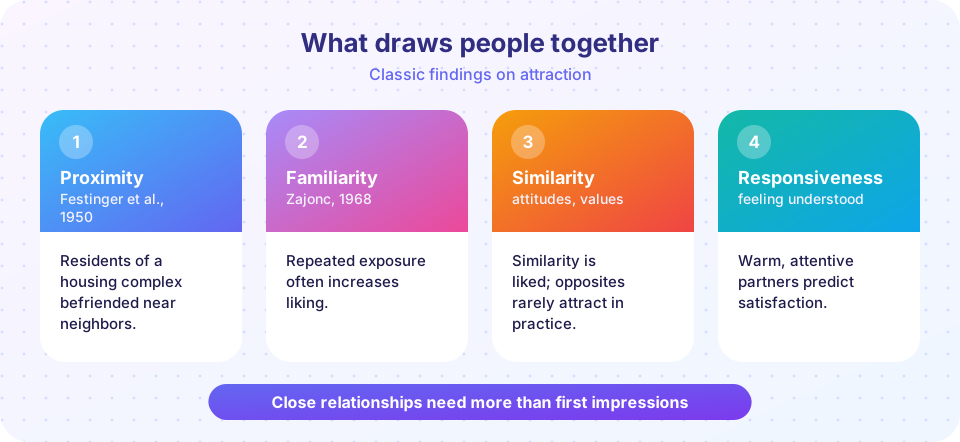
Proximity. In a classic study, Leon Festinger, Stanley Schachter and Kurt Back (1950) looked at friendships among residents of a university housing complex. People were much more likely to be friends with neighbors on the same floor, and especially with the next door neighbor, than with people further away. Some residents near the stairs had more friends because they saw more people. Proximity increases chances to meet and makes interaction cheap.
Familiarity. Robert Zajonc (1968) showed that simply seeing something repeatedly makes people like it more. Richard Moreland and Scott Beach (1992) had women attend a university class zero, five, ten or fifteen times without speaking; students rated those who attended more as more attractive and likable, though they could not recall seeing them very often. Familiarity can also fade into boredom; moderate exposure works best.
Similarity. Donn Byrne's work from the 1960s found that people like those who share attitudes and values; the more alike we are, the more we like. Later research suggests that perceived similarity matters even more than actual similarity in early meetings, though both count in lasting relationships. "Opposites attract" gets little support in this research. Similar partners confirm our views and make life easier to coordinate.
Reciprocity. We like people who like us. Learning that someone likes you raises your liking for them.
Physical attractiveness. In an early study, Elaine Walster and colleagues (1966) paired students at a "computer dance" and found that physical attractiveness was the best predictor of how much people liked their date and wanted to see them again. Later "speed dating" studies (Paul Eastwick and Eli Finkel, 2008) found that the traits people say they want in a partner often do not predict whom they actually like in person, and that chemistry in the moment matters. Attractiveness matters at first, but its importance depends on context, and people's preferences vary across cultures and individuals. Over time, qualities such as kindness, reliability and responsiveness become more important.
Love and closeness
Sternberg's triangular theory (1986) says love has three parts:
| Component | Meaning |
|---|---|
| Intimacy | Closeness, warmth, sharing |
| Passion | Physical attraction and arousal |
| Commitment | Decision to stay and maintain the relationship |
Different combinations give different kinds of love. Liking is intimacy alone; infatuation is passion alone; empty love is commitment alone; companionate love is intimacy plus commitment; romantic love is intimacy plus passion; fatuous love is passion plus commitment; and consummate love has all three. It is a descriptive framework, popular for teaching.
Self-expansion. Arthur Aron and colleagues suggest that in close relationships we include the partner in our sense of self. They also designed a structured conversation with increasingly personal questions, which in lab settings led strangers to feel closer than small talk did.
Attachment
John Bowlby and Mary Ainsworth studied infant-caregiver bonds. Cindy Hazan and Phillip Shaver (1987) applied the idea to adult romance. In simple terms: secure people are comfortable with closeness and independence; anxious people worry about being abandoned; avoidant people prefer distance. Attachment style is associated with how people behave in conflict and intimacy, but it is a tendency, it can shift with experience and partners, and the categories are simplifications.
Staying together
Investment model (Caryl Rusbult, 1980s). Commitment depends on three things: satisfaction (rewards minus costs), quality of alternatives (what else is available), and investment size (time, shared friends, shared possessions). High satisfaction, poor alternatives and large investments raise commitment. The model has support across many types of relationships.
Conflict and communication. John Gottman studied couples in a lab and followed them over years. He identified patterns that predict difficulty, such as criticism, contempt, defensiveness and stonewalling, and the role of repair attempts and positive interactions. His widely quoted ratios come from his lab and are best treated as rough guides rather than exact rules.
Responsiveness. Many studies find that feeling understood, validated and cared for predicts satisfaction better than any single trait.
Culture. Romantic love appears in most societies surveyed (William Jankowiak and Edward Fischer, 1992, found evidence in the large majority of 166 societies), though norms about choosing partners, marriage and expression differ widely.
Common misconceptions
"Opposites attract." Similarity of values and attitudes predicts liking and lasting relationships better.
"Looks are all that matters." Looks matter early; responsiveness and compatibility matter as relationships develop.
"Attachment style is destiny." It is a tendency that can change.
Try it
Press Run (or Ctrl + Enter) to see the result here.
Program input · what you'd type while the program runs
Type the answers before you press Run, one per line. Each time the program reads a line (with input()), it gets the next line from this box.
Press Run (or Ctrl + Enter) to see the console output here.
No output.
Check your understanding
Quick check · 5 questions
of 5 answered You scored / 5 · perfect!
-
1. What did Festinger, Schachter and Back's housing study show?
Physical closeness predicted friendship. -
2. Which component is NOT part of Sternberg's triangle?
The three are intimacy, passion and commitment. -
3. In Rusbult's investment model, commitment rises with...
Those three factors combine to predict commitment. -
4. The mere exposure effect says that...
Moderate repeated exposure tends to raise liking. -
5. Which statement about attachment is best supported?
Attachment styles are patterns that can shift with experience.
Summary
- Proximity, familiarity, similarity, reciprocity and (early on) appearance shape attraction.
- Sternberg's triangle: intimacy, passion, commitment.
- Attachment styles and Rusbult's investment model help explain closeness and commitment.
- Responsiveness and communication matter for long-term satisfaction; cultures differ in how love is expressed.
Track your progress
Create a free account to tick off lessons and pick up where you left off on any device.
of Social Psychology lessons completed