


















Lesson 15 of 46 · Social Cognition and Attitudes
Chapter 3 Review: Social Cognition and Attitudes
Review schemas, heuristics, attribution, the fundamental attribution error, attitudes and cognitive dissonance, with a recap table and a ten-question quiz.
This chapter showed how the mind works as a fast, economical interpreter of the social world, and how our explanations and attitudes grow from it. Try to recall the key terms in your own words before you look at the table, then take the quiz.
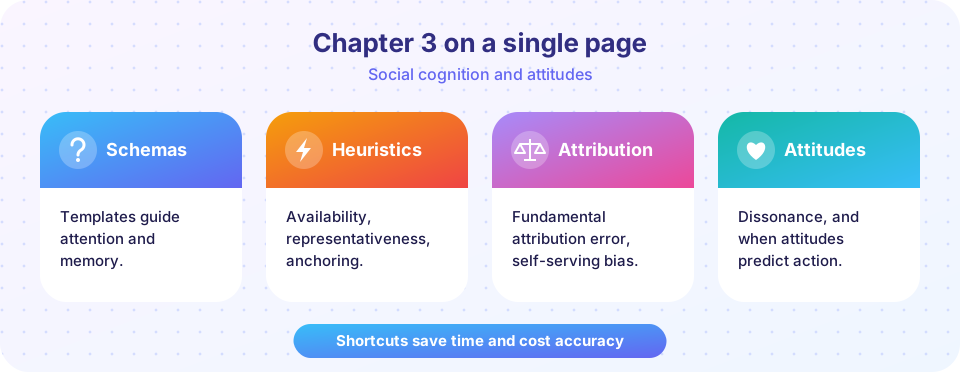
What you will review
- Schemas, priming and confirmation bias.
- Availability, representativeness and anchoring.
- Attribution, the FAE, actor-observer and self-serving biases.
- Attitudes, planned behavior and dissonance.
Recap table
| Lesson | Key ideas | Names |
|---|---|---|
| Schemas and heuristics | Schemas, priming, availability, representativeness, anchoring | Bartlett, Tversky, Kahneman |
| Attribution and bias | Dispositional versus situational, FAE, culture | Heider, Kelley, Jones, Ross, Morris |
| Attitudes and dissonance | ABC model, planned behavior, dissonance | Festinger, Ajzen, LaPiere |
Common misconceptions
"Biases only affect other people." The bias blind spot is itself a bias: we see others' biases more easily than our own.
"The fundamental attribution error means personality is irrelevant." It is about overweighting dispositions when explaining others, not denying them.
"Dissonance means being illogical." It is a psychological tension tied to the self-concept.
Try it
Practice with a quick bias-spotter, then run a mini attribution survey tally.
Press Run (or Ctrl + Enter) to see the console output here.
No output.
Check your understanding
Quick check · 10 questions
of 10 answered You scored / 10 · perfect!
-
1. A schema is...
Schemas organize what we know about concepts, people and situations. -
2. A study asks people to estimate a quantity after seeing a random number. This tests...
Anchoring means being pulled toward an initial number. -
3. Rating 'Linda is a bank teller and feminist' as more likely than 'bank teller' is...
A conjunction cannot be more probable than one of its parts. -
4. Low consensus, low distinctiveness, high consistency suggest...
Only this person acts this way, everywhere, repeatedly. -
5. The fundamental attribution error is...
We underweight situations when explaining others. -
6. Self-serving bias refers to...
It protects self-esteem. -
7. Which attitude best predicts behavior?
Specific, strong attitudes predict better. -
8. In the Festinger and Carlsmith study, which group showed the largest attitude change?
Insufficient justification led to attitude change. -
9. Effort justification means...
Aronson and Mills found liking increased after severe initiation. -
10. Which is NOT a way to reduce dissonance?
Reduction involves changing, adding or trivializing cognitions.
Summary
- The mind uses schemas and heuristics to think quickly; they are efficient and sometimes biased.
- We explain behavior with attributions, and common biases (FAE, self-serving) distort them.
- Attitudes predict behavior under certain conditions; planned behavior adds norms and control.
- Dissonance explains why actions can change attitudes.
Track your progress
Create a free account to tick off lessons and pick up where you left off on any device.
of Social Psychology lessons completed