


















Lesson 32 of 46 · Prejudice and Stereotypes
Stereotypes, Prejudice and Discrimination
Define stereotype, prejudice and discrimination, see where bias comes from (categorization, competition, identity) and learn the stereotype content model.
"Prejudice" is used loosely in everyday talk, but researchers are careful about it because different words point to different causes and fixes. A stereotype is something you believe, prejudice is something you feel, and discrimination is something you do. The three often go together but not always: a person can know a stereotype without believing it, hold a prejudice without acting on it, or discriminate without any conscious ill will, for example by following a rule that disadvantages a group.
What you will learn
- The ABC model and why it matters.
- Sources of bias: categorization, competition, identity, learning, motivations.
- The stereotype content model.
- Evidence of discrimination from field experiments.
Key terms
Social categorization: sorting people into groups, usually automatically.
Minimal group paradigm: studies showing that even arbitrary groups cause ingroup favoritism.
Realistic conflict theory: hostility between groups grows when they compete for scarce resources.
Illusory correlation: perceiving a link between two things (a group and a trait) that are not actually linked.
Three components: A, B and C
- Cognition (stereotype): "Group X is like this."
- Affect (prejudice): "I like or dislike Group X."
- Behavior (discrimination): "I treat people from Group X differently."
Stereotypes are not always negative or false in every detail; the problem is applying a group-level belief to an individual, ignoring variation, and using it to justify unequal treatment.
Where does bias come from?
Categorization and the ingroup. The mind simplifies by sorting. Henri Tajfel's minimal group studies (1971) split schoolboys by trivial criteria, such as an alleged preference for one painter, and then asked them to divide points between anonymous others. Even though the groups had no history, no contact and no benefit, boys tended to give more to their own group. Social identity theory (Tajfel and Turner, 1979) explains this: part of our self-esteem comes from our groups, so we favor them and compare them favorably with others.
Competition. In Muzafer Sherif's Robbers Cave study (1954), two groups of boys at a summer camp in Oklahoma were put into competitions with prizes for only one side. Hostility and name-calling followed. Later, when the groups worked on superordinate goals that needed everyone (such as fixing the water supply), tensions eased. This is the idea behind realistic conflict theory: threats and scarce resources feed prejudice. (The study has been criticized for how much the adults shaped events, so treat it as suggestive.)
Learning and culture. Children absorb stereotypes from family, media and peers, and they can learn them without anyone teaching hatred directly.
Cognitive biases. Illusory correlation (Hamilton and Gifford, 1976): people notice when two rare things coincide, such as a small group and an unusual behavior, and overestimate the link. The outgroup homogeneity effect: we see our own group as varied and others as "all alike". Confirmation bias: we notice cases that fit and explain away cases that do not.
Motives and ideology. Some people are more drawn to hierarchy. Researchers measure social dominance orientation (a preference for group-based hierarchy) and right-wing authoritarianism (Bob Altemeyer's measure of submission to authority and conventionalism); both correlate with prejudice in many studies.
The stereotype content model
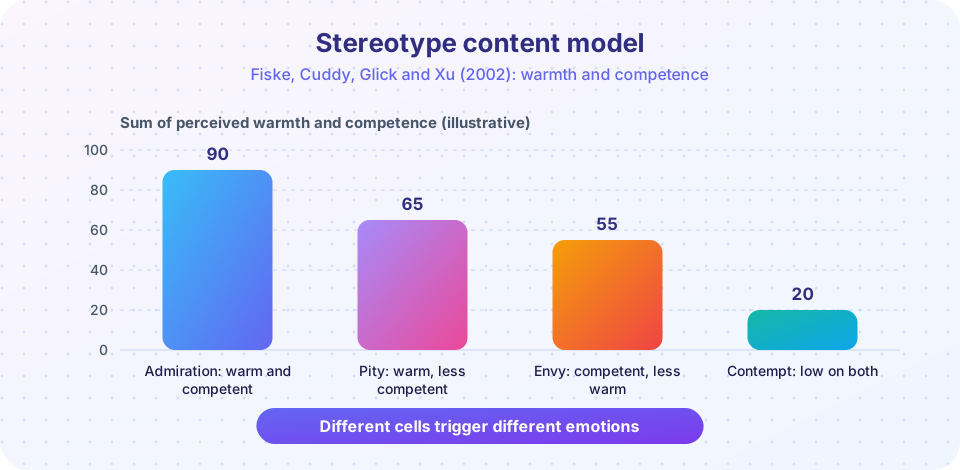
Susan Fiske, Amy Cuddy, Peter Glick and Jun Xu (2002) proposed that people judge groups on two dimensions: warmth (are they friendly and well-intentioned?) and competence (are they capable of carrying out intentions?). Four combinations arise, with different emotions:
| High competence | Low competence | |
|---|---|---|
| High warmth | Admiration (ingroup, close allies) | Pity (for example, in US samples, older people) |
| Low warmth | Envy (for example, in US samples, groups seen as wealthy and powerful) | Contempt (groups seen as both unfriendly and incompetent) |
The model was developed with samples from the United States and then tested in many countries, where similar patterns often (not always) appeared. It shows that prejudice is not a single dial from "positive" to "negative": a stereotype can be positive in one dimension and negative in the other, which still limits people. Peter Glick and Susan Fiske's ambivalent sexism theory makes a related point: benevolent sexism (paternalistic "protective" attitudes) and hostile sexism are linked and both reinforce inequality.
Discrimination in the field
Does bias show up in actual decisions? In a well-known field experiment, Marianne Bertrand and Sendhil Mullainathan (2004) sent thousands of fictitious résumés to employers, identical except for names that were typically White or African American in the United States. Résumés with the White-sounding names received roughly 50 percent more callbacks. Such audit and correspondence studies avoid asking people to report their own attitudes and have been run in many countries and for many characteristics, such as age, religion, disability and gender. Findings vary by setting, but the method provides direct evidence of unequal treatment.
Common misconceptions
"Stereotypes are always false." They can contain a statistical kernel, but they exaggerate differences, ignore variation and lead us to misjudge individuals.
"Prejudice is only hostility." Pity and paternalism are also prejudices.
"Prejudice requires conscious intent." Habits, rules and defaults can produce unequal outcomes.
Try it
Press Run (or Ctrl + Enter) to see the result here.
Program input · what you'd type while the program runs
Type the answers before you press Run, one per line. Each time the program reads a line (with input()), it gets the next line from this box.
Check your understanding
Quick check · 5 questions
of 5 answered You scored / 5 · perfect!
-
1. Which pair is correct?
Cognition, affect and behavior in the ABC model. -
2. Tajfel's minimal group studies showed that...
Trivial categories were enough to produce ingroup favoritism. -
3. In Robbers Cave, hostility decreased when groups...
Goals needing both groups' cooperation eased tensions. -
4. In the stereotype content model, 'pity' goes with...
Warm but seen as less competent. -
5. Field audit studies like Bertrand and Mullainathan's are valuable because they...
They measure behavior in real decisions.
Summary
- Stereotype (belief), prejudice (feeling) and discrimination (behavior) are distinct.
- Bias grows from categorization, identity, competition, learning and cognitive biases.
- The stereotype content model uses warmth and competence to predict emotions.
- Field experiments show unequal treatment in real decisions.
Track your progress
Create a free account to tick off lessons and pick up where you left off on any device.
of Social Psychology lessons completed