


















Lesson 42 of 46 · Projects and Practice
Project: Model the Bystander Effect
Turn Latané and Darley's five-step model into a small simulation, compare ambiguous and clear emergencies, and see why individual helping can fall while group helping holds.
The bystander effect has a puzzle at its core: how can each person be less likely to help when others are around, and yet the group as a whole sometimes does just as well or better? In this project you will model the five-step helping process, compare an ambiguous emergency with a clear one, and then examine your results the way a careful researcher would.
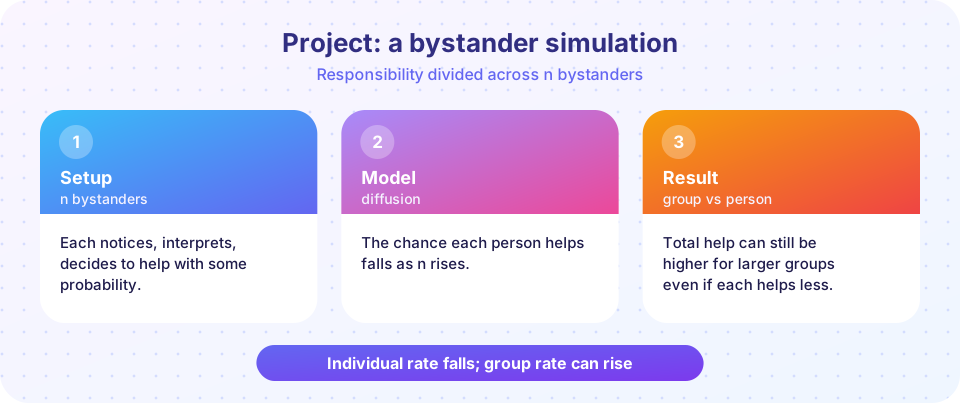
This is a simulation with invented parameters. It shows the logic of a theory, not real helping rates.
What you will learn
- How to encode a multi-step theory as probabilities.
- How an ambiguous and a clear emergency differ in the model.
- Why individual and group results can move in opposite directions.
- How to report model results with proper caveats.
Key terms
Probability model: a model in which outcomes depend on chance with set probabilities.
Conditional probability: the chance of one event given that another has happened.
Individual rate: share of single bystanders who help.
Group rate: chance that at least one bystander helps.
Step 1: Encode the five steps
For a person to help, they must pass all five steps, so their probability of helping is the product of five step probabilities:
- Notice
p1: constant (say 0.9). - Interpret as an emergency
p2: in an ambiguous case, it falls as more calm bystanders are present (pluralistic ignorance); in a clear case, it stays high. - Take responsibility
p3: falls with the number of people present (diffusion of responsibility), for example1 / n ** 0.5. - Know how
p4: constant (0.8). - Act
p5: constant (0.9).
Press Run (or Ctrl + Enter) to see the result here.
Program input · what you'd type while the program runs
Type the answers before you press Run, one per line. Each time the program reads a line (with input()), it gets the next line from this box.
Step 2: Individual rate versus group rate
If each of n people helps independently with probability p, the chance that at least one helps is 1 - (1 - p) ** n. Compute it for both emergencies.
Press Run (or Ctrl + Enter) to see the result here.
Program input · what you'd type while the program runs
Type the answers before you press Run, one per line. Each time the program reads a line (with input()), it gets the next line from this box.
Step 3: Simulate virtual experiments
Rather than using the formula, simulate many events with random draws. This gives you averages and uncertainty.
Press Run (or Ctrl + Enter) to see the result here.
Program input · what you'd type while the program runs
Type the answers before you press Run, one per line. Each time the program reads a line (with input()), it gets the next line from this box.
Step 4: Interpret honestly
- In the model, adding bystanders lowers each person's chance (diffusion and, in the ambiguous case, pluralistic ignorance).
- In the ambiguous case the group rate also falls with size, because pluralistic ignorance cuts every person's chance. In the clear case it rises, because the extra chances that someone acts outweigh the drop in each person's rate. The recent real-world evidence is closer to the clear case, but the model assumes bystanders act independently. In reality they influence each other, in either direction.
- The real findings depend on the situation (clear or ambiguous, dangerous or not), and our model has only crude knobs for that.
Extensions
- Let bystanders see each other's actions, so that once one helps, others join (a social proof effect).
- Add a training parameter that raises
p4("know how") and see how much the group rate changes. - Add a "directed request" condition where one person is asked directly and the responsibility step resets to 1.
- Write three sentences for a newspaper explaining the model's message without overstating it.
Common misconceptions
"The model shows that more people means less help." It shows that more people can mean less help per person under specific assumptions.
"If you set parameters until the result looks right, you have shown the theory is right." You have only shown that you can fit it.
Check your understanding
Quick check · 4 questions
of 4 answered You scored / 4 · perfect!
-
1. In the model, why is the individual rate a product of five step probabilities?
Failure at any step stops help, so probabilities multiply. -
2. What does the formula 1 - (1 - p) ** n give?
It is one minus the chance that nobody helps. -
3. Why can the group rate rise while the individual rate falls?
Even with a lower individual rate, extra chances can raise the group's overall chance. -
4. Which extension would make the model more realistic?
Real bystanders interact, which the independence assumption ignores.
Summary
- The five-step theory can be turned into a product of probabilities.
- Individual rate and group rate answer different questions.
- Models clarify logic; real conclusions need real data and caveats.
Next: Practice set
Track your progress
Create a free account to tick off lessons and pick up where you left off on any device.
of Social Psychology lessons completed