


















Lesson 12 of 46 · Social Cognition and Attitudes
Schemas and Heuristics: Mental Shortcuts
How schemas organize social information, how priming and confirmation bias work, and how availability, representativeness and anchoring shape judgment.
Walk into a classroom you have never seen. Within a second you know where the teacher stands, that the desks are for sitting and that students will probably be quiet when someone starts to speak. You did not reason this out; you used a stored template of what classrooms are like. Social life is full of such templates, and they let us act quickly without starting from scratch every time.
This lesson covers two kinds of mental shortcut. Schemas are knowledge structures that organize what we know. Heuristics are rules of thumb for making judgments. Both are indispensable, and both can mislead.
What you will learn
- What schemas are and how they guide attention, memory and interpretation.
- Priming and self-fulfilling prophecies.
- Three famous heuristics: availability, representativeness and anchoring.
- Counterfactual thinking.
- When we switch from fast to careful thinking.
Key terms
Schema is an organized mental structure of knowledge about a concept or type of person or situation. Priming is when exposure to one stimulus influences how we process a later one. Heuristic is a mental shortcut or rule of thumb for judgment. Availability heuristic is judging how common something is by how easily examples come to mind. Anchoring is giving too much weight to an initial number or piece of information. Confirmation bias is seeking and favoring information that fits existing beliefs.
Schemas
The psychologist Frederic Bartlett (1932) asked English participants to retell a Native American folk story, "The War of the Ghosts." Over repeated retellings, they changed unfamiliar details to fit their own culture's expectations: the story became shorter and more familiar. Memory, Bartlett concluded, is reconstructive and shaped by schemas.
Schemas guide us in several ways:
- Attention: we notice what fits and overlook what does not.
- Interpretation: ambiguous behavior is read through the schema.
- Memory: we remember schema-consistent details and fill gaps with expectations.
- Inference: we guess missing information ("a librarian is probably quiet").
Seeing what we expect
Darley and Gross (1983) showed people a video of a girl, Hannah, taking an oral test. Those told she came from a wealthy background and those told she came from a poor background watched identical footage. Observers rated her ability in line with the expectation attached to her background, showing how schemas colour interpretation of ambiguous evidence.
Priming
Priming means a recently activated idea influences the next judgment. Reading a story about a "hostile" person can make a later ambiguous behavior seem more hostile. Priming of this concept-interpretation kind has solid support. But some famous claims about behavioral priming, such as Bargh's elderly-words-slow-walking study (1996), did not replicate well (Doyen and colleagues, 2012). Treat dramatic behavioral priming results with caution.
Self-fulfilling prophecies
A schema can create its own confirmation. In the "Pygmalion" study (Rosenthal and Jacobson, 1968), teachers were told that certain pupils would "bloom" intellectually; later those pupils, who had been picked at random, were reported to gain more. The study was criticized for methodology, and later analyses suggest that teacher expectations have real but modest effects. The mechanism: an expectation changes how we behave (more warmth, more challenge), which changes how the other person responds.
Confirmation bias
We look for information that confirms what we believe, and interpret mixed evidence in its favor. A schema works as a hypothesis; confirmation bias keeps it alive.
Heuristics
Amos Tversky and Daniel Kahneman, in the 1970s, catalogued heuristics: shortcuts that serve us well but cause predictable errors.
Availability
We judge frequency by how easily examples come to mind. People often think that more words begin with the letter k than have k as the third letter, because words starting with a letter are easier to recall; in fact k is more common in the third position (Tversky and Kahneman, 1973). After seeing news of a plane crash, people may overestimate flying danger: dramatic, vivid examples are easy to recall, even when they are rare.
Representativeness
We judge how likely something is by how well it matches a stereotype or prototype, ignoring base rates. In the famous "Linda problem" (1983), Linda is described as outspoken and concerned with social justice. People often rank "Linda is a bank teller and active in the feminist movement" as more probable than "Linda is a bank teller", which is logically impossible, since the first is a subset of the second. This is the conjunction fallacy.
Anchoring and adjustment
Tversky and Kahneman (1974) spun a rigged wheel of fortune that landed on 10 or 65 and then asked people to estimate the percentage of African countries in the United Nations. The group that saw 10 gave a median estimate of about 25 percent, while the group that saw 65 gave about 45 percent. An arbitrary, irrelevant number pulled the estimates. Anchoring appears in negotiations (the first offer), pricing and sentencing.
Counterfactual thinking
We often imagine "what might have been." Medvec, Madey and Gilovich (1995) analyzed reactions of Olympic medalists and found that bronze medalists often seemed happier than silver medalists. Silver winners focused on how close they came to gold ("if only"), while bronze winners focused on how close they came to no medal. The upshot: how we feel depends on the alternatives we imagine.
Overconfidence and planning
People tend to be overconfident about their knowledge and underestimate how long tasks will take, the planning fallacy (Buehler, Griffin and Ross, 1994). A helpful fix is to ask how long similar tasks took in the past.
When do we think carefully?
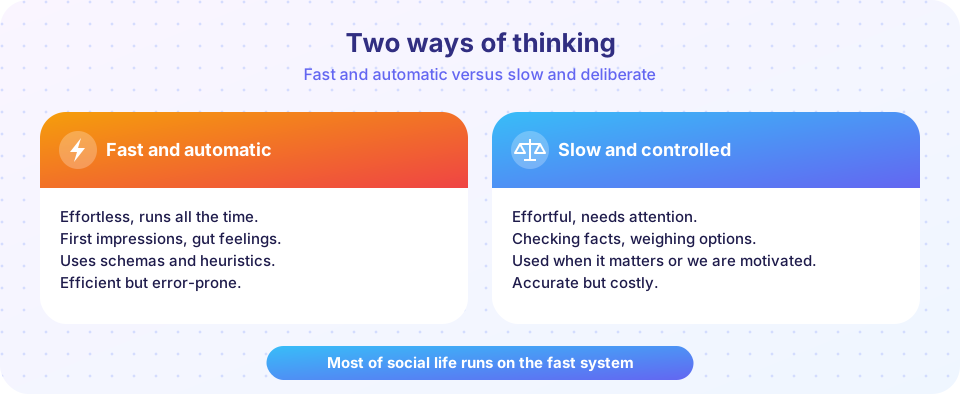
The mind shifts toward careful processing when it is motivated (the decision matters, we must justify our choice), has the ability (time, knowledge) and the opportunity (no distraction). Under stress, time pressure or fatigue, we lean more on shortcuts. Useful practical defenses: slow down on important choices, consider the opposite ("why might I be wrong?"), use base rates, and rely on checklists.
Common misconceptions
"Heuristics are irrational." They are often accurate in the environments where they evolved or were learned (Gerd Gigerenzer calls them "fast and frugal"). The errors appear in particular conditions.
"Schemas are just stereotypes." Stereotypes are one kind of schema, about social groups. Schemas also cover places, events, roles and the self.
"Knowing about anchoring protects you." Even experts are affected by anchors.
Try it
See anchoring in action and simulate the availability heuristic. Both are demonstrations with invented numbers.
Press Run (or Ctrl + Enter) to see the result here.
Program input · what you'd type while the program runs
Type the answers before you press Run, one per line. Each time the program reads a line (with input()), it gets the next line from this box.
Check your understanding
Quick check · 5 questions
of 5 answered You scored / 5 · perfect!
-
1. What did Bartlett's 'War of the Ghosts' study show?
Retellings were distorted toward the participants' cultural expectations. -
2. The availability heuristic leads us to judge frequency by...
Vivid, recent examples feel more common. -
3. The Linda problem illustrates...
A conjunction cannot be more probable than one of its parts. -
4. In Tversky and Kahneman's wheel of fortune study, a higher random number led to...
The anchor pulled estimates toward itself. -
5. Why might bronze medalists seem happier than silver medalists?
The alternatives they imagine shape their feelings.
Summary
- Schemas organize knowledge and guide attention, memory and inference.
- Priming of concepts is well supported; dramatic behavioral priming claims are weaker.
- Availability, representativeness and anchoring are heuristics that speed judgment and cause predictable errors.
- Counterfactual thinking shapes feelings about outcomes.
- We think more carefully when motivated, able and unhurried.
Next: Attribution and Bias
Track your progress
Create a free account to tick off lessons and pick up where you left off on any device.
of Social Psychology lessons completed