


















Lesson 17 of 46 · Persuasion and Influence
Routes to Persuasion: The Elaboration Likelihood Model
Learn the elaboration likelihood model and the heuristic-systematic model, the central and peripheral routes, need for cognition and the Petty and Cacioppo studies.
Two people see the same advertisement for a phone. One reads the specifications, compares battery life and checks reviews. The other notes that a famous actor is smiling on the screen and thinks, "That looks good." Both may end up buying the phone, but they have been persuaded by very different means. Which kind of persuasion lasts longer, and which would you use to sell a vaccine?
The elaboration likelihood model (ELM) answers these questions. It says that persuasion takes different routes depending on how much people think about the message.
What you will learn
- The central and peripheral routes of the ELM.
- What motivates and enables people to elaborate.
- The classic experiment of Petty, Cacioppo and Goldman (1981).
- Need for cognition and the heuristic-systematic model.
- Practical lessons for communicators.
Key terms
Elaboration is careful thinking about the content of a message. Central route is persuasion by evaluating the arguments. Peripheral route is persuasion by cues such as the source's attractiveness, popularity or the number of arguments. Need for cognition is the tendency to enjoy effortful thinking (Cacioppo and Petty, 1982). Heuristic-systematic model (HSM) is Shelly Chaiken's similar dual-process theory.
The model
Richard Petty and John Cacioppo (1986) proposed the ELM: the likelihood that a person thinks hard about a message depends on motivation (does it matter to me? do I like thinking?) and ability (do I have the time, knowledge and quiet to think?).
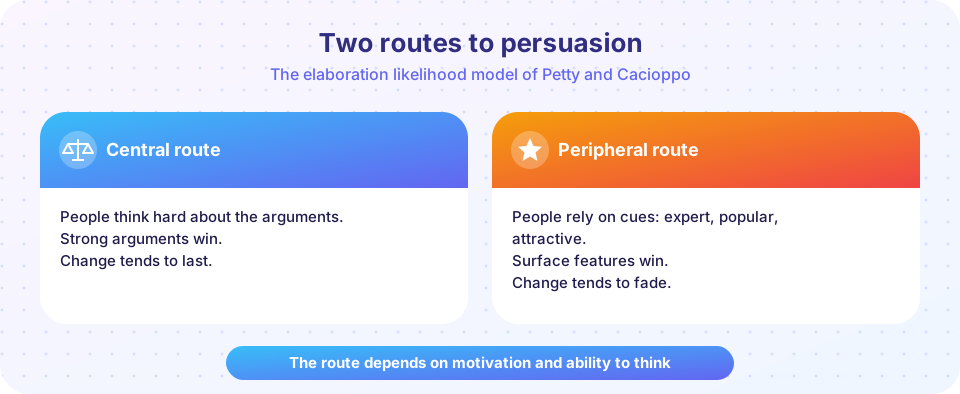
- High elaboration (central route). People scrutinize the arguments. Strong arguments persuade; weak arguments backfire. The resulting attitude is usually more durable, more resistant to counter-persuasion and a better predictor of behavior.
- Low elaboration (peripheral route). People rely on simple cues: "experts are right," "everyone does it," "she's attractive," "there are lots of reasons." The attitude change tends to be less durable.
In reality, elaboration is a continuum, and many messages work through both routes at once.
What counts as a cue?
| Cue | Heuristic in the listener's head |
|---|---|
| Expert source | "Experts are usually right" |
| Many arguments | "Length equals strength" |
| Popularity or consensus | "If many believe it, it is probably true" |
| Attractive or likable source | "I like her, so she must be right" |
| Rhetorical question | "That sounds reasonable" |
The classic experiment
Petty, Cacioppo and Goldman (1981) had university students hear a message arguing that all seniors should pass comprehensive exams before graduating. Three things varied: personal relevance (the exam would start next year, at their own university, or ten years later at another), argument quality (strong or weak) and source expertise (a Princeton education professor or a local high-school class).
The pattern: for students for whom the topic was highly relevant (high motivation), argument quality had a big effect and source expertise had little. For students for whom the topic was low in relevance, source expertise had the larger effect and argument quality mattered little. When people cared, they thought about the arguments; when they did not, they leaned on the source.
Need for cognition
Cacioppo and Petty (1982) created the need for cognition scale, with items such as "I find satisfaction in deliberating hard for long hours" (not reproduced exactly here). People high in need for cognition tend to elaborate more and are persuaded more by argument quality. People low in it use cues more. It is a tendency, not a measure of intelligence.
Other factors that increase elaboration: personal relevance, accountability ("you will have to explain your view"), silence and a calm setting. Factors that reduce it: distraction, fatigue, alcohol, time pressure and overload.
The heuristic-systematic model
Shelly Chaiken's HSM (1980, 1987) is similar. Systematic processing is effortful scrutiny of arguments; heuristic processing uses rules such as "experts can be trusted" or "majority is right." The HSM emphasizes that both can occur together and that people use as little effort as needed to reach a sufficient confidence level (the sufficiency principle).
Practical lessons
- If the audience cares and has time, lead with strong, clear arguments and evidence.
- If attention is low, simple cues (credible source, clear and relevant imagery) may work, but the effect will probably be shorter-lived.
- Do not assume that more arguments are better; for motivated audiences, weak arguments reduce persuasion.
- As a listener: ask, "Am I convinced by the evidence, or by the packaging?"
Mood and persuasion
Mood can influence the route. A good mood may reduce elaboration, leading to more reliance on cues; but mood effects depend on context and can even serve as information. Research here is detailed, so take the general lesson: feelings are part of persuasion, not just logic.
Common misconceptions
"The peripheral route is irrational." Cues are often reliable shortcuts; experts usually are more accurate than novices.
"People are either central or peripheral thinkers." Elaboration changes by topic, mood and situation.
"Strong arguments always win." Only when people are motivated and able to process them.
Try it
First, simulate the Petty-Cacioppo-Goldman pattern. Second, test yourself on spotting cues in ads. Both are demonstrations.
Press Run (or Ctrl + Enter) to see the result here.
Program input · what you'd type while the program runs
Type the answers before you press Run, one per line. Each time the program reads a line (with input()), it gets the next line from this box.
Check your understanding
Quick check · 5 questions
of 5 answered You scored / 5 · perfect!
-
1. In the ELM, which route involves careful thought about arguments?
The central route is high elaboration. -
2. Which two factors determine elaboration?
People must care and be able to think. -
3. In the Petty, Cacioppo and Goldman study, for low-relevance participants, which factor mattered more?
When people did not care, source cues decided. -
4. Attitudes formed through the central route tend to be...
Thoughtful change lasts longer. -
5. Need for cognition is...
It is a motivational disposition, not an ability.
Summary
- The ELM says persuasion goes through a central route (argument scrutiny) or a peripheral route (cues), depending on motivation and ability.
- The classic study showed arguments mattering for involved listeners and source status mattering for uninvolved ones.
- Central-route attitudes are more durable and predictive of behavior.
- The HSM offers a similar view with a sufficiency principle.
- Communicators should match their approach to audience involvement.
Next: Compliance Techniques
Track your progress
Create a free account to tick off lessons and pick up where you left off on any device.
of Social Psychology lessons completed