


















Lesson 34 of 46 · Prejudice and Stereotypes
Reducing Prejudice: Contact and Beyond
What reduces prejudice: Allport's contact conditions, the jigsaw classroom, extended contact, recategorization, perspective-taking and the limits of the evidence.
If prejudice is learned, can it be unlearned? That question has driven decades of research. Telling people to "be nicer" rarely works on its own. The most solid evidence supports something more structured: bringing people from different groups together under the right conditions. This lesson covers the contact hypothesis, the experiments and meta-analyses behind it, other promising approaches, and the honest limits of what is known.
What you will learn
- Allport's contact hypothesis and its four conditions.
- What the large meta-analysis by Pettigrew and Tropp found.
- The jigsaw classroom, extended contact and recategorization.
- When contact can backfire.
- What other interventions look promising and where evidence is thin.
Key terms
Contact hypothesis: the idea that positive contact between groups reduces prejudice, especially under certain conditions.
Superordinate goal: a goal that both groups want and can reach only by working together.
Extended contact: reduced prejudice from knowing that a member of your group has a close friend in the outgroup.
Common ingroup identity: seeing members of former outgroups as part of one larger "us".
Allport's contact hypothesis
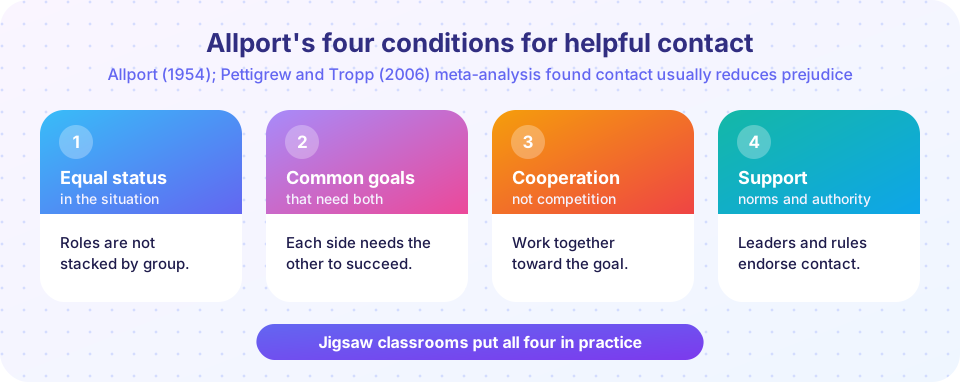
Gordon Allport (1954), in The Nature of Prejudice, proposed that contact between groups reduces prejudice when four conditions hold:
- Equal status within the situation.
- Common goals that need both groups.
- Intergroup cooperation rather than competition.
- Support of authorities, law or custom.
Mere proximity is not enough; two groups sharing a building but staying separate or competing may not become friendlier. This links back to Sherif's Robbers Cave study: cooperation toward superordinate goals reduced hostility that competition had created.
What does the evidence say?
Thomas Pettigrew and Linda Tropp (2006) analyzed 515 studies with over 250,000 participants across many countries. They found that intergroup contact is typically associated with lower prejudice, with a modest but consistent average effect. The effect was larger when Allport's conditions were present, yet contact reduced prejudice even when they were not all in place, so the conditions are helpful but not strictly required. The effect also tended to generalize: people with positive contact often felt better about the whole outgroup, not just the individuals they met, and about other outgroups. Some of the effect goes through lower intergroup anxiety and greater empathy and knowledge.
Cautions:
- Many studies are correlational, so people with less prejudice may seek more contact. Longitudinal and experimental studies help but do not remove every doubt.
- Contact effects are often stronger for majority-group members than for minority-group members, and positive contact may reduce minority members' appetite for collective action about inequality.
- Negative contact (an unpleasant encounter) can raise prejudice and may weigh more than positive contact in some studies.
Designing contact: the jigsaw classroom
In 1971, following school desegregation in Austin, Texas, Elliot Aronson and colleagues created the jigsaw classroom. Students are placed in small mixed groups. A lesson is split into parts, and each student becomes the "expert" on one part and teaches it to the rest. Each student needs the others to learn the whole, which creates interdependence and equal status. Studies reported more liking among groupmates, better attitudes toward school and, in several studies, improved self-esteem; effects on grades were more mixed. The method has since been used widely.
Other routes
- Extended contact (Stephen Wright and colleagues, 1997): learning that an ingroup friend has an outgroup friend can lower prejudice even without your own contact. It helps where direct contact is rare.
- Imagined contact (Richard Crisp and Rhiannon Turner): imagining a positive interaction can slightly reduce anxiety and bias, mostly in lab settings.
- Common ingroup identity (Samuel Gaertner and John Dovidio): emphasize a shared superordinate category ("we are all students at this school"). Caution: if group differences matter to people, removing them entirely can feel threatening, so a dual identity that recognizes both subgroup and shared identity is often better.
- Perspective-taking and narratives. David Broockman and Joshua Kalla (2016) trained canvassers to hold short, non-judgmental conversations in which residents were asked to recall times they were judged for being different. Attitudes toward transgender people shifted and the shift lasted months in their follow-ups.
- Norm change through media. Elizabeth Levy Paluck (2009) studied a radio drama in Rwanda that modeled reconciliation; listeners' perceived norms and some behaviors, such as discussing sensitive topics, changed more than their stated beliefs.
The state of the evidence
Paluck and Green (2009) reviewed the prejudice-reduction literature and concluded that many interventions, from diversity training to media messages, had little rigorous evidence of lasting effects on real behavior. Later reviews are more positive about some approaches such as contact and perspective-getting, but they still call for more field experiments with longer follow-ups. A fair conclusion is: structured, cooperative, equal-status contact has the most support; short one-off trainings have less; and effect sizes are usually modest.
Common misconceptions
"Putting groups in the same room fixes prejudice." Unstructured or competitive contact can fail or backfire.
"Awareness training alone is enough." The evidence for lasting change from brief trainings is limited.
"Contact only helps the people you met." Effects often generalize to the wider group, but they are not guaranteed.
Try it
Press Run (or Ctrl + Enter) to see the result here.
Program input · what you'd type while the program runs
Type the answers before you press Run, one per line. Each time the program reads a line (with input()), it gets the next line from this box.
Press Run (or Ctrl + Enter) to see the console output here.
No output.
Check your understanding
Quick check · 5 questions
of 5 answered You scored / 5 · perfect!
-
1. Which is NOT one of Allport's four conditions?
Cooperation, not competition, is the condition. -
2. What did Pettigrew and Tropp's meta-analysis find?
A modest, consistent reduction on average. -
3. In a jigsaw classroom, why does each student need the others?
Interdependence creates cooperation and equal status. -
4. Extended contact means...
It works through observed friendships. -
5. A fair summary of the evidence on one-off diversity training is that...
Reviews call for more rigorous field tests.
Summary
- Contact helps most when groups have equal status, shared goals, cooperation and institutional support.
- Large meta-analyses show a modest, consistent reduction in prejudice, with caveats about causation and negative contact.
- Jigsaw learning, extended contact, dual identity and perspective-getting are promising.
- Effects are usually modest, so combine contact with structural change and keep testing.
Next: Chapter review
Track your progress
Create a free account to tick off lessons and pick up where you left off on any device.
of Social Psychology lessons completed