


















Lesson 9 of 46 · The Social Self
Self-Presentation and Self-Perception
Goffman's front stage, impression management, self-monitoring, self-handicapping, Bem's self-perception theory, the overjustification effect and the spotlight effect.
Before a job interview you choose clothes, rehearse answers and think about what to say. On a first date you may laugh at jokes a bit more than usual. This is not lying; it is self-presentation: the ways we manage the image others have of us. At the same time, we also learn about ourselves in a surprising way: by watching what we do, as an outside observer would. This is self-perception.
Both processes show that the self is a two-way street. We shape how we appear, and we infer who we are from how we act.
What you will learn
- Goffman's front stage and back stage.
- Impression management tactics such as ingratiation and self-handicapping.
- Self-monitoring and individual differences.
- Bem's self-perception theory and the overjustification effect.
- The spotlight effect and its lesson.
Key terms
Impression management is trying to control the impressions others form of us. Self-monitoring is the tendency to adjust behavior to fit the situation (Mark Snyder, 1974). Self-handicapping is creating obstacles to excuse possible failure (Berglas and Jones, 1978). Self-perception theory is Daryl Bem's (1972) idea that we infer our attitudes from observing our behavior. Overjustification effect is a loss of intrinsic interest when an activity is rewarded. Spotlight effect is overestimating how much others notice us.
Front stage and back stage
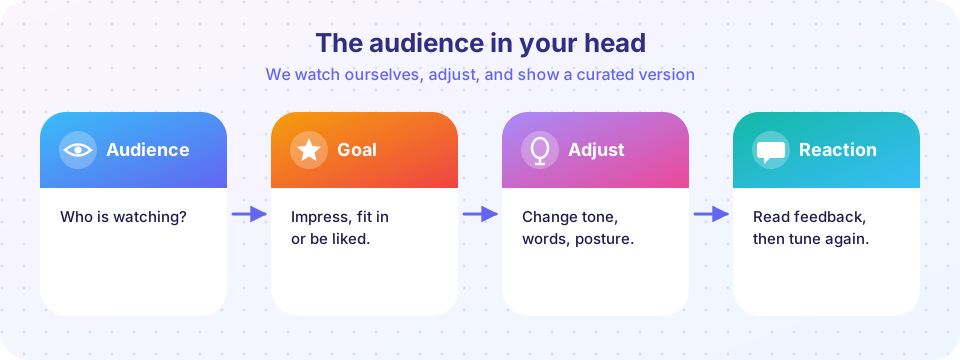
The sociologist Erving Goffman (1959) compared social life to theater. On the front stage we perform a role for an audience: a waiter is polite, a teacher is composed. Backstage, we relax the role. His dramaturgical view highlights that presenting yourself is a normal social skill, not hypocrisy.
Impression management
People pursue goals such as being liked, looking competent or seeming moral.
- Ingratiation (Edward Jones): flattery, agreement, favors to be liked. It backfires if it seems insincere.
- Self-promotion: highlighting achievements to look competent. Too much makes people look arrogant.
- Modesty and humility: can build likability, but too much hides ability.
- Self-handicapping: Berglas and Jones (1978) found that some people choose a performance-impairing option, such as less practice, to have an excuse for failure. It protects the image but harms results.
Online, people curate profiles, a modern front stage with a large audience.
Self-monitoring
Mark Snyder's self-monitoring scale (1974) separates high self-monitors, who adapt their behavior to what the situation calls for, from low self-monitors, who act in line with inner feelings and values. Neither is better in general: high self-monitors may succeed in roles needing flexibility; low self-monitors can be seen as consistent and authentic. This is a continuum, not a type.
Self-perception
Bem (1972) proposed that when our internal cues are weak or ambiguous, we figure out what we think by observing our behavior, as a stranger would. "I keep choosing hiking over TV, so I must like the outdoors." This offers an alternative to dissonance theory (Chapter 3) for some results.
Facial feedback
The idea that expressions influence feelings is an example. Strack, Martin and Stepper (1988) reported that people holding a pen in their teeth (a smile-like shape) rated cartoons as funnier. A large multi-lab replication (Wagenmakers and colleagues, 2016) did not reproduce the effect, though later analyses suggest a small effect may exist under some conditions. Treat it as an open question.
The overjustification effect
In a classic study (Lepper, Greene and Nisbett, 1973), children who liked drawing were told they would get a "good player" award for drawing, or not. Later, in free play, children who had expected the reward drew less than those who had not. Rewards can shift our explanation from "I draw because I enjoy it" (intrinsic) to "I draw for the prize" (extrinsic). Later research shows that rewards do not always undermine interest: unexpected rewards and rewards that signal competence are less harmful, and the effect depends on how rewards are framed.
The spotlight effect
Thomas Gilovich and colleagues (2000) asked students to wear an embarrassing T-shirt (a picture of a singer, Barry Manilow) and walk into a room of peers. The wearers estimated that about half of the people would notice it; in fact only about a quarter did. This spotlight effect shows that we overestimate how much others attend to us, because we are the star of our own experience. A related illusion of transparency is the belief that our inner states show more than they do.
The lesson is freeing: most people are busy thinking about themselves.
Common misconceptions
"Self-presentation means being fake." Adjusting behavior to context is normal; deception is different.
"Rewards always kill motivation." The overjustification effect depends on how rewards are given and perceived.
"Everyone is watching me." The spotlight effect shows that people notice far less than we think.
Try it
Simulate the spotlight effect and test how rewards change explanations. These are classroom models with invented numbers.
Press Run (or Ctrl + Enter) to see the result here.
Program input · what you'd type while the program runs
Type the answers before you press Run, one per line. Each time the program reads a line (with input()), it gets the next line from this box.
Check your understanding
Quick check · 5 questions
of 5 answered You scored / 5 · perfect!
-
1. In Goffman's view, the front stage is where we...
Front stage behavior is role performance for others. -
2. Self-handicapping means...
It protects the image at the cost of performance. -
3. According to Bem, we infer our attitudes from...
Self-perception theory says we act as observers of ourselves. -
4. In the Barry Manilow T-shirt study, wearers...
They believed about half would notice; about a quarter did. -
5. The overjustification effect is...
An expected reward can shift explanations from enjoyment to payment.
Summary
- We manage impressions through ingratiation, self-promotion and other tactics; self-handicapping can backfire.
- Self-monitoring varies from adapting to the situation to acting from inner values.
- Self-perception theory says we infer our own attitudes from our behavior.
- Rewards can reduce intrinsic motivation under some conditions.
- The spotlight effect shows that others notice us less than we think.
Next: Chapter 2 Review
Track your progress
Create a free account to tick off lessons and pick up where you left off on any device.
of Social Psychology lessons completed