


















Lesson 14 of 46 · Social Cognition and Attitudes
Attitudes and Cognitive Dissonance
What attitudes are, how well they predict behavior, the theory of planned behavior, and Festinger's cognitive dissonance with classic studies and modern debates.
Do you like pineapple on pizza? Do you support your national team? Is recycling a good idea? Each answer is an attitude: an evaluation of something, positive or negative. Attitudes matter because they steer what we choose, who we vote for, what we buy and how we treat others. But there is a puzzle: people often act in ways that do not match their attitudes, and then change their attitudes to match their actions.
This lesson asks two questions. How well do attitudes predict behavior? And what happens when our behavior and beliefs clash? The second leads to one of the most influential theories in the field: cognitive dissonance.
What you will learn
- The components of an attitude and how attitudes are measured.
- When attitudes predict behavior (and the theory of planned behavior).
- Festinger and Carlsmith's dissonance experiment.
- Ways to reduce dissonance and everyday examples.
- Debates and limits, including cultural differences.
Key terms
Attitude is a relatively lasting evaluation of an object, person, idea or issue. ABC model says attitudes have Affective (feelings), Behavioral and Cognitive (beliefs) components. Explicit attitude is one we consciously report; an implicit attitude operates automatically. Theory of planned behavior (Icek Ajzen) says behavior follows intention, shaped by attitude, social norms and perceived control. Cognitive dissonance is the unpleasant tension from holding inconsistent cognitions (Leon Festinger, 1957). Insufficient justification is when little external reason exists, so we find an internal one.
What is an attitude?
An attitude has three parts: what we feel (affect), what we believe (cognition) and how we tend to act (behavior). An environmentalist may feel concern, believe that emissions warm the planet and tend to cycle to work.
Attitudes are measured by self-report (rating scales), by behavior, and by implicit measures such as the Implicit Association Test (IAT; Greenwald, McGhee and Schwartz, 1998), which uses reaction times to pair concepts. The IAT is popular, but its reliability and its power to predict behavior for individuals are debated, so treat any single score with caution.
Do attitudes predict behavior?
Richard LaPiere (1934) traveled across the United States with a Chinese couple, stopping at many hotels and restaurants during a time of strong prejudice. Nearly all establishments served them. Months later, when LaPiere sent a questionnaire asking whether they would accept Chinese guests, the large majority of the replies said no. The study is a classic "attitude does not predict behavior" example, though it has methodological limits, such as that the person who answered the survey was often not the person who served the couple.
Allan Wicker (1969) reviewed dozens of studies and found weak average correlations between attitudes and behavior (roughly 0.15 in many reviews). Later research found conditions under which attitudes predict well:
- Specificity: attitudes toward a specific behavior ("I intend to recycle my paper this week") predict better than general attitudes ("I like the environment").
- Strength and accessibility: strong, easily recalled attitudes predict more.
- Few outside pressures: social norms and constraints matter.
- Aggregation: attitudes predict average behavior over many occasions better than single acts.
Theory of planned behavior
Ajzen's model says that behavior follows intention, which depends on (1) attitude toward the behavior, (2) subjective norms (what important others expect) and (3) perceived behavioral control (how easy it seems). It is widely used in health and environmental research and predicts intentions better than actions: the "intention-behavior gap" remains.
Cognitive dissonance
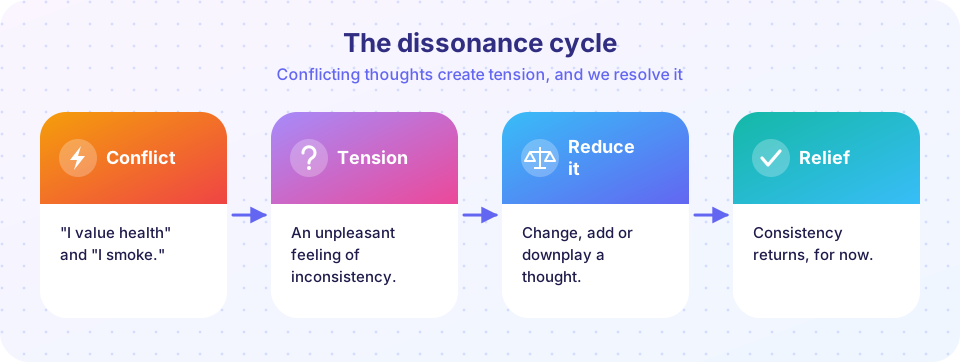
Leon Festinger (1957) noticed that people seemed to change their beliefs to match their actions. He proposed that holding two inconsistent cognitions, such as "I value my health" and "I smoke," creates an unpleasant tension called dissonance, which motivates us to reduce it.
The classic experiment
Festinger and Carlsmith (1959) had participants spend an hour on tedious tasks, such as turning pegs. Then each was asked to tell the next participant, who was actually a confederate, that the task was fun, for payment of either $1 or $20. Later, participants rated how enjoyable the task had really been. Those paid only $1 rated it as more enjoyable than those paid $20. The explanation: $20 is an adequate justification for lying, so there is little dissonance. $1 is insufficient justification, so those participants reduced dissonance by changing their attitude: "Maybe it was not so boring." Later work suggests that feeling personally responsible and the experience of unpleasant consequences matter for the effect (Cooper and Fazio, 1984).
Ways to reduce dissonance
- Change the behavior: quit smoking.
- Change a belief: "The health risks are exaggerated."
- Add a consonant belief: "Smoking helps me relax."
- Trivialize: "It is not that important."
People often choose the easiest option, which is not always the healthiest.
More dissonance findings
- Effort justification: Aronson and Mills (1959) found that women who went through a severe initiation to join a discussion group rated the (dull) group as more attractive than those with a mild initiation. We value what we suffered for.
- Post-decision dissonance: After choosing between two attractive options, we rate the chosen one more highly and the other less (Brehm, 1956). Shoppers who just bought a car pay more attention to ads for that car.
- Hypocrisy induction: Reminding people of times they failed to practice what they preach can increase their commitment to the desired behavior (Aronson and colleagues, 1991, in a health-protection setting).
Debates
Dissonance has been explained in other ways: self-perception theory (Bem), impression management (we want to look consistent) and the self-consistency view (dissonance is strongest when the self-concept is threatened). Evidence supports a role for the self. Cultural research shows that dissonance appears in many cultures but may be triggered differently: for East Asians, dissonance appeared more when choosing for friends than for themselves (Hoshino-Browne and colleagues, 2005). Neuroscience has linked dissonance to brain areas for conflict monitoring, but its interpretation is still developing.
Common misconceptions
"People always act on their attitudes." Many studies find that the link between attitudes and actions is modest and depends on conditions.
"Dissonance means being logically inconsistent." It is a psychological discomfort that depends on our self-image and values, not just logic.
"Paying people more always motivates them more." In dissonance studies, smaller rewards can lead to greater attitude change.
Try it
First, play with the planned-behavior model; then simulate dissonance. Both are teaching models with invented numbers.
Press Run (or Ctrl + Enter) to see the result here.
Program input · what you'd type while the program runs
Type the answers before you press Run, one per line. Each time the program reads a line (with input()), it gets the next line from this box.
Check your understanding
Quick check · 5 questions
of 5 answered You scored / 5 · perfect!
-
1. Which are the three parts of the ABC model of attitudes?
Attitudes include feelings, beliefs and behavioral tendencies. -
2. Which attitude predicts behavior best?
Specificity improves prediction. -
3. In Festinger and Carlsmith (1959), who rated the boring task as more enjoyable?
$1 gave insufficient justification, so they changed their attitude. -
4. Which is a way of reducing dissonance?
People can change behavior, change a belief, add a belief, or trivialize. -
5. Aronson and Mills (1959) found that severe initiation led to...
Effort justification: we value what we suffered for.
Summary
- Attitudes have affective, cognitive and behavioral components and are measured explicitly and implicitly.
- Attitudes predict behavior best when specific, strong and not overridden by norms or constraints.
- The theory of planned behavior links attitude, norms and perceived control to intention.
- Cognitive dissonance explains why behavior can change attitudes, especially under insufficient justification.
- Dissonance findings include effort justification and post-decision rationalization; debates continue.
Next: Chapter 3 Review
Track your progress
Create a free account to tick off lessons and pick up where you left off on any device.
of Social Psychology lessons completed