


















Lesson 16 of 46 · Persuasion and Influence
Persuasion and Influence: Chapter Overview
A map of chapter 4: how messages change minds, the roles of source, message and audience, the two routes to persuasion, compliance tactics and resistance.
You are asked to sign a petition, to buy a bigger coffee, to vote, to believe a news story, to try a new app. Hundreds of times a day someone, or something, tries to change what you think or do. This is persuasion, and it is not always sinister: teachers persuade students, doctors persuade patients to take medicine, and friends persuade friends to be kind. Understanding how it works helps you use it well and resist it when you should.
This chapter moves from attitudes (Chapter 3) to the question of how attitudes are changed by communication and requests.
What you will learn
- The classic model of persuasion: source, message, audience and channel.
- What credibility and likability do.
- A preview of dual-process theories and compliance tactics.
- Why resistance skills matter.
Key terms
Persuasion is the process of changing attitudes or behavior through communication. Compliance is changing behavior in response to a direct request. Source credibility is how expert and trustworthy a communicator seems. Sleeper effect is when a message from a low-credibility source gains persuasive impact over time (Hovland and Weiss, 1951). Fear appeal is a message that tries to persuade by arousing fear.
The Yale approach
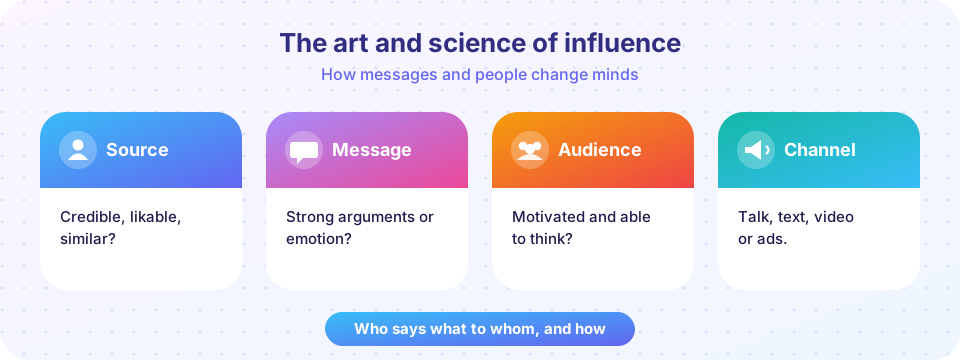
After the Second World War, Carl Hovland and colleagues at Yale studied persuasion systematically, asking "who says what to whom?" Their framework still organizes the field.
The source
The message
The audience
Source
People are more persuaded by sources seen as expert and trustworthy. Hovland and Weiss (1951) found that a message from a low-credibility source had less immediate effect, but after several weeks the effect of the message partly recovered as people forgot who said it: the sleeper effect. Later work shows the sleeper effect is fragile and appears under specific conditions. Likable and similar sources also persuade, especially when the audience is not thinking hard.
Message
Strong, well-organized arguments persuade people who think. Two-sided messages (mentioning and refuting the other side) can be more persuasive to skeptical audiences than one-sided ones. Fear appeals work best when they arouse moderate fear and give clear, doable steps to protect oneself (efficacy), as shown in research by Howard Leventhal and later meta-analyses; fear without a way out can lead people to deny the threat. Humor attracts attention but may distract from the arguments.
Audience
What matters most is whether people are motivated and able to think about the message. Audience age, mood and need for cognition (how much people enjoy thinking, Cacioppo and Petty, 1982) all matter.
Lessons in this chapter
- Routes to Persuasion: the elaboration likelihood model and the heuristic-systematic model.
- Compliance Techniques: foot in the door, door in the face, low-ball and reciprocity, with Cialdini's principles.
- Resisting Influence: reactance, inoculation and critical-thinking skills.
- Chapter 4 Review: a one-page recap and a mixed quiz.
Common misconceptions
"Persuasion is manipulation." Persuasion can be honest and respectful. It becomes manipulation when it hides information, exploits weaknesses or pressures people.
"Smart people cannot be persuaded." Everyone responds to influence; intelligence changes how, not whether.
"Scaring people always changes behavior." Fear without efficacy often backfires.
Try it
Try a credibility toy model, and a quick message-order simulation. Both are teaching models.
Press Run (or Ctrl + Enter) to see the result here.
Program input · what you'd type while the program runs
Type the answers before you press Run, one per line. Each time the program reads a line (with input()), it gets the next line from this box.
Check your understanding
Quick check · 4 questions
of 4 answered You scored / 4 · perfect!
-
1. The Yale approach asks...
It organizes persuasion into source, message and audience. -
2. Source credibility rests mainly on...
Expert and honest sources are more persuasive. -
3. A fear appeal works best when it...
Efficacy information helps people act rather than deny. -
4. Compliance means...
Compliance is behavior change after a direct request.
Summary
- Persuasion is communication aimed at changing attitudes or behavior.
- The Yale framework looks at source, message and audience.
- Credibility, argument quality and audience motivation all matter.
- Fear appeals need efficacy; two-sided messages help with skeptics.
Next: Routes to Persuasion
Track your progress
Create a free account to tick off lessons and pick up where you left off on any device.
of Social Psychology lessons completed