


















Lesson 26 of 46 · Group Behavior
Chapter 6 Overview: Group Behavior
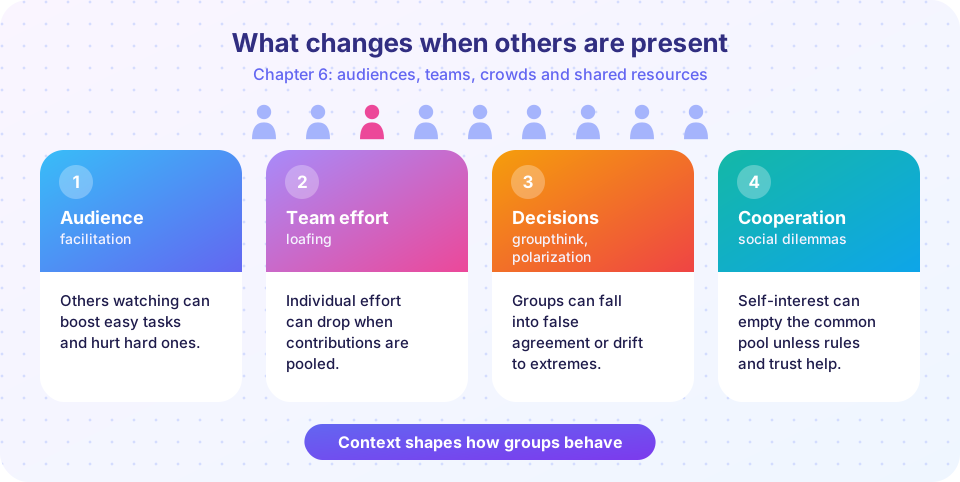
A map of chapter 6: how an audience, a team, a crowd and shared resources change what individuals do, from social facilitation to groupthink and cooperation.
You are rarely alone. You study in a class, work in a team, watch matches in a crowd and share roads, water and the internet with strangers. Social psychologists ask a simple but deep question: how does being part of a group, or even being near others, change what an individual does? The answers are mixed. Groups can raise performance, lower it, produce wise decisions, or produce disastrous ones. Understanding the conditions helps you build better teams and spot trouble early.
What you will learn
- What groups are and why social psychologists study them.
- A preview of the four big topics of the chapter.
- How to read the findings: effects depend on the task and the context.
Key terms
Group: two or more people who interact and depend on each other, in contrast to a mere crowd of strangers.
Social facilitation: an effect of others' presence on performance.
Social dilemma: a situation where individual and group interests conflict.
Norm: a shared expectation about how members should act.
A quick tour
Groups change behavior
Group decisions
Crowds and commons
What each lesson covers
- Social facilitation and social loafing: when an audience helps, and when a team slacks.
- Groupthink and group polarization: how decisions go wrong, and how to fix them.
- Deindividuation and cooperation: crowds, anonymity and social dilemmas.
- Chapter review.
Common misconceptions
"Groups are always wiser than individuals." They can be, but only under conditions such as independence and diversity of views.
"Crowds turn people into mobs." Crowds are usually orderly; anonymity can raise or lower norm-following depending on which norms are salient.
Try it
Press Run (or Ctrl + Enter) to see the result here.
Program input · what you'd type while the program runs
Type the answers before you press Run, one per line. Each time the program reads a line (with input()), it gets the next line from this box.
Press Run (or Ctrl + Enter) to see the console output here.
No output.
Check your understanding
Quick check · 3 questions
of 3 answered You scored / 3 · perfect!
-
1. Which describes a social dilemma?
In a social dilemma, what is best for each person differs from what is best for the group. -
2. Social facilitation is about...
It concerns how others' presence changes performance. -
3. Groups are wiser than individuals when...
Independence and diversity make group judgment strong.
Summary
- Groups change behavior in different ways depending on task and context.
- Four topics: audience effects, team effort, group decisions and cooperation.
- Group outcomes can be designed, not just endured.
Track your progress
Create a free account to tick off lessons and pick up where you left off on any device.
of Social Psychology lessons completed